Ben Lerner Hears Ghosts in the Wires
Critics read Ben Lerner’s new novel, Transcription, as a commentary on smartphones. But with gothic style and a Victorian temperament, it meditates on a much older technology — the spectral quality of disembodied speech introduced at the dawn of telephonics.
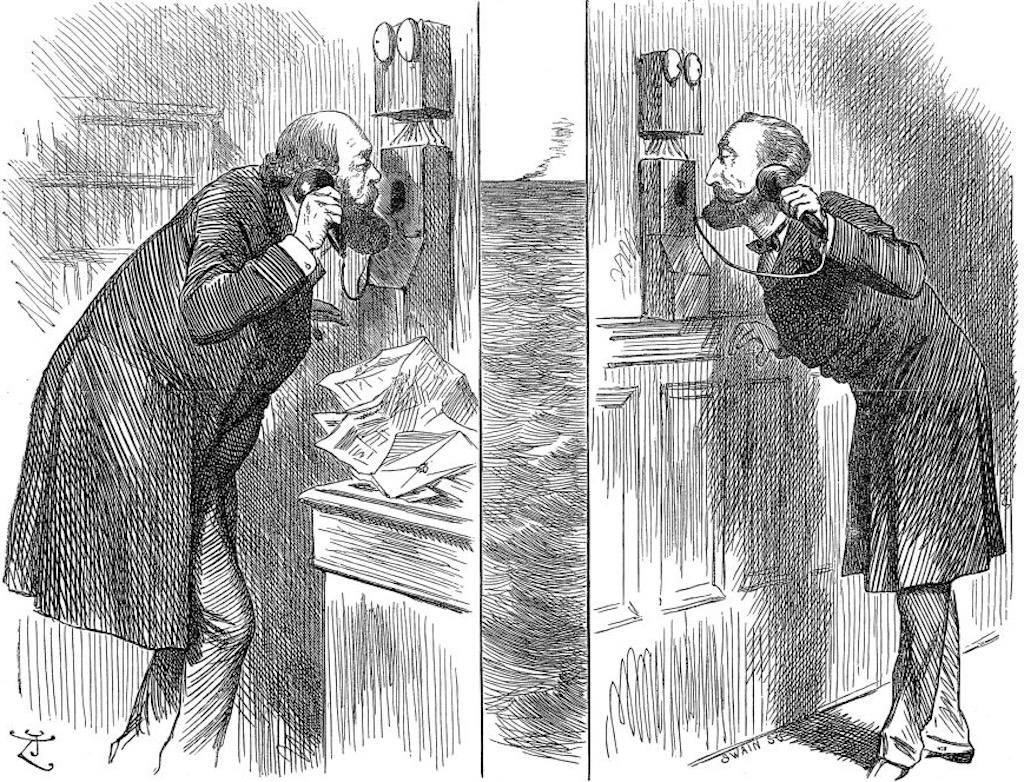
Transcription, the new novel by Ben Lerner, is the author’s take on nineteenth-century gothic. And like the Victorians, who held séances over the novel telephone, it dwells on the occult character of technology that severs speech from the speaker. (Oxford Science Archive / Print Collector / Getty Images)
In a short story called “Wireless,” published in Scribner’s in 1901, Rudyard Kipling described “a glass tube” with “two tiny silver plugs, and between them an infinitesimal pinch of metallic dust.” Fiddling with the plugs, Kipling’s protagonist slips into a trance and spontaneously transcribes John Keats’s “The Eve of St. Agnes,” a poem he has never read. In an instant, the man becomes a conduit for the unseen flows of text and speech that circulate continuously in the atmosphere. This machine, he says, “will reveal to us . . . the Power — our unknown Power — kicking and fighting to be let loose.”
The machine Kipling had in mind was the wireless telegraph, a device that existed only a decade or so before being supplanted by the radio. But you who poke at the glass of your glowing rectangle know exactly where to find “the Power” today. It emanates from the device you call, anachronistically, your “phone.”
Ben Lerner’s new novel, Transcription, begins when the narrator dunks his phone in a hotel sink, turning it into a “wounded animal” that he cannot revive. The loss sends him into a panic. Without the device, he can hardly imagine speaking to his young daughter, with whom he is accustomed to FaceTiming.
The drowned iPhone also sparks a professional, even writerly crisis in the narrator. The narrator has traveled from New York City to Providence, Rhode Island, to interview his mentor, a world-renowned academician named Thomas. Thomas is the only person the narrator knows, apart from his ten-year-old daughter, who does not own a smartphone. “Those screens, my love, they dull our senses,” the old man is fond of saying. Without a working smartphone, the narrator has no way to record the interview.
Walking to Thomas’s house, he experiences “a withdrawal indistinguishable from mild intoxication.” Incapable of “sending or receiving data packets,” his panic gives way to a dreamlike state that is, paradoxically, both unfamiliar and nostalgic. He feels he is walking into the past, “because only in the past would I be deviceless.”
When the narrator finally arrives, he commits a transgression from which he cannot recover. He taps the glossy black corpse of his drowned phone and tells Thomas it’s recording.
Ghosts in the Wires
The things we call phones today are not phones at all. We have appropriated the name of an older technology and applied it to something entirely distinct. If the smartphone is as bright and alluring as Narcissus’s mirror, the telephone — the real phone — was dark and obscure. It did not lull, or seduce, or enchant. It haunted, tormented, and whispered. It drove one mad not through flattery or pleasure, but through a kind of pervasive uncanniness that threatened always to overwhelm the distinction between the scientific and the occult.
The history of telephonics is the history of spiritualism, séances, and ghosts in the wires. “There can be drawn no arbitrary line labelled the supernatural or the supermundane,” wrote Florence Whiting in 1899, “when, by the telephone, persons speak with one another from Boston to Kansas City.” Whiting’s friend Kate Field, who in 1868 published a book she claimed was revealed to her by a spirit-writer, worked for a time as a publicist for the transatlantic Bell Company; she convened a series of wildly popular “telephone séances” to promote the telephone overseas.
The medium Leonora Piper, who counted the philosopher William James among her clients, listened to the dead by cupping her palm over her ear. She called it her “spiritual telephone.” After James and a group of similarly pedigreed intellectuals founded the Society for Psychical Research in 1882, the term “thought-transference” was replaced by the sophisticated-sounding “telepathy.” This was an obvious allusion to the newfangled communication technologies that promised to transfer speech and text first through the motion of unseen electrons encased in wires, and later through unseen waves traveling through the air. And telepathy, in turn, was the word Whiting used in her 1900 book The Spiritual Significance: Or, Death as an Event in Life, which described Piper’s ongoing communications with Field, who had died four years before.
My point is that the occult character of telephonics — as well as that of its slightly older cousin, telegraphy — was amply represented in the literature of the time.
Wobbling under the weight of the early electrical age, Victorian novelists made of the telegraph a vessel for their angst and neuroses. George Eliot’s novella The Lifted Veil, about a man wracked by unwanted psychic visions, invoked telegraphy metaphorically, as “a physical link between the mechanical and organic worlds,” writes the scholar Richard Menke in a book called Telegraphic Realism. Anthony Trollope — famously enamored of Kate Field, whom he encountered as a teenager — was more explicit in his short story “The Telegraph Girl,” as was William James’s brother Henry, whose novella In the Cage followed a young telegraphist’s descent into cruelty and madness.
The Victorian era, with its cities crowned by tangled wires, was the original information age. The sound that authors like Kipling, Trollope, Eliot, and James heard traveling down the line was the first roar of that disembodied monster called, then and now, mass media. Their literary chore, Menke writes, was “imagining information as something real that — whatever its nature — lies beyond the normal limits of human minds and bodies.”
Although he writes in the era of 5G and WiFi, not telegraphs and telephones, this is the chore Lerner assigns to himself as well.
Transcription has a distinctly Victorian mood about it. This is not a style I associate with Lerner. His earlier books document self-conscious fixations on anti-fascist poetry (Leaving the Atocha Station), transcendentalism (10:04), and postwar psychoanalysis (The Topeka School). With Transcription, Lerner has given us his take on the nineteenth-century gothic. Its settings are regal old hotels, darkened sitting-rooms harboring madmen and troubled children, gatherings of English-speaking intellectuals in southern Europe: all recognizably Victorian fare.
The most Victorian thing about the novel, however, is that it is downright obsessed with the macabre surreality of the telephone. Not the smartphone — the telephone.
Each of the novel’s emotional peaks is possible only because Lerner forces the trappings of the smartphone (screens, video-links, Google) to fall away, exposing the spectral traces of bygone technologies — the telegraph’s disarticulated text, the telephone’s disembodied speech.
After their interview dissolves into incoherence, the narrator uses the old man’s landline to call his daughter, whom he knows is sitting at home with his wife awaiting a FaceTime. But rather than saying goodnight to a video screen, as he has done countless times before, the narrator slips into a surreal state in which time is compressed and memories arrive unbidden and out of order, like electrons traveling through a cable.
The voice that answers the narrator’s call is “tinny, made into soft metal by the landline,” and inscrutable. It is simultaneously his wife’s, and his daughter’s, and his own “at the age of six . . . saying hello to my father when he’d call home from D.C.” Finally, he recognizes the speaker to be his daughter, but “her voice, isolated from her image, was aged” as if it “had traveled many years.”
Then he perceives a third presence in the wire:
I’d detected, or had imagined, the soft click of someone coming on the line, as if Thomas had picked up his office phone, covered the mouthpiece. Now I was in that room, too, had a sense of its dimensions; I was hovering above me . . . And now I felt that Thomas had arranged the exchange he was listening in on (but surely he wasn’t listening), that my mentor was conducting this electronic opera, orchestrating these interferences, crossing wires, worlds. Impossibly thin glass filaments underground, underwater, in the lungs, in the cochlea, vibrating when the small waves hit them — You call this fiction, but it is more.
Like James’s telegraphist or Kipling’s trance-writer, Lerner’s narrator loses himself in a “superimposition of voices.” The uncanniness of it overwhelms him.
Crossing Wires
Lerner’s oeuvre is full of doubles. Certain characters recur in various forms across his four novels. One of these is Lerner himself, or rather his fictionalized stand-in: a “self-hating, lying, overmedicated, brilliant fool of a hero,” as the novelist Paul Auster wrote in a review of Lerner’s debut, who ages somewhat more slowly than Lerner himself. Thomas is also a familiar Lernerian character. He recalls Klaus from The Topeka School or Bernard from 10:04 — aged European academics whose intellects warp every room they inhabit.
But in Transcription, Lerner is concerned with other kinds of doubling, too.
For one thing, there is the auditory doubling inherent to electronic sound transduction, the inevitable repetition of a sound emitted in one location by a machine somewhere else. “Do you know that weird effect where you hear somebody in real space and through the phone simultaneously?” asks Thomas’s son late in the novel. “I could hear his voice coming through the kitchen window and, with the tiniest delay, I could hear it through the device pressed to my ear; there were two of him now.”
The Topeka School includes the same motif, although the medium is cassette tape, not the telephone. In that novel, a psychologist studying a phenomenon he calls “speech shadowing” thrusts his research subjects into “glossolalia, although without any apparent ecstasy,” by slowly accelerating a recorded voice and asking them to repeat its disembodied speech.
In Transcription’s emotional climax, which arrives in the early days of the coronavirus pandemic, Thomas’s adult son receives word (via telephone) that his father has been brought to the hospital and is not expected to live. To avoid alarming his daughter, he texts rather than calls out to his wife in the other room. “These text messages were darting through the air in our house, hopefully staying out of range of Emmie, who might pull them from the ether,” Lerner writes, in a sentence that could just as easily appear in Henry James’s telegraph novella.
The hospital staff provide the son with a Zoom link and invite him to say goodbye to a comatose Thomas via video screen. But the technology fails. This is something the New York Times book critic Alexandra Jacobs misunderstands in her review of Transcription; she writes that “it is a screen” which allows the son “to impart the meaningful final messages that, in actual face-to-face time, he is unable to deliver.” It is not FaceTime but a grainy audio connection, and a phone held to the dying father’s ear, that facilitates this memorable scene:
I could hear him listening; I could somehow sense the shape of his attention. I can’t do this, I was thinking, maybe I even said that out loud, I can’t do this, but then I just was doing it, a rush of German and tears, no longer concerned about being overheard, things I never would have said if his image or his body were before me, or if anyone could see my face; I could only say them as a disembodied voice.
The narrator and Thomas’s son, too, are doubles of one another. And this moment is itself a double of the narrator’s earlier experience, when he senses his mentor’s silent presence, eavesdropping, through the telephone.
Finally, there is the doubling that occurs when a voice is recorded (or not recorded) and then channeled, as if by a medium, after the speaker’s death.
After failing to record his visit with Thomas, the narrator reconstructs the conversation from memory and publishes it as the old man’s final interview. When he confesses this transgression at a conference full of Thomas’s old students and admirers, one colleague is piqued enough to call him “the worst journalist in the world.”
But Lerner’s narrator is not a journalist. He is a Victorian. He is tapped into The Information (“something real that — whatever its nature — lies beyond the normal limits of human minds and bodies”). The Information flows constantly through and across the ether. It is unconstrained by time. It intermixes and splices and over-layers the narrator’s memory and senses. By making himself a conduit, a medium, for The Information, the narrator accesses Thomas from beyond the grave.
It is what Kate Field did in Planchette’s Diary, a book revealed to her by a spirit who controlled the scribble of her pen. And it is what Florence Whiting did forty years later, when she allowed Field’s spirit to possess her own writing hand through the “spiritual telephone” of Leonora Piper’s cupped palm.
The narrator’s interview with Thomas is not a con or a fraud, nor even a lapse in judgment committed by a grieving, disoriented man. It is the record of a séance. This may have been obvious to the Victorians. But it is something we avatars of the smartphone age do not easily understand. “You call this fiction, but it is more.”
The critic Hannah Gold, reviewing Transcription in Harper’s, writes that smartphones, like mass literacy, “literally changed human consciousness.” There are “mind-altering powers coiled in these devices,” she writes.
Telephonics, the vehicle of the Victorians’ original information age, changed human consciousness, too. Even now, more than a century in the future, we have yet to understand the nature of that transformation.