Ben Lerner’s Transcription Is a Brilliant Meditation on Tech
Transcription, Ben Lerner’s slim but layered new novel, is a penetrating meditation on fraudulence, fatherhood, and the fate of authentic experience in our digital age.
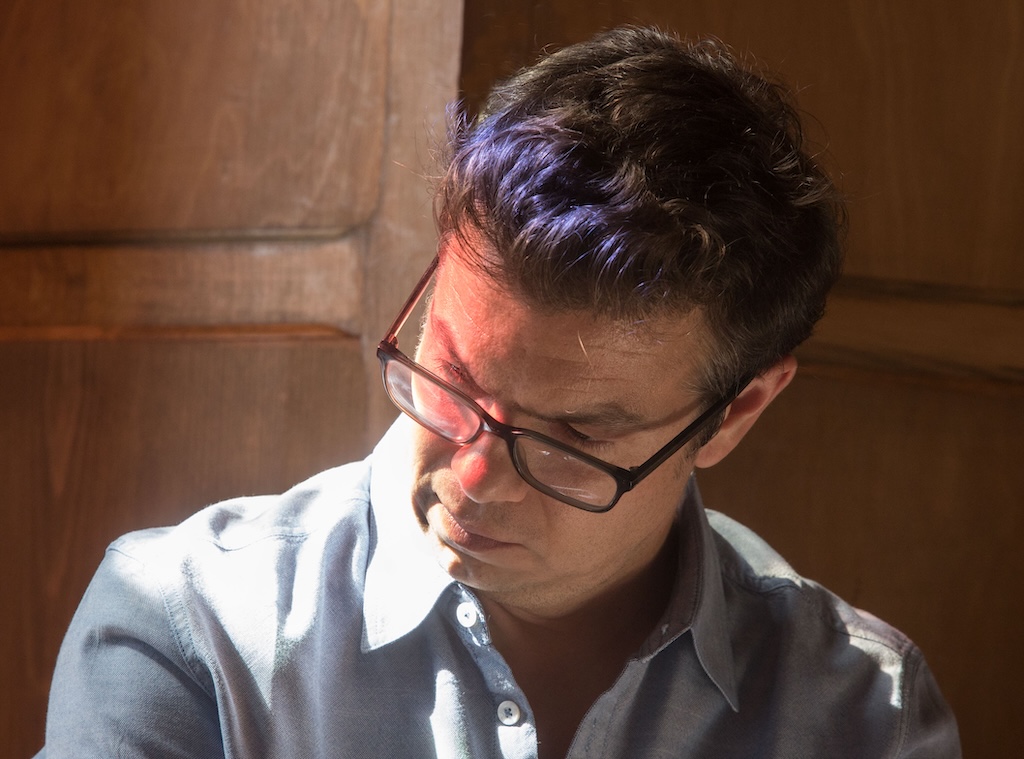
Ben Lerner's Transcription begins with the narrator dropping his phone in a sink full of water. The novel that follows is a richly observant inquiry into authenticity, faithful reproduction, and what’s possible when the recording stops. (Raphaël Gaillarde / Gamma-Rapho via Getty Images)
Authenticity, performance, the thin line between fact and fiction: these are, by now, the well-known central preoccupations of Ben Lerner’s fiction. His first novel, Leaving the Atocha Station, follows an American poet named Adam Gordon in Madrid in 2004, who witnesses the aftermath of the 11-M commuter train bombings. Adam is a divisive lead; he’s solipsistic and drifts through the city on a self-medicated cocktail of marijuana and coffee. He can barely speak Spanish, though he somehow captures the romantic attention of two beautiful women. “I was a violent, bipolar, compulsive liar,” Adam says. “I was a real American.”
In The Topeka School, a sequel of sorts, Lerner used the competitive high school debating circuit and the “violent identity crisis among white men” in 1990s Kansas as a prehistory of, among other things, the demise of civic integrity in Donald Trump’s first term (to say nothing of the second). And now we have Transcription, a book that revisits his long-standing concerns with fraudulence and masculinity — this time, with a far greater interest in the role technology plays in mediating the two.
The story begins with our middle-aged unnamed narrator, a writer, traveling to Rhode Island to conduct an interview. His subject is Thomas, his German-born, ninety-year-old former mentor and the father of his best friend, Max. When the narrator drops his phone into the sink of his hotel room, it stops working, and he’s left without a recording device. He decides to visit Thomas’s house anyway, hoping that their initial discussion might serve as a warm-up and that the proper interview can start once his phone is fixed the following day. But the narrator’s plan promptly goes awry when Thomas is ready and eager to begin the interview immediately. “Otherwise we repeat ourselves and it grows unnatural,” Thomas says. “We will sound like bad actors. Even the transcript will show that we have rehearsed.”
The novel is divided into three chapters, each named after a hotel important to the plot. Hotel Providence is where the narrator interviews Thomas. The brief second section at Hotel Villa Real in Madrid takes place during a memorial-symposium for Thomas after his passing. The final section is named after Hotel Arbez, a hotel on the France–Switzerland border where the main characters had once stayed together, but it’s set in Los Angeles, where the narrator interviews Max. The scene is a single, sustained conversation in which both men trade conflicting accounts of Thomas’s character. The narrator soon realizes that the Thomas he had spent years admiring was falsified, or at least partly fictional.
The mutability of selfhood is, of course, well-trodden ground for Lerner by now. In Leaving the Atocha Station, Adam obsessively lies in a bid to seem more interesting. Ben, the neurotic narrator of Lerner’s 10:04, has a grander ambition. He imagines “small-scale” political transformations that might be enabled by his helping (or trying to help) his fellow Brooklynites. Ben tutors an eight-year-old undocumented Salvadoran immigrant, covers his best friend’s dental and fertility treatments, and volunteers at a food co-op: “When a homeless shelter in the neighborhood burned down, ‘we’ — at orientation they taught you to utilize the first-person plural while talking about the co-op — donated the money to rebuild it.”
Lerner uses the novel form to explore what he calls “the potential for a good collectivity” — an ambition he inherits from Walt Whitman, who tried to build a poetic “I” capacious enough to “contain multitudes” and give voice to collective experience. In Thomas’s words, the project is a way to “make the dream social”: to transform personal insight into something communal and generative.
Transcription continues this project by troubling, if not outright refusing, the stability and solidity of selfhood in our digital age. This isn’t exactly a new idea for Lerner, though. In 10:04, Ben realizes that “so much of the most important personal news I’d received in the last several years had come to me by smartphone” when he receives an email about a friend’s hospitalization. More recently, Lerner’s short story “The Hoffman Wobble” details a man’s experience turning Wikipedia into a “propaganda machine” by adding fabricated information on biographical pages — an act he describes as being “somewhere between childish pranks and tiny terrorist attacks on the historical record.” Without his phone, our narrator in Transcription is at a total loss. He can’t FaceTime his wife, Mia, or their ten-year-old, Eva, and finds himself “craving my cellular phone on a cellular level.” Nor can he “swipe and scroll and photograph, to frame and filter and archive, to share [his] location.”
In 1977’s On Photography, Susan Sontag prophesied that mass-reproduced images of destruction would anesthetize and desensitize viewers to the atrocities of war. Lerner takes up this idea at the start of Transcription, too, suggesting that digital technology strips historical events of their affective impact. In his Providence hotel room, the narrator watches the news shift from the war in Gaza to the Paris bedbug scourge. It happens in such a rapid succession that the broadcaster flattens them into apparent equivalence. Then later, Thomas breezes past the revelation that his earliest aural memory is Adolf Hitler’s voice, “rising and rising in pitch” on the radio as a child.
Copy-Paste
If this seems like rather a lot to cram into a single novel, it is. But that only makes Transcription’s slender 144 pages all the more remarkable.
In interviews, Lerner has fondly deployed the term “heteroglossia” to describe the novels he admires, and one might also think of his own books in similar terms. They are complex containers for multiple voices, temporalities, and literary modes: ranging from conventional prose and poetry to the occasional winding digression on how to separate art and commodity fetishism. More than that, novels hold space for “all this other kind of contingent stuff, like how you feel and how you slept, and who you’re in love with or not in love with” — all the incidental details of a life.
The conversations in the novel are digressive but unusually open, giving the book a theatrical feel. Lerner doubles down on this theatricality thematically too, threading references to performance and failure throughout until the plot literalizes them. After Thomas dies, the narrator gives a symposium speech where he admits to reconstructing the interview. He thinks it went well. Then Rosa, a friend and fellow of Thomas’s, informs him that he “more or less confessed that you falsified a big part of what many thought of as his last, I don’t know, testament. A deep fake.”
Transcription‘s third and final section is dominated by Max and a discussion of paternity. It’s also here that Lerner’s broader interests in replication and accuracy cede to one of literal reproduction — and a second meaning of the novel’s title. Transcription also involves the replication of DNA for gene expression, one generation passing something of itself into the next. But Max and his partner Adelle find that their daughter Emmie’s Avoidant/Restrictive Food Intake Disorder (ARFID) is something they can’t trace back to themselves or explain through inheritance. Max wonders instead whether Emmie is starving herself “because she is registering a sense of futurelessness, catastrophe — fires, floods, fascism?”
This concern casts Thomas in a new light, too. Max describes Thomas’s glib response to Emmie’s troubles (he compares ARFID to pre-Christian asceticism), and how unmoved he was by news that Adelle was having a biopsy: “Ah, bios, opsis — what a beautiful combination. Life, sight.” In his constant diverting conversations back toward his academic interests, Thomas seems indifferent to his son’s problems, if not outright callous.
Although Lerner never quite decides what fatherhood really means in our age, he wisely resists the fatalism that the novel’s darker passages would seem to invite. In the phone’s absence, the narrator finds himself in awe of a sublime version of reality and his awareness of the “silicates glittering in the asphalt, the little plumes of vapor that were my breath, the articulation of branches and their shadows on the sidewalk” heightened. Max’s phone gives him the chance to call Thomas, hospitalized with COVID, and give him what should have been the perfect goodbye: “Emmie will carry you with her, she loves you so much, the love goes on forever in both ways. . .” This is only for Thomas to pull through, and though it’s unclear if he heard or remembered what Max said, Max feels unable to repeat himself or honestly recreate a moment that has already passed.
Transcription never stops asking whether technology corrodes authentic experience. But this ultimately leaves us with a different question: whether it can also carry what we most want to pass on. The epilogue — its coda, of sorts — is lifted from a letter written by Leopold Blaschka, a nineteenth-century artist, about his son Rudolf. Together, the two made such lifelike glass sculptures of plants and flowers that some assumed they were produced by a “secret apparatus” that no human hand could be responsible for. Blaschka, however, credited Rudolf with an innate gift: a touch that “increases in every generation.” In Transcription, Lerner seems to suggest something similar: that each act of transmission is also an act of creation — and that each generation may have the chance to be better than the one that came before.