The Left Needs an Alternative Cosmopolitanism
While many critics view rising global chaos strictly in geopolitical terms, political philosopher Lea Ypi argues that it’s really ideological — the result of an increasingly coordinated global right. To compete, the Left must internationalize in equal measure.
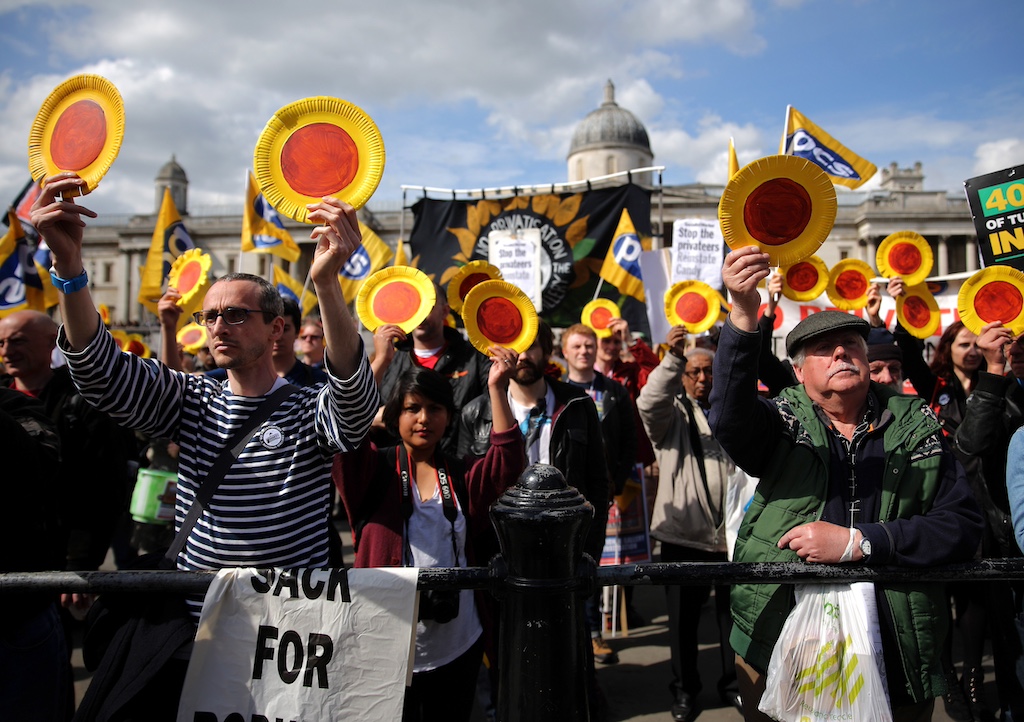
At the annual May Day march in London, demonstrators held sunflowers as a show of solidarity. (Dan Kitwood / Getty Images)
- Interview by
- Meagan Day
The standard critique of the liberal international order comes from the Right these days: the nation-state is supreme, global institutions are a racket, and cosmopolitan elites have sold out ordinary people. The standard defense comes from liberals who conflate the internationalism of the postwar order with the economic system it upholds and defend them both at once.
Not satisfied with either position, political theorist Lea Ypi instead urges us to develop what she calls an alternative cosmopolitanism — a left-wing internationalism equipped to meet the challenges of escalating inequality, rising authoritarianism, and spiraling war.
Ypi is the Ralph Miliband Professor of Politics and Philosophy at the London School of Economics. She grew up in communist Albania and lived through its collapse as a child, an experience she chronicled in her memoir Free: Coming of Age at the End of History. Her most recent book, Indignity: A Life Reimagined, likewise mines her family history to illuminate the interwar rise of fascism. Ypi’s writing integrates personal content with insights from her work in political philosophy — particularly reflections on liberals’ and socialists’ shared value of freedom and its many historical betrayals.
In this conversation with Jacobin’s Meagan Day, Ypi argues that the global right-wing surge is not best understood as a geopolitical realignment but as an ideological convergence, one that mirrors the interwar period in unsettling ways. She dissects the distinction between conservatism and fascism, explains why MAGA’s radicalization follows a recognizable logic of escalation, and makes the case that migration is fundamentally a class issue, not a cultural one.
Ypi also draws on her family’s history to argue that the Left needs to reckon honestly with the twin failures, rooted in the limitations of the nation-state, of state socialism and social democracy, both of which she traces to the limitations of the nation-state, if we hope to build a left politics adequate to the scale of the present crisis.
Meagan Day
Given the mayhem currently unfolding in Iran, it makes sense to start with the breakdown of the geopolitical order. As we watch the postwar institutions fracture or confront their own impotence — the United Nations, the Bretton Woods institutions, the whole architecture of liberal internationalism — do you think we are witnessing a failure of those institutions or the exposure of the fact that they never really delivered what they promised?
Lea Ypi
A combination of the two. There is a story about those institutions that says they were always at the service of colonial patterns and a particular economic system, serving elites in the rich countries against the poorer parts of the world. But those institutions were also the result of efforts to counter the exclusionary tendencies of liberalism. They didn’t fully realize their stated value of universal freedom, but they represented an ongoing fight to extend it.
What we have now is a breakdown that people tend to understand in purely geopolitical terms — the rise of China, the crisis of the US’s relationship to Europe. But what we are really seeing is geopolitical conflict driven by ideological alignment: the rise of a right-wing worldview centered on the supremacy of the nation-state. It is ethnocentric, ethnonationalist, and rooted in a critique of liberal cosmopolitan elites.
This is a phenomenon you find in Europe, the Middle East, and the United States. It’s an ideological alignment on the Right, centered on the perspective that might is right, the strong do what they have to do, and the weak suffer what they must.
Meagan Day
Is something new emerging on the global right, ideologically? Or is this similar to how the Right has always looked, only newly emboldened and unleashed?
Lea Ypi
It’s very similar to the critique of liberal cosmopolitan elites that you would have found on the Right in the interwar period, when fascism was rising. A lot of people think fascism is just conservatism, but it also has a constructive understanding of where it wants the world to be, a critique of liberal internationalism that was already there after World War I and the financial crisis.
What’s different now is that this seems to be the hegemonic critique of liberal capitalism and globalization. In the interwar period, you had another reading that was also a critique of capitalism and international liberalism, but coming from the Left, from a class perspective. Today the criticism of the status quo is coming overwhelmingly from the Right, with the mainstream left still struggling to recover its own critique of capitalism.
Meagan Day
Can you flesh out the distinction between conservatism and fascism?
Lea Ypi
It’s a distinction in methods. Fascism is a kind of revolutionary conservatism. It feels that the departure from the status quo needs to be more radical, because the status quo is too committed to liberal assumptions. Conservatism takes more of a reformist route — commitments to traditional values and customs but not this idea that you need to break the world to remake it according to some vision of the nation, civilizational superiority, and racial homogeneity that underpins a lot of fascist thinking.
Whereas in conservatism you find more compromise with the liberal order, fascism has a much more destructive and creative energy. There is a Nietzschean understanding of the relationship between morality and power in fascism that is very different from liberal universalism. Fascism, at its core, is committed to the idea that power justifies itself and that moral claims to the contrary are just the complaints of the weak.
Meagan Day
Would you say that the rise of Trumpism and figures like Viktor Orbán and Jair Bolsonaro is evidence of a rising fascist tide?
Lea Ypi
They come out of different predicaments. Orbán comes out of the failure of liberal cosmopolitanism in Eastern Europe, the financial crisis, and the shock therapy of the ’90s, while Trump and Bolsonaro emerge from their own histories. But these trajectories, which start very differently, all seem to be converging toward a more utopian fascist direction.
I don’t think MAGA actually starts out fascist. There’s a process of radicalization. These movements need a utopian vision in order to explain why they’re not delivering on policy. Why are costs and prices still so high even though you’re in power? You need long-term ideological misdirection to justify it to your constituencies — an ever-more exclusive utopia of hierarchy.
Meagan Day
I was just reading about a minor scandal in American politics: the Miami Young Republicans had a group chat leak, and in it, right-wing college students are sharing memes about the esoteric Hitlerist Julius Evola and Heinrich Himmler’s concept of Agartha — very niche, occult fascist concepts. To your point, I don’t think that is in MAGA’s DNA. I think that is absolutely an ideological escalation.
Lea Ypi
Exactly. And as I was studying the rise of fascism in the 1920s and ’30s for my last book, you find a similar ideological escalation. When we think about Hitler and the Nazis now, we think about the high point: the Holocaust, the concentration camps. But in the first years of Hitler’s power, liberals who had been concerned about him were saying, “Well, he forced his people to take down the anti-Jewish writings because he understood his base had gone too far.” People were reassured: “It’s not as bad as it looks.” Even in the case of Nazi Germany, there were processes of concessions and withdrawals, a dialectic responding to events as they unfolded.
Meagan Day
There’s almost nothing more chilling than drilling down into the escalation of fascism in Germany and noting how ordinary people found themselves like lobsters in a boiling pot. How much credence do you give to the parallels with the interwar period?
Lea Ypi
I think there are real parallels. The right-wing fascist escalation is a response to liberal capitalist crisis. That was true in the ’20s, and it’s true now. History won’t repeat itself in exactly the same way, but we can read the rise of the Right as a response to the failures of social democracy on the one hand and liberal capitalism on the other, as was the case in the ’20s and ’30s.
Meagan Day
You also had an empowered left in the interwar period, and arguably today you do not.
Lea Ypi
Yes and no. The Spanish Civil War was the last moment in which you had real left internationalism. After that, the Left was committed — in both its socialist and social democratic forms — to the nation-state. And in that sense, it’s not a project that can adequately respond to this crisis, which is ultimately a transnational crisis. What you have now is the inability of the Left to create a broad international front with a clear vision of where it wants to take its critique of capitalism.
Meagan Day
Meanwhile, the Right seems to be very effectively weaving together a cohesive international project.
Lea Ypi
Yes, and it had already started doing that when it was not in power. Think of Steve Bannon and the role he played in connecting the various right-wing movements in Europe and America — there was already broad transnational mobilization around this ideology of the nation and the state. They were able to say that capitalism is transnational and, therefore, any effort to criticize it from the Right also needs to be transnational. These characters went around forming networks: think tanks, news platforms, individual figures who were the connecting links. They weren’t waiting to be in power.
Meagan Day
What accounts for the Left’s relative failure to replicate this?
Lea Ypi
The abandonment of the critique of capitalism as a class project. You have the environmentalist left, the feminist left, the anti-racist left, and there’s been a critique of universalism that has made it difficult to connect these identity-based struggles into one vision. Paradoxically, the Left has inherited the same culturalist approach that the Right takes to understanding conflict — saying it’s about racism or gender without fitting those critiques into a critique of the broader mode of production.
What the Left really lacks is an alternative cosmopolitanism. When I was a student in the late ’90s and early 2000s in Italy, that was the moment of the alter-globalization movement. You had the World Social Forum in Porto Alegre, the emerging idea of an alternative globalization. But that movement was suffocated by the hegemony of neoliberalism, which insisted that you didn’t need another politics, you just needed the right policy. All you had to do was cater to the Third Way: policy fixes, a little redistribution, compromise with economic elites.
Those of us who were on the streets were seen as ridiculous romantics who didn’t understand that the Cold War was over and there was no alternative. That’s what we lost, and that’s what we’re struggling to recover.
Meagan Day
The Left has been suspicious of the nation-state for good reason. But in recent history, it’s largely been within this context that the weak have been able to express their power. Is there anything redeeming about the nation-state?
Lea Ypi
Pragmatically, yes, because the nation-state is the site of coercive power. If you want to take and exercise power, you need to know where it resides. Otherwise, the social struggle just remains everywhere and nowhere.
But the reason people pinned so much hope on the nation-state was that in the 1920s and ’30s, you had the nation against the empire. Nationalism was a progressive force in the struggle against the imperial order, against churches and monarchies that had zero democratic representation. That’s why it was presented as progressive in the left-wing debates of the period, the writings of [Vladimir] Lenin and [Rosa] Luxemburg and so on.
But now the empire is over. The nation-state is itself a representative of the old order. Nationalism is no longer progressive even in its most favorable articulation. It’s just the exclusion of the other. People want to make distinctions between ethnic and civic nationalism, but ultimately when there is a border, there is a difference between who is in and who is out. It’s inevitably exclusionary. We are at a different moment, and we need a different kind of analysis.
Meagan Day
On that point, how should the Left position itself when speaking to a public that has serious anxieties about migration?
Lea Ypi
First, we need to change the discourse away from the moralization of migration. A lot of the left-wing discussion goes: borders are arbitrary, freedom of movement is a basic right, why can’t people move freely? It’s conducted at such a moralistic level that it’s hard to distinguish the liberal defense of migrants from the left-wing one.
Migration is only a problem when it happens in asymmetrical power relations, as from the Global South to the Global North. Nobody worries about migration from Canada to the United States or from Australia to Great Britain. We only worry about migration when it reflects broader asymmetries of power. And those asymmetries are themselves the result of war, economic crisis, and environmental breakdown.
Migration is a consequence, not a cause. If you really want to solve the problem, you have to intervene at the level of its causes. And that’s where the Right doesn’t have an answer. “We must make our own country great again at others’ expense” can only result in more war, more crisis, and more disaster around the world — and, consequently, more migration.
It’s also really important to bring out the class dimension. Borders have never been more open for some people and more closed for others than they are now, even in places where the Right is in power. When Trump was posting those images of people in chains being deported, he was simultaneously boasting about how easy it was for Russian oligarchs to get investor visas.
The golden visas, the citizenship-by-investment programs — the Right has been completely willing to open borders for the wealthy. So if the concern is really about cultural mixing and integration, why does migration become so easy for some people and so difficult for others who come from the same cultural background? Migration is a question of class, not culture.
Meagan Day
You grew up around 1989, and your memoir treats it as a very ambiguous turning point rather than a triumphant one. Is there something in the post-communist experience that gives us useful tools for thinking about this moment of instability?
Lea Ypi
One of the interesting things in the transition literature from the 1990s is the concept of the “triple transition.” Former communist countries had to build market economies, democratic states with structures of legitimation, and resolve the territorial problem, meaning all the nationalist conflicts within multinational units like Yugoslavia and the Soviet Union. Scholars pointed out that you couldn’t have all three at the same time, and that there were no intermediary institutions in those societies — no trade unions, no vibrant civil society, no real parties.
What’s fascinating is that people were saying this as though the West was staying constant. They took the best of the West — the golden age of social democracy, constraints on markets, mass-member parties — and said the East needed to catch up. But while they were having these discussions, those intermediary institutions were being completely dismantled in the West. This was the time they were destroying unions, when parties were becoming cartel parties. Everything the East was supposed to pivot toward was being lost.
It was an ideological operation that attributed the gains of Western social democracies to liberalism rather than to the labor movement, while at the same time the [Margaret] Thatcher–[Ronald] Reagan era was destroying the labor movement. They were taking credit for what the labor movement had achieved but without the structures that had made those achievements possible. What people had predicted would happen in the East — authoritarian right-wing leaders using cultural issues to distract from economic failures — ended up happening in both the East and the West. The transition went not from East to West but from West to East.
Meagan Day
I want to pluck out a thread from your interview with Aaron Bastani on Novara Media, which has to do with your family history of persecution under communism and continued identification as socialists afterward.
Almost all Americans ever hear on this topic is: “My family lived under communism, they were persecuted, and I am qualified to tell you it can never work.” But many socialists were persecuted under communism and maintained their commitment to socialist values. Can you talk about how that worked in your family?
Lea Ypi
My grandfather was a social democrat and was persecuted by the Albanian communist leadership for it. But a social democrat of the 1920s and ’30s was different from what we mean by social democracy today. The social democrats of that era didn’t think democracy and capitalism were compatible. Social democracy at its origins was a much more radical project than we now give it credit for.
The only real difference between social democrats and communists at the time concerned revolution and, consequently, the relationship between the vanguard and the people. The big discussion between Eduard Bernstein and Rosa Luxemburg was on the method, reform versus revolution, but the goals were the same. The fundamental assumption was that if you wanted real democracy, you needed to contain and eventually overcome capitalism.
In places like Albania, the project of building socialism was merged with the project of building a nation-state out of the collapse of empire. That meant you didn’t have socialism built with democratic means. You had this weird hybrid: control over markets but no functioning public sphere, no democratic legitimation, no party democracy. It was socialist by some important measures, but it was also very repressive, including to socialists and social democrats who stepped out of line.
By contrast, we can imagine a democratic socialism. It’s possible to have a socialist state with a socialist constitution and different kinds of socialist parties, and indeed a multiparty system really helps with legitimation and accountability. So then why do we take that very narrow understanding of what socialism was, typified by examples like Albania, and make it the definitive definition — contrary to all the alternative socialists who were suppressed by the state socialists?
People sometimes suggest to me that I must not care about my own family. But I don’t see why caring about my family means siding with those my grandfather always thought were wrong. He always thought capitalism was the problem. The fact that he suffered under communism in Albania didn’t mean capitalism stopped being a problem. Staying true to my roots means not letting his enemies define what socialism means.
Meagan Day
I think newer socialists are sometimes confused on this point. They’ve discovered their own critique of capitalism, and now the world seems split into two competing camps, and they want to be on the right side. It’s critical to nuance that picture.
Lea Ypi
Right, when in reality, to rebuild the Left, you need to settle accounts with both failures of the twentieth century: the failure of state socialism and the failure of social democracy in its nation-state-rooted version. State socialism fails because of its weddedness to the nation-state, its lack of democracy, and its neglect of first-generation freedoms such as freedom of movement, association, and expression. You can’t just say, “They had to do it, so it was fine.” Socialism was always about equality, but it was never only about equality; it was always also about freedom.
At the same time, we need to also be really critical of the social democrats and how they compromised with capitalism, and where that led: to the waves of neoliberalism in the ’90s. Both failures are connected to the nation-state. An alternative needs to learn from both. We need to recover the critique of capitalism on the one hand and the critique of the nation-state on the other. The nation-state requires structures of legitimation that don’t work with a critique of transnational capital — capital that operates across the Global North and South, that generates imperialism and conflicts over resources at the global level.
Meagan Day
What’s on your mind as events unfold in Iran?
Lea Ypi
War is the logical conclusion of the tendency to respond to political and economic crisis by vowing to make your own country great again. A worldview constructed around the nation-state is necessarily built on the idea that the world belongs to the powerful, and the powerful have a right to destroy everything that doesn’t conform. War is just that logic carried to its end point.
But what’s really interesting about this Iran war is that the United States feels no need to morally legitimize it. When you think about the Iraq War, liberal internationalists went to great lengths to explain that it was about international norms, international justice. There was a need for justification beyond the nation-state. The logic wasn’t just sheer naked power. With this war, there is very little of that.
Meagan Day
That seems to reflect the weakness of liberal institutionalism. We’ve perhaps arrived at the place where the Right can simply have a war on its own terms without appealing to the ethics of the liberal order at all.
Lea Ypi
Yes. But in defending pacifism, it’s important not to defend it just on the basis that we need to respect the liberal international order — because that order was always flawed and asymmetric. Real pacifism is only possible once you’ve overcome both problems: capitalism on the one hand, and the nation-state as an obstacle to the realization of a socialist world on the other. There is a vision of international institutions that isn’t just defending the institutions we have in their current form.
I don’t know that we can lay out a ten-point program for what comes next. You start with an analysis of the present moment and a critique of what went wrong in the past, and from there you build the democratic institutions required to take that critique forward. But I do think it must take the form of an alternative cosmopolitanism. That is the most coherent way of making sense of the conflicts of the globalized world.