Japan Is Building a War Machine in the East China Sea
Japan’s conservative leader, Takaichi Sanae, won a supermajority of seats in this year’s general election. Takaichi and her allies are using this position of strength to advance a dangerous militarist agenda as part of Washington’s anti-China front.
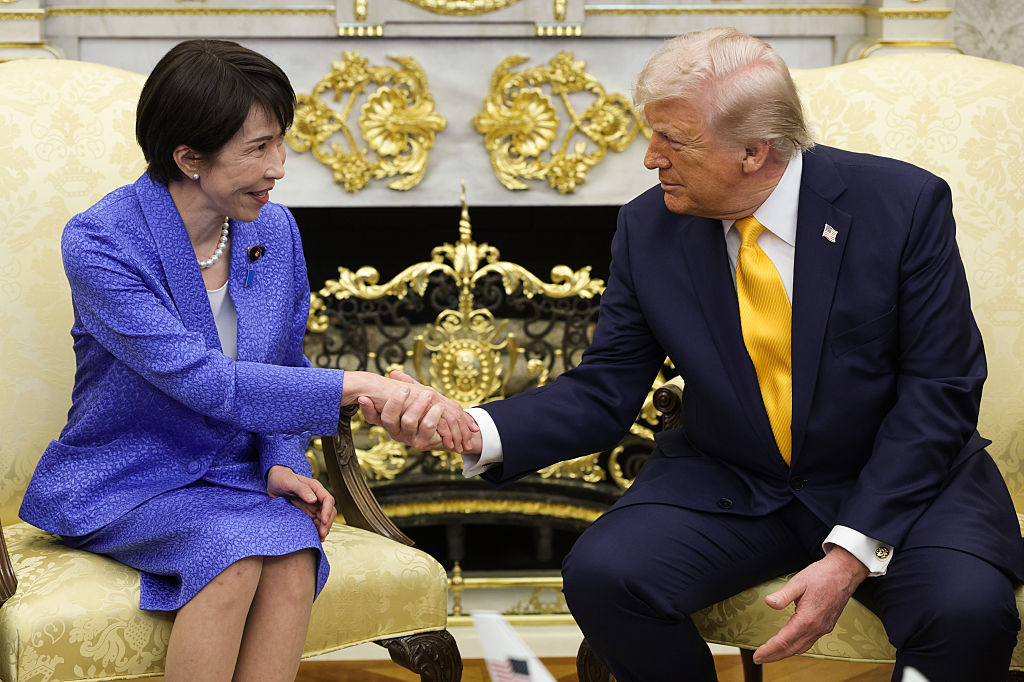
Eighty years after suffering devastating defeat in war, Japan again stands at a crossroads, facing a choice over whether to maintain and consolidate the US-led global anti-China front or to commit to building a peaceful East Asian community of nations. (Alex Wong / Getty Images)
Less than six months after her assumption of office as Japan’s 104th (and first female) prime minister, and two months since her rise was confirmed by a resounding victory in a national election, the grip of Takaichi Sanae on the levers of state is unchallenged, and her support level remains high.
However, thoughtful and historically aware commentators are speculating that a fundamental transition of the state might be underway, one from “peace state” to “war state.” Looking back to the Konoe Fumimaro government of 1937, which in retrospect we can see as taking the steps that led to a catastrophic war four years later, they fear that Takaichi might be replaying that scenario.
Supermajority
On February 8, 2026, the Japanese people went to the polls for an election to the lower house of the National Diet. It was generally taken to be a test of the latest government led by the Liberal Democratic Party (LDP), formed in October 2025. With the party leader Takaichi enjoying support levels of around 70 percent, the election outcome was scarcely in doubt, but its scale still took many by surprise. Takaichi took the LDP from 198 seats (short of the 233 needed for a parliamentary majority) to 316 seats, giving the LDP a two-thirds supermajority.
She confronted an opposition led by the mildly reformist Centrist Reform Alliance (CRA), a new force formed through a merger of the former Constitutional Democratic Party and the neo-Buddhist Komeito, a long-standing coalition partner of the LDP. Having set out to increase its Diet strength, the CRA suffered instead a humiliating loss, dropping from 167 to forty-nine seats.
In the long history of the LDP from its foundation in 1955, no leader had ever performed quite so brilliantly as Takaichi. She emerged from the election with political power greater even than her sometime mentor, Abe Shinzo. Her supermajority in the Diet meant that, unlike previous LDP governments, she could press confidently ahead with her rightist agenda, including steps for constitutional revision.
However, this electoral victory did not necessarily reflect overwhelming national support. The 56 percent turnout was the fifth-lowest in the postwar era. In the single-member constituency seats, the LDP won 49 percent of votes cast, while in the regional party-list seats, it took just 37 percent. Such are the vagaries of the electoral system that the support of 28 percent of all those eligible to vote was sufficient to gain the party two-thirds of all seats.
End of the “Peace State”?
Eight decades have now passed since the collapse in 1945 of Japan’s Asia-Pacific community, the so-called “Greater East Asia Co-Prosperity Sphere,” and the message that many Japanese people took from that catastrophe was clear. Under Article Nine of the constitution adopted in 1946, Japan pledged to renounce “war as a sovereign right of the nation and the threat or use of force as means of settling international disputes,” adding that “land, sea, and air forces . . . will never be maintained.”
Although periodic polls always show strong popular support for Article Nine, Japan did nevertheless over time build formidable land, sea, and air forces, evading the constitutional proscription by calling them “Self-Defense Forces” (SDF). The pacifist pledge, unrevised but steadily emptied of content, remains, but the 1946 aspiration to create a new kind of state, one resting on the “peace” principle, was largely forgotten. Over subsequent decades, the United States came to regret its recrafting of Japan as a “peace state” and began exerting pressure on it to revive and expand its military.
The level of Japanese military spending rose steadily throughout the Cold War, though remaining for long within the self-imposed limit of 1 percent of GDP. The size of Japan’s economy meant that this was still a large amount in absolute terms. However, as GDP growth slowed, in 2022 the level doubled to 2 percent, with an overall target of 43 trillion yen (US$355 billion) for the five-year period from 2022 to 2027.
Roughly on schedule to reach that target, military spending for the first time surpassed nine trillion yen ($58 billion) in 2025. Under Takaichi, we can expect further steady expansion. If we assume that Japan will be an early adopter of NATO’s target of 3.5 percent of GDP for military expenditure, the nine trillion would blow out to 24 trillion yen — roughly $140 billion. This is a staggering sum that would require drastic cuts to health, education, and welfare budgets. If it goes further by adopting NATO’s second target of 5 percent by 2035, which Donald Trump is believed to be demanding of Japan, the sums involved beggar the imagination.
Eventually, and especially under the Abe Shinzo government in office from 2012 to 2020, Article Nine–based restrictions were swept aside, spending accelerated, and Japanese and US military forces were reinforced and integrated. After taking office in October 2025, Takaichi promised further, substantial increases in maritime and air defense (including long-range hypersonic missiles), along with a commitment to construction and deployment of a missile defense umbrella, to be known as a Synchronized, Hybrid, Integrated, Enhanced, Littoral Defense (SHIELD) system.
One of Takaichi’s closest advisers late in 2025 even questioned the commitment to “Three Nonnuclear Principles” — nonpossession, nonmanufacture, and nonadmission of nuclear weapons to Japanese territory — that the LDP government adopted in 1967. The prime minister herself is reported to agree and has been reviewing the “three nons” policy.
Those who celebrated the Washington-Tokyo alliance as “the cornerstone of peace and security in the Indo-Pacific region” took it for granted that Japan would exercise “bold leadership” and that Japan’s forces would constitute a significant component reinforcing US global dominance. Over and under the East China Sea, battleships and aircraft carriers, missile and countermissile systems, fighter jets and submarines — not only Japanese and American, but also British, French, Australian, Canadian, and German — are stepping up their rehearsal of a possible future war between a US-led coalition of the willing and China.
Under such conditions, it is unthinkable that Japan’s heavily armed forces could ever operate independently. They constitute in effect a “second US Army.”
Okinawa
A significant US military presence — approximately 26,000 US personnel, or half the total stationed in Japan — is positioned on Okinawa Island, where attention focuses on the hugely unpopular and still hotly contested Henoko base being built there by Japan for the US Marine Corps to replace the obsolescent Futenma. Meanwhile, Japan over the past decade has steadily expanded its own military presence on its lesser-known islands.
Under strong US pressure, it has deployed, or is in the process of deploying, missile and countermissile units in a series of new and under-construction bases, decisively changing the character of the Ryukyu island chain that stretches from Kagoshima to Taiwan. The size and population of these islands range from Mage (area 8.5 square kilometers, population zero) to Okinawa itself (area 1,206 square kilometers, population 1.4 million). In geographical terms, a line drawn from Kagoshima City in western Japan to the northern shores of Taiwan passes through these islands. Japan and the United States appear to believe that, if or when the need arises, they can “bottle up” China and deny it access to the Pacific Ocean.
Japan’s southwestern frontier islands of Mage and Yonaguni deserve particular attention. Mage in the north is closest to Kagoshima, while the sparsely populated Yonaguni in the south is just 110 kilometers from the coast of Taiwan. Mage, which is adjacent to the Japanese space industry island of Tanegashima, was initially chosen to house US carrier-based fighter jet takeoff and landing exercises.
This gradually evolved into a project to accommodate all three of Japan’s military forces (Ground, Sea, and Air SDFs) together with unspecified numbers of their US counterparts. The project would be under the auspices of an arrangement that ensures ultimate Pentagon coordination, control, and command of Japanese military operations throughout the adjacent seas. From 2021, a six-thousand-strong workforce was mobilized to this remote island site, and the date for completion of the base construction works was moved forward to 2030.
Yonaguni is close enough to Taiwan that on a clear day, its mountains can be seen. Occasional Taiwanese friendship missions have landed on Yonaguni beaches from motorized jet skis. The community split over the government’s commitment to install a major military installation on the island, although a February 2015 island referendum did not win enough support to block the plan. A site was chosen, and in March 2016, an initial 160-strong Ground SDF unit marched in.
Mage and Yonaguni, both once renowned for the richness of their biodiversity, thus have become centers for the preparation and conduct of war. Military facilities of one kind or another soon followed on the other islands.
Filling in the Blanks
Throughout the Cold War decades, what distinguished the southwestern islands (other than Okinawa itself) was the absence of US military installations. Undefended, they posed no threat and were themselves unthreatened. Those who knew the islands in their premilitary base days — this author among them — remember them as idyllic.
But to bureaucrats and SDF top brass in Tokyo, not to mention the Pentagon, the absence of such military forces gradually became of paramount concern in national defense doctrine. The raison d’être for these Okinawan islands became their positions as US-Japan bastions from which to project force in the service of the regional and global hegemonic project.
The nominal reason for the militarization of the “first island chain” is to defend Taiwan in case of a “contingency.” This is the euphemistic sobriquet by which war over Taiwan between China and Taiwan has come to be contemplated since Abe Shinzo’s statement (repeated by Takaichi in 2025) that “a Taiwan contingency would be a Japan contingency.”
The broader role assigned to the first island chain is to position US-Japan power in a place where it can contain a rising China in the region that has come to be known as the Indo-Pacific. The United States insists on its own “full-spectrum dominance,” meaning global economic, technological, and military hegemony. To the extent that it challenges (or appears to challenge) that prerogative, China “threatens” the US.
A sane defense policy for a country such as Japan — or indeed for any country — would surely be one that attached highest importance to avoiding dispute and building cooperation, rather than striving to “win.” Any East Asian war today or tomorrow would be a missile war, involving naval and air power, and could conceivably become nuclear.
Missile and antimissile units are now being installed on the southwestern islands, including four hundred “off the shelf” Tomahawk Land Attack Missiles for which Japan placed an order late in 2022. Such missiles are said to be capable of attacking forces within a 1,500-kilometer radius (including major centers in Russia, China, and North Korea).
Regardless of who “wins” such a war, damage and devastation would be assured for all sides. Contemplating such catastrophe, Okinawans recall their sacrifice in the spring of 1945 in the final battle of the Pacific War, which took the lives of more than one-fourth of the Okinawan population.
Japan’s authorities might issue an “alert” warning in case of conflict breaking out, as was done on the occasion of several recent North Korean missile launches. But in the 2020s, just as in 1945, there would simply be no time for the Okinawan civilians to withdraw to safety, and indeed nowhere for them to go.
A Peace Community
Ironically, the Okinawa now being militarized and readied for war with China has a five-hundred-year-long history of friendly interchange between the Ryukyu Kingdom and the Ming and Qing China dynasties. The Okinawan people do not share the militaristic Japanese Bushido ethic. There is no evidence of the Chinese resorting to violence in their relations with the Ryukyu authorities over the course of those centuries, and the exchanges are still remembered and celebrated in Naha today.
In contrast, Okinawa’s incorporation into the modern Japanese state was accompanied with great violence, from the torture-induced assent by Ryukyu Kingdom elites to the absorption of the Ryukyu Kingdom and its territories into Japan in 1879. This was followed by violent attempts to crush the distinctive Okinawan language and identity and by the catastrophe of 1945, when Okinawa alone among Japanese territories suffered the horror of land war. The violence continues, with an ongoing assault from the contemporary Japanese state trying to break the Okinawan will for a nonmilitarized East China Sea community.
Under successive prefectural governors, the realization has grown that in order to overcome the threat of war, it is necessary to shift the emphasis from preparing for war to creating peace. This author recalls discussions with former Okinawan governor Ōta Masahide, in office from 1990 to 1998, on the need to combat East China Sea militarist agendas by taking the initiative in building an East China Sea peace community.
Unfortunately, that suggestion went nowhere — shortly after our conversation, an intense campaign by the national government drove Governor Ōta from office. Yet the urgency of taking such steps is so much greater now than it was during Ōta’s term of office.
Dynamics of War
However much Japan under Takaichi scrimps and shifts resources from social services to its military, the logic of the bottom line is inexorable. The Japan that as recently as 1994 accounted for 17.8 percent of global GDP has now shrunk to just 3.4 percent after a long period of economic stagnation.
Meanwhile, China’s GDP, having been one-quarter of Japan’s in 1991, surpassed it in 2001 and quadrupled it in 2018. The gap has continued to widen since then. With the size of China’s economy now amounting to four times that of Japan’s and its share of world economic output, according to the CIA, a formidable 19 percent, the absurdity — not to speak of the criminality — of any US-Japan design to take down such a country is plain.
Eighty years after suffering devastating defeat in war, Japan again stands at a crossroads, facing a choice — of which its citizens are largely unaware — over whether to maintain and consolidate the US-led global anti-China front or to commit to building a peaceful East Asian community of nations. With her supermajority in the lower house of the Diet, most observers anticipate that Takaichi will press ahead with her long-term dream of constitutional change, deleting or at least fundamentally revising Article Nine.
The post–World War II Asia-Pacific settlement thus continues to morph from the 1947 declaration of peace toward a dynamic of war and war preparation. China, outraged by US-Japanese-led attempts to freeze it out of regional and global institutions, pours a high proportion of its formidable and rapidly growing resources into its military, reinforcing its presence in the East and South China Seas in particular.
Meanwhile, Japan deploys tanks and missiles to its remote islands, conducts evacuation drills, and urges local residents to make contingency plans for war. The US Marine Corps “repurposes” its Okinawa-based units, facilitating their deployment to other islands and arming them with antiship missiles for use against Chinese shipping in the event of any Taiwan “contingency.”
In October 2025, Takaichi had Donald Trump’s enthusiastic support as she ascended to high office in Tokyo. Once in office, she positioned herself as his faithful servant, committed to “making America great again.” One of her first tasks was to put together an enormous “aid” package worth $550 billion (approximately 80 trillion yen) to assist the Trump project and to further Japan’s clientelist incorporation into his emerging global order, opening the door for a “new golden era” (Trump’s words last October).
Takaichi was the only leader of the old G7 who had no word of criticism of the joint US/Israeli war on Iran this year, and she alone seemed to have no compunction about issuing a grovelling public pledge to nominate Trump for the Nobel Peace Prize. Probably no one in the world could share the sentiment expressed by Takaichi on sitting beside the president in the Oval Office on March 19: “It is only you, Donald, who can bring peace and prosperity to the world.”
In this scenario, Japan would be an unquestionable military superpower, number three in the world after the United States and China. Regional states with reason to know, fear, and remember Japanese militarism, Australia included, show little if any interest in Japanese constitutional matters. To the extent they are aware of it at all, they dismiss Article Nine as a quixotic survival from a bygone age. With the constitution steadily sidelined, Japan is already one of the world’s “great” military powers. Paradoxically, the more it builds up its “defenses,” trusting its destiny to the genocidal rogue superpower, the less secure it becomes.
As the constitutional peace state of 1946 morphs into a military superpower, it is surely time that civic groups in Japan and Australia (and other Pacific Rim countries) joined to shift their governments from the war path and toward one of peaceful cooperation. If anything is to be done with Article Nine, it should be to restate, reinforce, and universalize the peace principle, not to delete or dilute it.