The Iraq War Presaged Donald Trump’s War on Iran
A small group of hawks convinced George W. Bush to launch a war in the Middle East, despite his campaign-trail rhetoric and against the advice of top US military and intelligence officials. The parallels with Donald Trump’s war on Iran are striking.
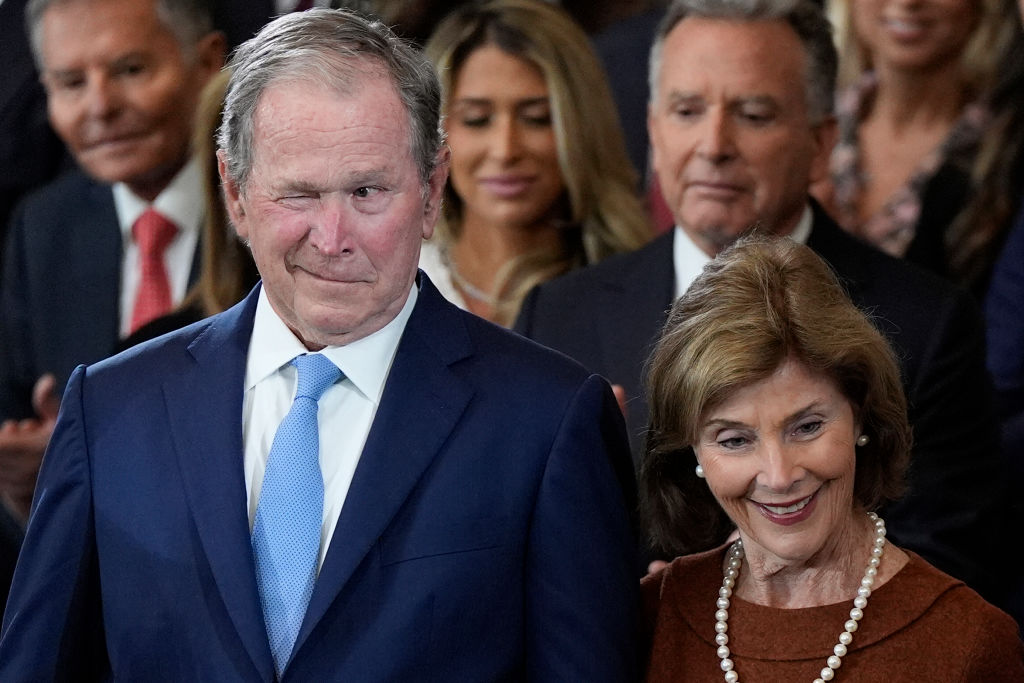
Despite the differences in personnel between the Bush and the Trump administrations, the parallels between the war in Iraq and the war in Iran are pretty straightforward. (Julia Demaree Nikhinson - Pool / Getty Images)
The New York Times had a decent-enough report yesterday on how the United States made its decision to go war with Iran. Though it’s filled with sharp reporting and detailed accounting, it fails to identify the big forest amid the trees. That’s this: despite the differences in personnel between the Bush and the Trump administrations, the parallels between the war in Iraq and the war in Iran are pretty straightforward.
First, a hard-right Republican president comes to power denouncing the more “internationalist” and “establishment” Republicans and Democrats who see the United States as the world’s policeman. We often forget that one of George W. Bush’s promises when he ran in 2000 was that he wouldn’t do nation-building, the United States would be “humble,” he would pursue a narrow definition of the US national interest, and so on.
Second, a small group of influencers — neocons in Bush’s case, the Israelis in Trump’s case — make the argument for war on two logically incompatible grounds: a) the enemy regime is poised to be so militarily powerful that if the United States waits any longer, the enemy will be able to land a devastating blow against it; b) destroying the enemy regime militarily will be staggeringly easy.
Third, top-level US intelligence and military officials say that this advice is nonsense, totally lacking in evidence. Additionally, they repeatedly ask, what if you are able to destroy the regime, what comes next? How are you going to run the country?
Fourth, eager to destroy an enemy regime that has been a thorn in the side of the US for decades, the president ignores the intelligence and military establishment, displays scant concern about what comes next, and takes the country to war.
Fifth, Republicans and conservatives scratch their heads. How did a president who came into office promising not to be the world’s policeman wind up unnecessarily taking the country to war?
Structurally, the two important continuities are these: 1) the distinction between a radical right and moderate establishment right in the Republican Party is nonsense; 2) Congress and both parties have long abandoned their role in limiting the power of the president when it comes to war.