La France Insoumise After the Local Elections
Local elections saw La France Insoumise make its first real gains in taking over city halls. Ahead of the 2027 presidential race, it still badly needs to expand its voter base to have a chance of winning a national election.
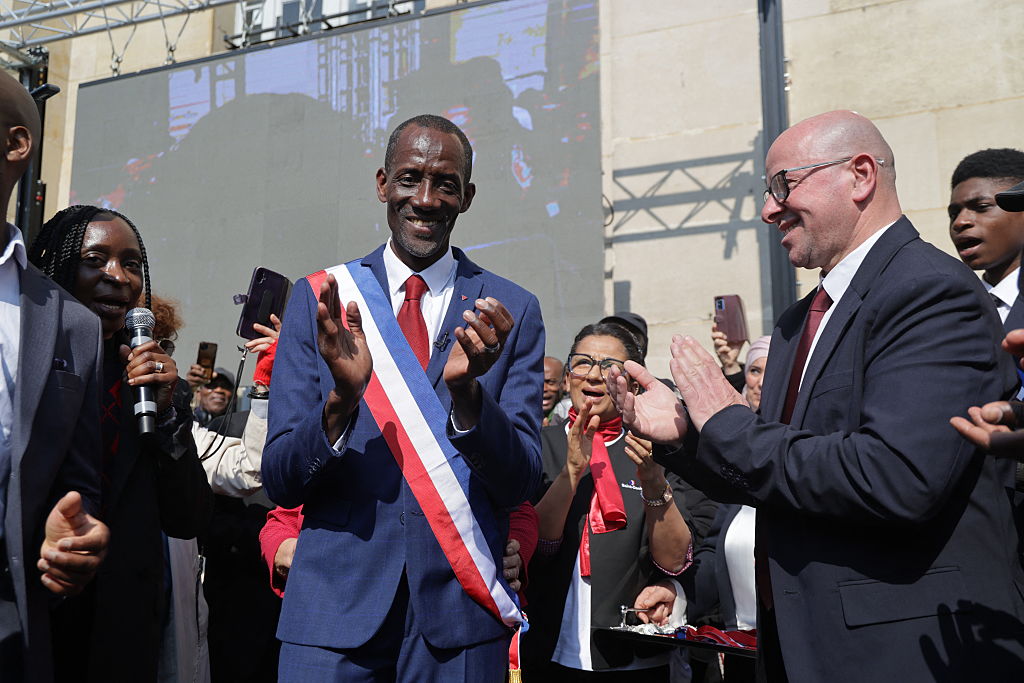
Establishment media tried to use the local election campaign to declare La France Insoumise a violent and illegitimate force in national politics. But its vote held up well, confirming it as a serious contender in the 2027 election. (Ludovic Marin / AFP via Getty Images)
The recent local elections across France offer a revealing snapshot of the balance of forces on the Left — and above all, of the position of La France Insoumise (LFI) as it looks toward the presidential elections in 2027. Rather than confirming a crisis or the hegemony of a particular tendency, the results point to a more complex reality. This is a socially dynamic party territorially advancing in some parts of France, yet unable to impose itself as a dominant force across the entire left.
Just a year ahead of the presidential race, these elections were not merely local contests but functioned as a strategic rehearsal for national power. For the first time, LFI invested heavily in municipal campaigns, seeking to consolidate a durable base capable of supporting a future presidential victory. Control over city halls matters symbolically, and even more so institutionally, shaping political networks, public visibility, and even influence over the composition of the Senate.
From this perspective, LFI’s results were mixed. Notably, it failed to make a decisive breakthrough that would have consolidated its left leadership status. The party made some progress, particularly in suburban areas of large cities, confirming its capacity to mobilize and win in specific contexts. On the other hand, LFI continues to have a weak presence in many parts of rural France — in the kind of regions where the gilets jaunes movement emerged, with their predominantly white, precarious populations. Some are concluding that such demographics tend to gravitate toward the hard-right Rassemblement National — an assessment that seems premature, as their radicalism and rejection of the establishment might still swing either way.
Another of the central dynamics of the election was the strategy of the Parti Socialiste (PS). It is openly seeking to hegemonize the left-wing camp ahead of the presidential race, and it now faces a strategic dilemma over whether to organize primaries to designate a candidate. What the Parti Socialiste lacks is a natural runner. In day-to-day coverage, Raphaël Glucksmann appears as the strongest contender, but has not been confirmed. On the one hand, the impression is that outside the TV spotlight he carries little real weight; but the precedent of Emmanuel Macron’s unexpected rise to power in the 2010s shows that, in France, the media-driven construction of a candidacy can be highly effective. As for LFI, there is no doubt that Jean-Luc Mélenchon will run for the fourth time, the third as its candidate. (What is rarely discussed openly is his succession; at seventy-five years old, it is likely to be his last presidential bid.)
In terms of a broader leadership strategy, the PS approach during the municipal elections was hard-edged, affirming its intention to spearhead the Left. It refused alliances with LFI in key cities while building coalitions with the Greens and the Communists. In general, this tactic proved electorally effective. Indeed, the traditional left retained control of many of France’s most important cities, including the three largest ones: Lyon, Marseille, and, crucially, Paris, underlining a strong performance overall.
Rupture
LFI tended to identify itself with a program of rupture — and perhaps as a result, secured triumphs in poorer, more multiethnic municipalities such as La Courneuve, Roubaix, and Creil. These victories showcased an insurgent social and political profile: elected officials from immigrant backgrounds, typically of African and Arab origin, emerging directly from the popular classes. This narrative was particularly striking in Saint-Denis, the largest district in the Parisian suburbs, where the mayor elected was Bally Bagayoko — the son of Malian parents, and a Muslim — a figure who embodies both LFI’s anti-racist struggle and the promise of republican equality. (The biggest development in the days following the election is the overt racism from the Right against the new mayor of Saint-Denis — which has seen many ghosts from the past come to light.)
LFI is advancing a form of political representation rooted in the peripheries, one that challenges the traditional sociological composition of political elites in France. At a deeper level, this political shift raises fundamental questions about the French republican model. Officially, France recognizes no minorities, only equal citizens. In practice, however, working-class suburbs like Saint-Denis — home to ethnic minority populations, migrants, and the traditional working class — are treated as internal fractures of the Republic, and commonly subjected to aggressive policing, stigmatization, and political marginalization. The rise of what LFI calls a process of “creolization” directly challenges this illusion, seeking to create a new imaginary that aligns with the wider evolution of French society. This perspective does not reject universalism outright but aims to reconstruct it on more inclusive foundations, indeed as an affirmation of essential French republican ideals.
In this sense, LFI’s strategy attempts to articulate social equality within a broader conception of “the people.” Their local governments are also programmatically ambitious. They hope to renew a welfare-state agenda centered on democratic redistribution of resources: social housing, price controls, free public transport, and free school meals. In this sense, LFI is attempting to anchor its project in concrete improvements to everyday life, particularly for working-class populations. The difficulty lies in how to fulfill such promises against a backdrop of French economic stagnation and now-chronic crisis, today likely heightened by the escalating wars across the globe.
Coalitions, or Not?
Despite its advances, LFI faces clear limits, as the election results underline. Its inability to secure major metropolitan centers, most notably Toulouse (which the party could and perhaps should have won), underscores what an uphill task it is to translate its local breakthroughs into national dominance. Le Monde and others have argued that some of the towns where the PS formed an alliance with the LFI were lost and that, conversely, where PS kept its distance from the LFI a series of victories were secured.
The quandary of whether to coalition-build (or not) must also be understood in light of recent political developments. In the 2024 parliamentary elections, LFI achieved a major and unexpected victory within the framework of the Nouveau Front Populaire (NFP), finishing ahead of the far right that had been widely predicted to win. However, due to disagreements and intransigence on all sides, the alliance ultimately collapsed, leaving room for a counterattack. Such developments significantly altered LFI’s position in the wider system, as the political and media establishment cast it not merely as a rival contender, but as the principal threat to the Republic, even more than Marine Le Pen’s party.
The municipal elections were widely seen as an opportunity for such tendencies to halt LFI’s momentum and render it politically unviable. While this objective was not achieved — LFI was neither defeated nor marginalized — the level of growth the party might have hoped for failed to materialize. The outcome is, then, ambiguous: LFI has not been neutralized, but it now faces real difficulties in establishing itself as the leading force of the Left. It appears to have a solid strategy of local implantation, with figures other than leader Mélenchon, such as Clémence Guetté, Manuel Bompard, and Danièle Obono playing strong roles in public debate, demonstrating the party’s organizational ability. However, it is not so strong as to bring together other left-wing groups around a common project under its leadership. The kind of coordination attempted in the parliamentary elections of June–July 2024 under the NFP banner now seems much more difficult.
What seems to have been confirmed above all is something that has been growing evident in recent years (at least since Macron dissolved parliament in June 2024), and which was reinforced by the tone of the municipal campaign: namely, the widespread and effective demonization of LFI. The “cordon sanitaire” that until recently was placed around the far right so that a republican front could form against it now seems to have been shifted to the other end of the political spectrum. The dominant discourse in major media and rival parties (also from many figures within the PS, Greens, and Communists) is that the enemy to be fought — the one that truly threatens France’s cohesion — is now LFI. A tone reminiscent of the anti-communism of the Cold War and the interwar years has again gained traction. No cost seems too high to ward off the perceived threat posed by LFI.
The accusation of antisemitism attached to LFI seems to be the most difficult one to counter. Perhaps this insistence conceals something else: it is possible that what is most unacceptable about LFI for French society is its attempt to effectively integrate descendants of immigrants into the party and into positions of power. In a society that has long been marked by a complex social fracture, the abolition of long-standing racial hierarchies is often seen as unacceptable. The attempt to challenge them through new means may be what most scandalizes a segment of French society that seems unwilling to let these hierarchies fall away. A fundamental episode of the campaign illustrates this drift. The murky killing of Quentin Deranque (a confirmed neofascist activist), in Lyon on February 12 was immediately linked to LFI and resulted in a minute of silence in the National Assembly, something that has never before happened in the wake of a political killing (especially not those carried out by police, which occur regularly in France).
It is possible that a significant portion of the establishment would consider a Rassemblement National victory acceptable if its opponent were LFI. Among the so-called extremes, the elites may already have made their choice. This tendency was embodied in this campaign by examples like Rachida Dati, the conservative Républicains contender in the runoff for the Paris mayoralty. She attempted to label the — ultimately victorious — PS candidate as far left, trying at all costs to associate him with LFI’s radicalism.
The PS might yet be able to compete in the presidential race next year. But one of its major difficulties is that, unlike other parties — notably France Insoumise — it does not yet have a strong, obvious candidate to put forward. More broadly, it may be being sidelined in favor of a centrist alliance that will ultimately bear a strong resemblance to that which propelled Macron to the presidency. There is still a possibility for the Left to win in France. But in order for this to happen, some sort of preelection agreement is needed, indeed one that doesn’t look close at hand. Otherwise, the resulting fratricide will have immense consequences for French society and beyond.