Europe’s Steel Industry Should Be Publicly Owned and Controlled
Europe’s steel firms are increasingly unprofitable, and rising energy prices are making things even worse. Public ownership is vital to ensure conversion to green production while maintaining jobs.
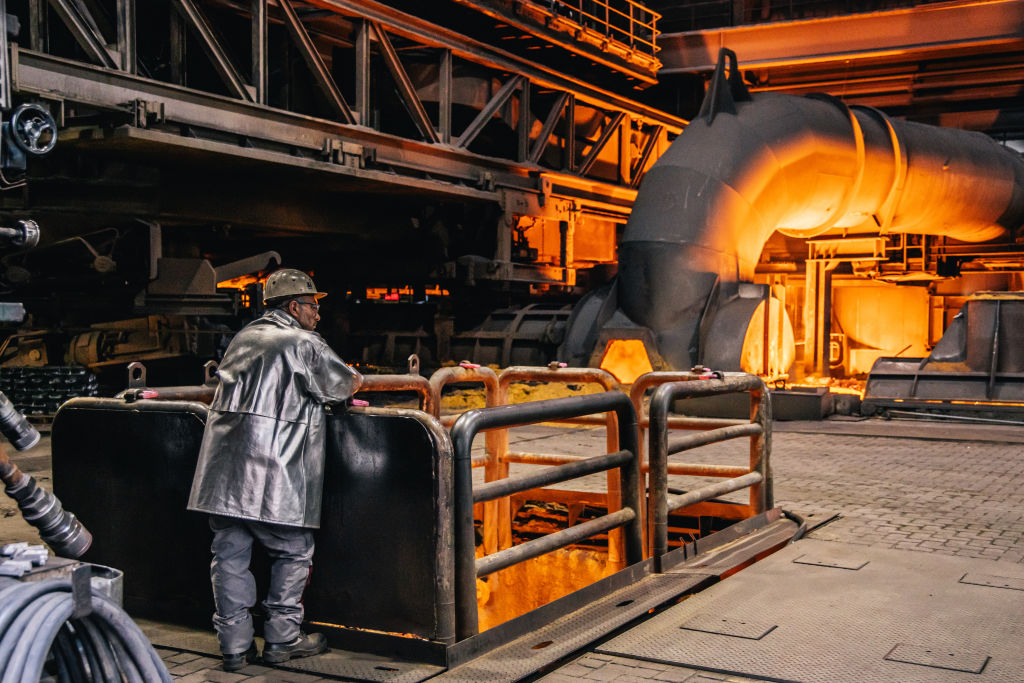
The US-Israeli war on Iran promises fresh risks to Europe’s energy-intensive steel firms. Public ownership is a way of avoiding mass layoffs and stabilizing the supply of steel to sectors like public transportation and housing. (Hesham Elsherif / Getty Images)
Europe’s steel sector is in crisis. The obvious culprit is the continent’s high energy prices, now further escalating in the wake of the Iran war. But the deeper problem lies elsewhere: the industry risks returning increasingly fewer profits to company bosses and shareholders. Amid their troubles, there’s an opportunity for the Left to make a strong case for public ownership of the steel sector and for a wider reform of European energy markets.
Today, with gas prices in Europe having already surged by 70 percent following the illegal US-Israeli war on Iran, the continent’s energy-intensive industry is once again on alert. The steel sector is no exception. This comes on top of pressure from cheap steel imports and global overcapacity, which, according to the industry, present an “existential threat to European steelmaking.”
But the EU’s crisis lies much deeper.
The bloc’s steelmakers often blame global competitors, and particularly the world’s largest steelmaker, China, for flooding the market with too much steel. Yet Europe has its own overcapacity issue. While the EU’s installed capacity hovers at around 198 megatons of potential annual output, its domestic steel production sunk to 125.8 megatons in 2025: what the industry calls a “historic low.” Continually weak demand in steel-using sectors like auto manufacturing and construction has pushed steelmakers to decrease output.
Steel production has recurrently faced such crises in Europe. Today, however, a second crisis adds to the first: decarbonization. Steel is one of the world’s most polluting industries, responsible for 8–10 percent of global emissions.
This pressure to decarbonize is set to reach new heights, seeing as conventional fossil fuel–intensive steelmaking, which uses blast furnaces, is projected to become increasingly uncompetitive in the EU during the 2030s, as a result of carbon pricing. The EU institutions are largely focused on propping up private steelmakers’ profits to prevent their relocation abroad where electricity and pollution are cheaper. Yet today a movement among unions and left-wing actors across Europe is coalescing around a demand for an alternative path: public ownership of steel production.
In November 2025, France’s National Assembly passed a bill to nationalize ArcelorMittal’s French sites, responding to the company’s refusal to invest in coal-free steel production and its plans to cut 1,600 jobs — a signal that the company was set on prioritizing steelmaking outside Europe. Proposed by La France Insoumise in support of mobilization by the metalworkers in the Confédération Générale du Travail (CGT), France’s largest union, the bill was rejected by the Senate. The struggle continues.
This is not an isolated case of layoffs and canceled decarbonization investments. At Germany’s ThyssenKrupp, ten thousand jobs are slated for cuts, while ArcelorMittal canceled a green steel project despite receiving €1.3 billion in subsidies from the German government. In this context, the parliamentary group of Germany’s socialist party Die Linke has recently endorsed steel socialization. In Italy, the state temporarily seized control of the nearly bankrupt former Ilva steel site in Taranto, previously co-owned with ArcelorMittal, and sued the company for €7 billion over mismanagement. This intervention follows more than a decade of severe environmental and health damage linked to the site’s toxic emissions, a situation that led the European Court of Human Rights to condemn Italy for failing to protect people from industrial pollution.
Producing “green steel” can be approached in two main ways. One involves using renewable hydrogen to directly reduce iron ore: a process known as the “direct reduced iron” (DRI) route. The resulting iron is then processed in electric arc furnaces powered by renewable electricity. Today this is widely considered the most viable method to decarbonize primary steel production, needed in sectors such as automobile manufacturing. The other pathway is to expand secondary steel production by recycling scrap in electric furnaces.
But transitioning fossil fuel–dependent operations to green steel requires enormous amounts of energy. By 2030, now just four years away, the EU’s planned low-carbon steel projects could demand more renewable electricity than all electricity consumed by Belgium. This is on top of rising electricity demand from other sectors that also seek to decarbonize. And yet, even if they become operational, current green steel initiatives in the EU could only decarbonize about 24 per cent of primary steel production.
Sweden’s HYBRIT Project
Even Europe’s most promising green steel project using renewable hydrogen, Sweden’s HYBRIT, has had difficulties scaling up, largely due to electricity costs. HYBRIT, a joint venture of steelmaker SSAB, public mining company LKAB, and utility Vattenfall, produced the world’s first renewable hydrogen-reduced sponge iron at pilot scale in 2021.
To scale to a demonstration plant, LKAB has sought a long-term electricity supply agreement with Vattenfall. But the latter, a state-owned company, has insisted on securing long-term electricity prices higher than LKAB prefers before it commits to building new renewable capacity. The European Commission has suggested such agreements as a way to deal with the steel industry’s energy crisis.
But electricity prices are not the only issue: even with favorable agreements, a demonstration plant would increase Sweden’s total electricity consumption by almost 4 percent.
Hydrogen Doesn’t Really Exist
Given the immense electricity requirements, it is unsurprising that renewable hydrogen production at a meaningful industrial scale is yet to materialize. Projects for electrolytic hydrogen are being delayed or canceled worldwide. In Europe, no large-scale electrolysis-based hydrogen capacity currently exists for steel, and overall it amounts to just 0.5 percent of the EU’s industry projections of electrolyzer capacity for 2030.
To have any chance of success, renewable hydrogen development must, therefore, focus on sectors where alternatives don’t exist and where it is efficient. Public ownership and strategic planning could achieve this far better than leaving investment to private markets looking for returns, including sectors such as oil refining, which compete for scarce hydrogen resources.
But Europe is avoiding this reality check by hoping that exporters like Namibia can become its green iron and hydrogen suppliers. Such third countries could presumably produce it more cheaply, and have more resources for renewable electricity such as land and sunshine. But projects there are also delayed, and it is unclear how much green iron is actually produced. One such planned renewable hydrogen project would foresee installing solar panels and wind turbines over an area of Namibia equivalent to the size of Berlin. It is hard to imagine a surface of this size to be made available across Europe, which reveals the logistical and neocolonial limits of such strategies.
With no renewable hydrogen in sight, some steelmakers, such as ThyssenKrupp, plan to fuel “hydrogen-ready” plants with natural gas, while others, like ArcelorMittal, have halted DRI investment in Europe. In the meantime, China’s HBIS supplied Italy with steel slabs with 50 per cent lower carbon content — an offer currently “almost impossible” to obtain in Europe — thanks to using coke oven gas in DRI plants.
Relying on fossil gas as a transitional fuel risks locking in expensive infrastructure without decarbonization prospects. Even if renewable hydrogen becomes available, it will be impossible to decarbonize the EU’s entire steel production. Tough political decisions will need to be taken on where to direct investment. Either they can continue to depend on profitability, or else follow long-term social and environmental priorities.
Here, the aims for a circular economy and sufficiency as a basis of a low-carbon economy also clearly clash with profitability. What if fewer resource-intensive SUVs were sold, and instead were replaced with public transportation and infrastructure investments? What if housing construction were more efficient and relied on fewer resources? To create demand for green steel, do we really need the EU’s rearmament agenda to prop up industries producing “net-zero” tanks and weapons?
Public Ownership
An inherent contradiction between industrial decarbonization and profitability cannot be fixed by billions of subsidies, trade measures, or even partial rescue nationalizations alone. To build a strong, socially and sustainably rooted steel sector (and economy at large), a strategy that can acknowledge and deal with these structural tensions must be built on the principle of socialized ownership.
That means going beyond mere nationalization within the current market-based framework, which risks forgoing the benefits of public ownership, toward socialization. This would entail collective public ownership and control, but also the prioritization of needs other than profitability. With strong union membership and close ties between large steelworks and surrounding regions, the sector provides a good starting point for gradually extending this model.
Public ownership could stabilize demand for green steel in critical sectors like housing, renewable energy, and public transportation. It could also protect workers from abrupt plant closures, safeguarding employment and ensuring social and economic well-being through long-term planning.
This could be coupled with an ambitious campaign to socialize energy and reform Europe’s electricity market. In its current form, the market links electricity prices to gas, often forgoing the benefits of the near-zero cost of renewable generation. With the United States’ and Israel’s wars likely to impose a severe economic crisis onto the world’s working classes, such a campaign could show that a different economy is possible.
By connecting proposals for industry socialization with popular struggles — such as those for public housing and services, climate action, and the low-carbon economy — the European left can articulate a coherent vision of a socialized economy and win the power to deliver it.