The Spirit of the Americas Against the Donroe Doctrine
New York City’s Avenue of the Americas reflects a New Deal gesture toward hemispheric cooperation. April 14, Día de las Américas, offers a chance to revive that spirit by affirming Pan-American solidarity, self-determination, and social equality.
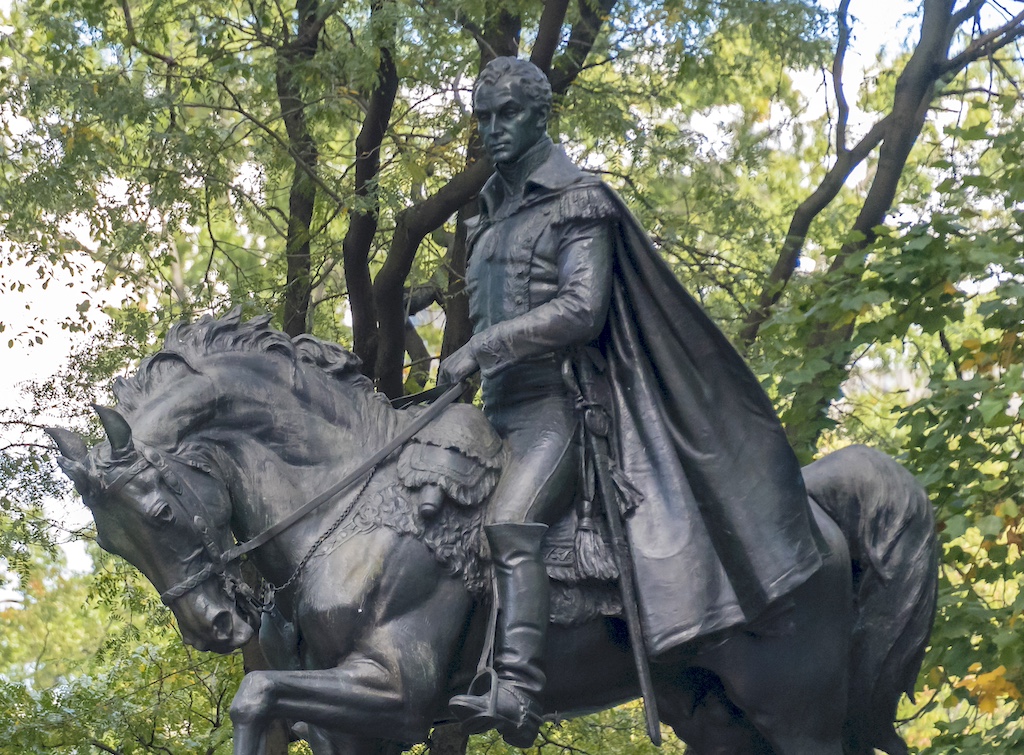
A statue of Simón Bolívar, one of the seven such tributes to Latin American leaders and liberators on the Avenue of the Americas. (Roberto Machado Noa / LightRocket via Getty Images)
On October 2, 1945, Mayor Fiorello La Guardia — whom Zohran Mamdani has consistently cited as his “all-time” favorite New York City mayor — signed into law a city council bill renaming Manhattan’s Sixth Avenue to the Avenue of the Americas. Weeks later, he presided over a grand renaming ceremony, flanked by flags from across the western hemisphere and joined by Chilean president Juan Antonio Ríos, who installed the new street sign himself.
Renaming Sixth Avenue was a hyperlocal policy, but it was designed with geopolitical intent. La Guardia was firmly aligned with President Franklin Delano Roosevelt not only in his domestic New Deal agenda but also with FDR’s progressive foreign policy vision for the western hemisphere. Dubbed the “Good Neighbor Policy,” FDR attempted to reorient US policy in the Americas away from its long history of overt military intervention and toward a vision of cooperation, trade, sovereign equality, and New Deal–style social democratic economics.
The policy intended to forge hemispheric unity in the global struggle against fascism, a cause in which La Guardia fervently believed. Indeed, in addition to his now celebrated anti-fascist radio broadcasts to Italy, La Guardia also had a radio program that aimed to counter German and Italian propaganda in South America.
Naturally, the Good Neighbor Policy was motivated in part by US national interests — strengthening trade relationships, expanding markets, and preserving US hemispheric “leadership.” But in its commitment to sovereignty and peace, it was undoubtedly also a step that moved forward away from the occupations, coups, and gunboat diplomacy of administrations past.
Even today, the Good Neighbor Policy remains shorthand for an alternative to the US domination of Latin America. Just this year, New York Congresswoman Nydia Velázquez introduced a bill to end the Monroe Doctrine and establish in its place a “New Good Neighbor” policy.
Won’t You Be My Neighbor?
La Guardia’s aim in pushing for the renaming of Sixth Avenue was to use his position as mayor of the “global city” to advance the Good Neighbor vision, particularly following the unexpected death of FDR earlier that year. At the renaming ceremony, La Guardia called the designation “an expression on the part of our people of the love and affection we have for our sister republics of Central and South America.”
He continued: “The Good Neighbor Policy has been talked about and kicked around for more than thirty years. But nobody took any action until the great President Franklin Delano Roosevelt.”
Following the renaming, the city affixed medallions featuring the coats of arms of the nations of the Americas to lampposts up and down Sixth Avenue. In the decades that followed, seven statues of Latin American leaders and liberators were added to the Avenue of the Americas — Simón Bolívar, José Martí, and José de San Martín at the point where the avenue meets Central Park; Benito Juárez and José Bonifácio de Andrada e Silva along Bryant Park; José Artigas in Spring Street Park; and Juan Pablo Duarte at the intersection with Canal Street — paragons of nineteenth-century nationalism, republicanism, and political independence. Juárez’s statue clasps a tablet evoking his famous aphorism: “Among individuals, as among nations, respect for the rights of others is peace.”
Over time, however, the symbolism of the Avenue of the Americas has largely faded away. Today few New Yorkers stop to inspect the recently restored medallions, let alone consider US hemispheric relations. Most simply refer to it as Sixth Ave. But as a mayor with La Guardia–like aspirations, Mamdani has an opportunity to revive its vision — and revamp it for the twenty-first century.
Soon after the renaming of the avenue, FDR’s prewar Good Neighbor Policy gave way to Harry Truman’s hard-line postwar anti-communism. Though the victims and rationales have shifted, the eighty years since have been consistently characterized by reckless US military, political, and economic coercion across our hemisphere.
President Donald Trump has taken this already egregious bipartisan consensus to new heights, attacking Venezuela and abducting its president, imposing a draconian fuel blockade of Cuba, threatening annexation of Canada and Greenland, launching a campaign of maritime killings near Caribbean and Pacific shores, pardoning Honduras’s convicted narco-trafficking former president, sanctioning a Brazilian Supreme Federal Court justice that dared oversee the prosecution of a Trump ally for plotting a coup, and much more. Mayor Mamdani has taken office at a time of outright assault on Latin American lives and sovereignty.
For América, Against the Donroe Doctrine
The mayor’s ability to directly impact US foreign policy is limited, of course, but there is power in shaping historical memory. It was not only La Guardia who recognized this; Mayor Ed Koch proclaimed Malcolm X Boulevard in 1987, and since 9/11, over 400 streets have honored fallen first responders. Place names, commemorations, and events, though symbolic, imbue our city with political meaning. Mayor Mamdani, as one of the most prominent US progressives, could revitalize the fraternal vision of the Avenue of the Americas and stand for hemispheric peace and unity in this era of the so-called Donroe Doctrine.
Mayor Mamdani also governs a city with a much stronger Latin American and Caribbean influence than La Guardia. In 1950, less than 5 percent of the city’s population was Latino. Today it’s nearly 30 percent. An additional 5 percent identify as Caribbean. A celebration of Pan-Americanism today is not just a foreign policy but a celebration of the largely working-class Latin American and Caribbean diaspora communities that have shaped the city — and helped elect Mamdani, from Little Haiti, Brooklyn, to Corona, Queens.
One opportunity to revive the spirit of the Avenue of the Americas arrives a year from today. Every April 14 is Día de las Américas, a largely overlooked day of commemoration of Pan-Americanism. Though the holiday emerged from a more problematic history — celebrating the founding of what would become the Organization of American States (OAS), which is today a vehicle for the projection of US power — the day itself can easily be recontextualized in support of a more progressive vision of Pan-Americanism.
On the next Día de las Américas, Mayor Mamdani could hold a public ceremony by the statues of Bolívar, Martí, and San Martín, paying homage to the avenue’s history. The Avenue of the Americas could be lined with flags from across the hemisphere — a far more visible display than the understated medallions.
While some countries’ national heroes are represented on the avenue, many still lack representation. The city could invite the respective consulates to include their own monuments along the avenue. Other options to celebrate the avenue’s history include the (admittedly overdone) parade, public concerts featuring music from across the Americas, or the temporary co-naming of cross streets where they intersect with the Avenue of the Americas (similar to how Mayor Eric Adams temporarily co-named thirteen streets after New York Knicks during their 2025 playoff run).
Mamdani also has access to a unique discursive tool that La Guardia did not: LinkNYC kiosks. Mamdani has already used these kiosks effectively to promote new policies and disseminate public service announcements. In celebration of Día de las Américas, the Mamdani administration could turn the more than forty LinkNYC kiosks on the Avenue of the Americas into tools for shaping historical memory, by displaying celebrations of particular historical figures from the Americas, adding color and context to the bronze statues.
In doing so, the administration — through the leadership of the Mayor’s Office for International Affairs and Office of Immigrant Affairs — could not only recommit to Pan-Americanism but also update its substance. Far from replacing revered figures like Bolívar and Martí, it is time to add to the pantheon for the new politics of a new century.
Building on the legacy of nineteenth-century liberators, Mamdani could commemorate leaders in the struggle for sovereignty, democracy, and a progressive vision for the working masses. While the existing statues depict mostly white elites of Spanish descent, new commemorations could also highlight black, indigenous, women, and working-class champions.
A New Hemispheric Pantheon
Of course, the city would need to make necessary diplomatic consultations and collaborate with the respective governments in question, but the following are some examples of figures whose celebration could advance a progressive vision of internationalism and anti-imperialism in the Americas:
Tecún Umán (Guatemala) — Tecún Umán was a leader of the K’iche’ people who died in battle against Spanish conquistadors in 1524. He was proclaimed a National Hero of Guatemala in 1960.
Dandara dos Palmares (Brazil) — Dandara was a leader and freedom fighter in the struggle to create and defend the quilombo of Palmares, an autonomous community of tens of thousands of self-liberated, formerly enslaved people in northeast Brazil.
Nanny of the Maroons (Jamaica) — One of the seven National Heroes of Jamaica, “Queen Nanny” was a revolutionary guerrilla Maroon leader who waged war against the British for over a decade. Unable to defeat her forces in combat, the British were forced to sign a treaty to end the war.
Micaela Bastidas Puyucahua (Peru) — Micaela Bastidas was an Afro-indigenous revolutionary commander in the revolts against the Spanish and the wife of fellow leader Túpac Amaru II. She was tortured and executed in 1781 after commanding thousands of troops in an anti-colonial rebellion against the Spanish Empire.
Bartolina Sisa (Bolivia) — Bartolina Sisa was an Aymara revolutionary who led many revolts against Spanish colonial rule together with her husband, renowned indigenous leader Túpac Katari. She was publicly executed on September 5, 1782, commemorated today as the International Day of Indigenous Women.
Joseph Chatoyer (Saint Vincent and the Grenadines) — Chatoyer (or Satuye) was a chief of the Afro-indigenous Garifuna people, who led rebellions against British colonial rule in the First and Second Carib Wars. He died in battle and is recognized as a National Hero of Saint Vincent and the Grenadines.
Toussaint Louverture (Haiti) — Born into bondage in the then-French colony of Saint-Domingue, Toussaint Louverture was the revolutionary leader and general of the Haitian Revolution that abolished slavery and liberated Haiti as the first sovereign black republic.
Bussa (Barbados) — Born free in West Africa, Bussa was abducted and enslaved in Barbados. In 1816, he died in battle leading the largest slave revolt in the country’s history and is now celebrated as one of the eleven National Heroes of Barbados.
Policarpa Salavarrieta (Colombia) — Policarpa Salavarrieta (also known as “La Pola”) collected intelligence for the revolutionary forces for Colombian independence. She was executed by Spanish colonial forces at just twenty-two years old.
Bernardo O’Higgins (Chile) — Bernardo O’Higgins was a Chilean revolutionary general, born of Irish and Spanish heritage, fought in the wars for liberation from Spanish rule. He is considered a founding father of Chile.
Francisco Morazán (Honduras) — Born in Tegucigalpa under Spanish rule, General Francisco Morazán dedicated his life to the unity of Central America as president of the Federal Republic of Central America. He was a liberal republican and progressive reformer, honored across the region.
Manuela Sáenz (Ecuador) — Manuela Sáenz was a feminist revolutionary leader who supported fellow revolutionaries Bolívar and San Martín in the liberation of South America from Spanish rule. She was posthumously awarded the rank of general and given a state funeral in Venezuela’s National Pantheon.
Ezequiel Zamora (Venezuela) — Ezequiel Zamora was the leader of the 1846 Venezuelan peasant insurrection and a central figure in the 1859–63 Federal War, in which he championed land reform and fought against the conservative oligarchy.
Juan Santamaría (Costa Rica) — Juan Santamaría was a laborer and drummer in the Costa Rican army who fell in battle defending his country from the invading forces of US mercenary filibuster William Walker. He was posthumously declared a National Hero of Costa Rica.
Paul Bogle (Jamaica) — One of Jamaica’s seven National Heroes, Paul Bogle was a Baptist preacher who led the 1865 Morant Bay rebellion, a key moment in the struggle for civil rights and justice for Jamaica’s working-class majorities against white colonial oppression.
Charlemagne Péralte (Haiti) — Charlemagne Péralte was a freedom fighter and guerrilla leader against the US 1915–34 occupation of Haiti, later ended by FDR. Péralte was assassinated by US Marines in 1917.
Emiliano Zapata (Mexico) — Emiliano Zapata was a leading figure in the Mexican Revolution who fought for land reform and the rights of peasants under the banner of “Tierra y Libertad” (Land and Freedom). He led the Liberation Army of the South, resisting both the federal government and other revolutionary factions, and was assassinated in 1919, becoming a lasting symbol of agrarian justice and revolutionary struggle.
Augusto César Sandino (Nicaragua) — Augusto Sandino was a guerrilla fighter and leader of an insurgency against the US military occupation of Nicaragua from 1927 to 1933. He was killed in 1934 by the forces of Anastasio Somoza García, whose family dynasty would go on to rule the country until 1979.
Anton de Kom (Suriname) — Born in Suriname in 1898, Anton de Kom was an anti-colonial leader and author before his exile to the Netherlands in 1933. After the Nazi invasion, de Kom fought in the anti-fascist Dutch resistance before his imprisonment and death in a German concentration camp.
Jorge Eliécer Gaitán (Colombia) — Jorge Eliécer Gaitán was a leader of the Liberal Party who championed social justice and the rights of the poor. He was assassinated in 1948 while running for president on a platform of economic populism, an event that triggered massive riots known as “El Bogotazo” and the spark for a decade-long civil conflict called “La Violencia.”
The Mirabal sisters (Dominican Republic) — Patria, Minerva, and María Teresa Mirabal were three sisters who became prominent pro-democracy activists against the US-backed dictatorship of Rafael Trujillo. They were assassinated by Trujillo’s secret police on November 25, 1960, a date now recognized by the UN as International Day for the Elimination of Violence Against Women.
Óscar Romero (El Salvador) — As the Archbishop of San Salvador, Óscar Romero became a leading advocate for social justice and human rights in the context of a civil war that pitted left-wing guerrillas against US-backed military and paramilitary forces. He was assassinated while celebrating mass in 1980 by a government-aligned death squad.
José Alberto Mujica (Uruguay) — José “Pepe” Mujica was a guerrilla fighter with the Tupamaros National Liberation Movement who was jailed and tortured by the US-backed military dictatorship in the 1970s and 1980s. After the return to civilian rule, he was elected president of Uruguay in 2010, enacting progressive social reforms and earning widespread admiration for his humility and austere lifestyle.
Mayor Mamdani has limited options at his disposal to influence US foreign policy. He is also, understandably, prioritizing delivering on his promises to materially improve the lives of working-class New Yorkers over the waging of discursive battles. But as La Guardia showed, the mayor of the City of New York still has a role to play in shaping the popular narrative in the country’s largest city. One year from today, Mayor Mamdani has a chance to do just that, by recommitting to and reinventing La Guardia’s symbolic push for a hemispheric politics based in peace, prosperity, and sovereign equality. In the era of the Donroe Doctrine, he would be remiss not to.