Crypto Is Flailing

Donald Trump used the White House to pump crypto to unprecedented highs. It’s still collapsing.
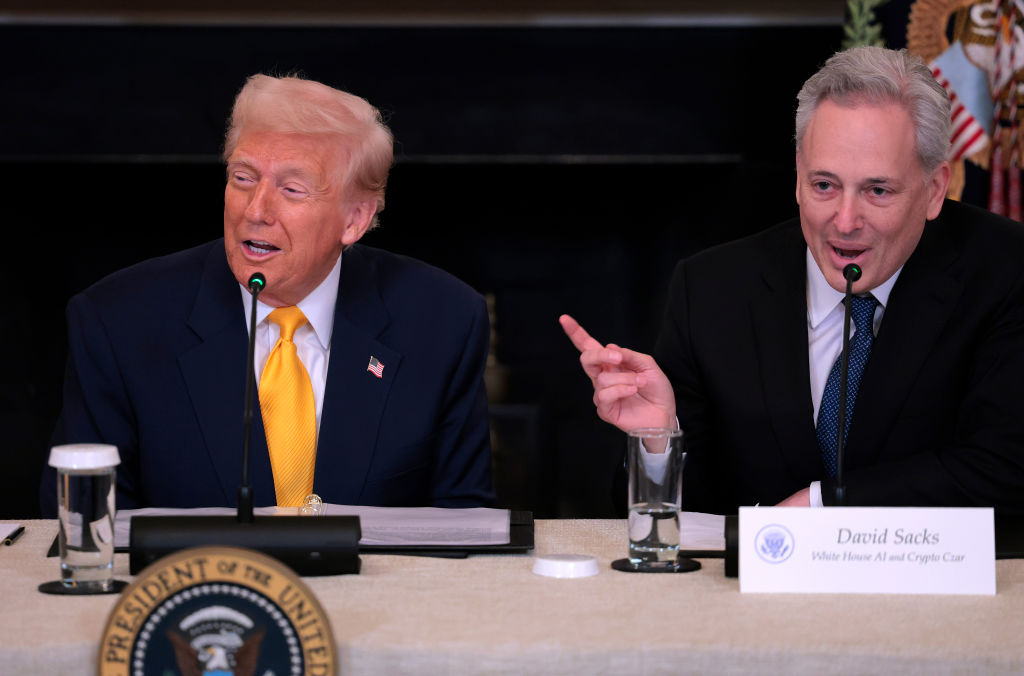
The Bitcoiner in chief cleared the path for crypto with a machete, pumping a wild bubble that is now popping. But don’t let the roller coaster fool you: rewriting the rules of finance will have long-lasting and dangerous consequences. (Anna Moneymaker / Getty Images)

It feels like just yesterday when crypto markets last crashed hard. Back in 2022, what had been a wildly careening celebrity- and media-fueled hype train suddenly was a smoldering wreckage. Those were the days of Sam Bankman-Fried’s fraud-riddled FTX exchange, which went belly up along with a slew of other big crypto projects. The price of Bitcoin, the largest and most trend-setting of thousands of cryptocurrencies, dropped from its high of over $64,000 in 2021 to barely hitting $17,000 by 2022’s end. Along with Bitcoin, all things crypto sank.

It felt at the time as though we all awoke from a bizarre collective dream in which mass-produced JPGs of cartoon monkeys had sold for prices that rivaled those of an average home, and trading made-up digital tokens on your phone promised to deliver unthinkable riches for the brave of heart. In the wake of crypto’s crash, most people preferred to tune out anything that included words like “blockchain,” “NFTs,” or “Bitcoin.” Even when prices for crypto recovered in 2024, the cringey backwash of 2022 clung on within mainstream public opinion.

And then came Donald Trump.

Trump returned to the White House with a promise to make crypto great again and the United States “the crypto capital of the world.” The crypto industry, in a coming-of-age moment, lavished the aspiring Bitcoiner in chief and other crypto-friendly candidates with mountains of cash during the 2024 elections, organizing the most aggressive fundraising operation it had marshaled yet. According to Public Citizen, nearly half of corporate contributions in that year’s cycle came from the crypto lobby. On the campaign trail, Trump responded in kind and, as a new crypto convert, pledged to help Bitcoin prices “skyrocket like never before.”

The newly forged Trump and crypto-capitalist alliance paid off handsomely for the industry and, predictably, to the Trump family.As of January, the Trump family fortune grew by more than $1.4 billion from its crypto empire, which crisscrosses the digital markets landscape: from TRUMP and MELANIA “memecoins,” to non-fungible token (NFT) Trump trading cards, to a Bitcoin mining company, to the World Liberty Financial crypto platform (including its own WLFI token and USD1 “stablecoin,” both among the top forty cryptocurrencies by market capitalization)

Using his position as the most powerful (and least accountable) politician in the most powerful nation in the world, Trump made quick work of defanging an already barely regulated industry. The president pardoned high-profile crypto criminals (mostly those that invested in his crypto projects), pushed a series of pro-crypto bills in Congress, and announced the creation of a government Strategic Bitcoin Reserve, while his regulatory appointees dropped every major crypto-related investigation and lawsuit meant to rein in fraud, market manipulation, money laundering, sanctions violations, and other basic securities violations.

With regulatory doors flung wide open, crypto was poised to become mainstream and be adopted by the same financial institutions that the crypto movement once claimed to rebel against. Money was flowing into crypto, and prices were booming. Bitcoin prices peaked at an unthinkable $126,000 last October. The size of the crypto market ballooned from a capitalization of $1.7 trillion at the end of 2023, to $3.5 trillion the following year after Trump’s election. It broke the $4 trillion mark by September of 2025.

But four months later, despite having thrown everything but the kitchen sink to power a crypto boom, the market shrunk back to just over $2 trillion. Bitcoin fell to half its peak and is now fighting to clear the $70,000 mark. Despite no-holds-barred boosting from the world’s most powerful and brazen politician, crypto is flailing. What happened?

What Goes Up Must Come Down

Crypto prices first began their recovery in 2024, before Trump returned to the White House. This was largely because President Joe Biden’s Securities and Exchange Commission (SEC) had already approved of a trendy Wall Street instrument called exchange-traded funds (ETF) to include Bitcoin and another major cryptocurrency, Ether. ETFs are funds run by asset managers like BlackRock or Fidelity that hold a basket of underlying assets. They issue shares of those funds, which track the value of their assets. In the case of Bitcoin and Ether ETFs, investors gain exposure to crypto price movements without having to set up crypto “wallets” and buy the digital assets themselves.

Wall Street loved it. But ordinary Americans were exposed to them, whether or not they knew it. Nearly a dozen US pension funds and at least a couple of state pensions have invested in crypto ETFs, binding the financial health of millions of working people to the volatility of the crypto markets. Crypto ETF growth drove demand for Bitcoin and Ether and pushed the rest of the industry along with them.

Once in office, and with Wall Street’s entanglement with crypto by now growing, Trump intervened to clear the industry’s path “to the moon” through legal legitimization and deregulation. Crypto companies and traditional financial institutions partied like it was 1929.

The Trump-crypto bloc used three major prongs to get there. First, by issuing pardons and throwing out every major lawsuit and investigation, Trump did more than signal to crypto criminals that they need only drop hundreds of millions of dollars to curry his favor. He also signaled to the whole crypto industry that anything goes, and to banks and traditional finance that they can feel free to play in crypto’s murky waters without worrying about legal consequences.

Second, Trump’s SEC reversed course from Biden’s and recently declared that crypto tokens and assets are definitely NOT securities (tradable financial instruments) — and therefore cannot be regulated as such. (Their all caps, not mine.) Defining tokens as securities had been the linchpin of previous attempts to begin to regulate a thoroughly unregulated field. Now reversing this position essentially gave the message that crypto is “not the SEC’s problem.” The rules that apply to the rest of capital markets don’t apply here.

Last, Trump leaned on Republican lawmakers to draw up legislation (allegedly with middle-of-the-night phone calls) — pulled directly from industry white papers and finessed with closed-door meetings with crypto leaders — to “future-proof” the regulatory about-face. The Guiding and Establishing National Innovation for U.S. Stablecoins (GENIUS) Act, passed last summer, enshrines the nearly $300 billion worth of crypto stablecoins as legally recognized, privately issued currency, operating with minimal oversight.

The Digital Asset Market Clarity (CLARITY) Act essentially does the same for other cryptocurrencies. It provides carve-outs to crypto tokens, crypto exchanges, crypto advisers, and crypto funds and portfolios from all existing major securities laws. The CLARITY Act is currently being held up while the crypto industry and banking industry fight over how far stablecoins can go. Coinbase CEO Brian Armstrong scuppered negotiations, and after he met with the president, Trump took to Truth Social to berate the bankers as well.

Trump couldn’t take total credit for his midnight calls creating congressional compliance. According to FinTech Weekly, “Seven of the forty-six senators currently sitting on the two Senate committees with direct control over the CLARITY Act received a combined $265,500 in direct contributions from individuals employed at or affiliated with crypto companies during the 2025-2026 cycle,” including the CEOs of Coinbase, Ripple, Kraken, and founders of Blackstone.

This all pales in comparison, though, to the money poured in by Fairshake, the crypto super PAC, which has already spent an unprecedented $271 million on the 2026 midterm elections — delivering a not-subtle message to legislators about what will happen if they don’t toe the crypto line.

And yet, with all the might of the White House and billionaire crypto capitalists flexing, the markets are flailing.

The increased participation of traditional finance turned out to be a double-edged sword. Just as quickly as investor cash can flow into the market, it can flow out. And institutional investors, at first sign of market retreat, always dump their riskiest assets (i.e., crypto) first. Beginning last fall, a combination of fears of tightening Fed rates, Trump’s tariff shocks, and war with Iran spooked Wall Street. In early February, investors yanked roughly a billion dollars from ETF funds in one week alone.

The sudden collapse undermined the crypto narrative that it was on an unstoppable flight to the moon, and that Bitcoin in particular was like a “digital gold.” Maja Vujinovic, CEO of digital assets at FG Nexus, told CNBC: ”[The] straight line bull run that a lot of people expected hasn’t really materialized yet. Bitcoin isn’t trading on hype anymore; the story has lost a bit of that plot. It is trading on pure liquidity and capital flows.”

In other words, gone are the days when celebrities could be counted on to whip up extra hype every time the market flags. The crypto market, instead, is dependent on institutional capital flows.

But outside of crypto’s extreme price cycles lies a more long-term and dangerous consequence. The partnership between Trump and the crypto industry is not just one of extreme moneymaking and grift (although it is both). The alliance more dangerously solidified a power bloc of anarchocapitalists, Silicon Valley venture capitalists, and Trump’s burgeoning authoritarian state. Crypto creates easy avenues for that alliance to grow in opaque ways, with the president’s sundry crypto projects giving any criminal or foreign interest that cares to invest in them special access to the president.

That bloc is legitimizing a parallel, almost completely unregulated, financial ecosystem, even more shadowy than Wall Street’s current very shadowy banking system. That legitimacy has the potential to create an even greater proliferation of stablecoins, holding billions — perhaps trillions — of Treasury securities to back their reserves. If those stablecoins collapse, as unregulated financial bodies in particular have a habit of doing, their issuers would need to to sell off high volumes of securities, destabilizing markets.

If the crypto market continues to collapse, Wall Street and their political cronies will lose interest, and the shadowy ecosystem will idle, at least for the time being. But even so, as long as the legislation and regulatory capture continues, crypto will use the new legal framework currently being put in place and pick up where it left off if at the next wild boom.