Capitalist Profits Depend on Stealing Our Future
Capitalists have succeeded in arranging the future as a calculable source of extraordinary wealth, enriching a few in the present by imposing debts on the vast majority — and undermining the environmental conditions for a better tomorrow.
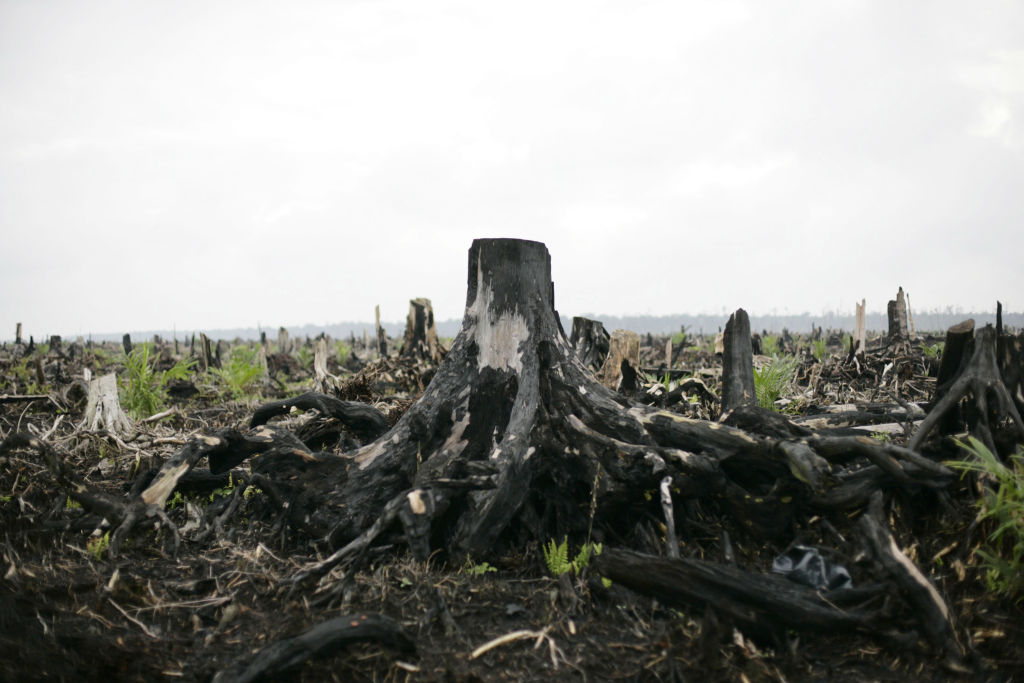
Capitalist profitability increasingly depends on the extraction of value from the future, whether that takes the form of burdening ordinary people with debt or imposing severe ecological costs on coming generations. (Dimas Ardian / Getty Images)
We live in an age in which extraordinary wealth seems to arrive from unfathomable sources. When the US firm Uber went public in 2019, the stock market set its value at $82 billion, an immense figure for a ten-year-old car service company that owned no cars and had never made a profit. To explain such events, the news media often turn to metaphors from meteorology, describing the investors’ gains as “stratospheric.” What other way to explain, for example, how the $5 million that Goldman Sachs had invested in Uber in 2011 was now worth over half a billion dollars, a return in eight years of more than 1,000 percent? More critical commentators called the firm’s value something conjured out of “thin air.”
The source of such windfalls is nothing meteorological. To understand this way of making money we need to come down to Earth.
While Uber is an extreme case, its mode of acquiring unearned wealth is commonplace. The mode is a defining feature of our contemporary form of life, a key to understanding how and why the methods of enrichment and impoverishment we call capitalism came into being, and a clue to grasping why we now face the catastrophe of climate collapse. The company created its value by constructing a practical means of consuming the future.
Methods of extracting income from the future have been around for a long time. The device that Uber used, the joint-stock company, has existed in its current form for more than 150 years. Modern investor-owned firms first proliferated in the West in the nineteenth century to construct railways and other extended, terraforming, carbon-intensive, often imperial structures whose scale and durability, usually built at great ecological and human cost, promised their shareholders access to unearned wealth from the future. The history of joint-stock companies goes back even further, to the armed trading corporations that European merchants began creating some three centuries earlier to conquer world trade, enabling them to colonize lands and subjugate or eliminate peoples across the earth.
In the past, such methods of enrichment were usually the exception. Joint-stock companies could be established only by royal charter or act of Parliament, the charter typically expiring after a limited number of years. The early colonizing corporations led to speculative bubbles and the burdens of imperial war and were liable to political opposition, closure, public rescue, or collapse. The older merchant networks of Asia and Africa that European colonization sought to usurp, in particular those of the Indo-Islamic world, had placed limits on the use of business contracts for acquiring unspecified, unseen future goods, on the grounds that such speculative schemes allowed one party to extract unearned profit from another.
Even so, long-distance trade across that world was routinely conducted on credit, the distance creating a delay in payment that justified a higher price — distance and delay thus operating as the very source of profit. Islamic legal practice also recognized arrangements that allowed merchants to profit from the speculative purchase of future assets, such as the widespread use of forward contracts to acquire agricultural crops cheaply in advance, from those compelled to find funds to pay taxes. But the futures from which surplus was extracted were limited by the length of the crop cycle or the extent of a transregional trade route. With the colonial expansion of the West, and especially from the imperial age of the late nineteenth century, the investor-owned corporation became a means of controlling futures across continents and reorganizing livelihoods and landscapes on an immense scale.
Today a firm like Uber works through somewhat different methods but has a similarly expansive ambition. Following its stock market launch in 2019, the company borrowed $3 billion to purchase the Dubai-based firm Careem, in an effort to monopolize the car service business across the Middle East and North Africa — part of a plan to dominate transportation services on every continent. The geographical expansion of such firms, both past and present, serves as, and at the same time conceals, the source of their investors’ wealth. What they seek to control is the acquisition of revenue from the future.
We have an everyday language for describing our economic relation to the future, using terms like stock price, interest rate, the advance of technology, and economic growth. But none of these terms explains the source of unearned income, to show how those coming later pay the bill. Nor do they explain how lives in the present are encumbered by previous extractions from the future or how such privatized relations to the future, in which tomorrow’s forms of life become assets bought and sold in the present, contribute to the destruction of a viable collective future. In fact, the language of finance blinds us to this relationship, persuading us that future human livelihoods are not the source of the gains but their beneficiaries.
In the face of the climate crisis and other anthropogenic disruptions to the balance of earth systems, including the destruction of river basins, the collapse of habitats, the accelerating extinction of species, and the poisoning of land, sea, air, and human bodies with synthetic plastics and agricultural biocides — and aware of the very unequal vulnerability of different human communities to these disruptions — we need to understand how this blindness is produced. Having already exceeded safe and just limits to the human modification of the earth, we are seeing everywhere a belated acknowledgement that the future livability of the planet must today be taken into account.
So we coexist with two contradictory ways of grasping the future in the present: one apocalyptic, recognizing in current disasters and disruptions the immediate signs of a catastrophe to come; the other a mechanism of blindness that has brought the calamity upon us, by arranging the future as a calculable source of extraordinary wealth, enriching the wealthiest in the present by imposing debts on the vast majority. Governments appear unable to take account of this contradiction, while their actions often seem to be powerless against the agents seeking the further control of future assets, or to be working on their behalf. Even if it were possible to overcome these difficulties, the consequences would still seem unworkable.
Capitalism, whatever its costs, claims to have given us growth. How could we survive under a different temporality, in which the future was not defined by a principle of economic expansion?
For as long as we have organized collective life around the principle of economic growth, there have been efforts to point out its limits: that growth is unsustainable, is mismeasured, or comes at too great a social and ecological cost. Those are important criticisms, but there is another way to see our relation to the future. Growth is not the logic of capitalist modernity but its alibi.
Value Over All
Capital is not something saved up from the past. As others have shown and this book will further explore, it is a capture from the future. We can start thinking about this relation to the future through the straightforward case of the way a modern shareholder-owned firm acquires its value. When a company is floated on the stock market, the shares offered for sale represent a claim on the ownership of its future profits. Since the revenue is not available immediately, the value of each year’s prospective income is adjusted downward, or “discounted,” to compensate for the delay in time until it arrives. Adding up the “present discounted value,” as it is called, of the years of future profits, produces the firm’s valuation.
Let us return to the example of Uber. At the time the firm went public, Uber had not yet made a profit. The company had been setting the price of car service rides below their actual cost, to drive competitors out of business. These subsidized operations were losing billions of dollars every year. To value the firm, financial analysts assumed that Uber would continue to expand until it achieved “market dominance.” By eliminating alternatives, Uber and its one US rival, Lyft, could continue to claim a portion of every fare their drivers earned, taking on average a 20 percent share, while using their growing dominance to limit the part paid to drivers and increase the cost to passengers. These assumptions suggested that Uber would stop losing money six years after turning public and, within ten years, would be earning annual profits of almost $5 billion.
An investor-owned company provides not just a claim on future profits. It is a mechanism for acquiring that promised income in the present. In offering shares for sale on the stock market, the investors who own a firm are selling a form of property, the ownership today of assets acquired from the future. This is the process known as “capitalizing” a future revenue. The windfalls the promoters earn from the sale come not from thin air, but from the political robustness of capitalization — the method of monetizing and marketing a private claim to the future. The term “political robustness” here refers to all the forms of authority, law, policing, economic reasoning, and disregard of claims for social justice or planetary futures on which the extraordinary value of a future claim depends.
The windfall represents the value of an encumbrance imposed on the firm’s future customers and workers and on the communities and ecologies to which they belong. The company’s profits, and thus its shareholders’ dividends, depend on maintaining and indeed increasing this burden. The value of the share, and the dividend on which it depends, takes priority over any demand from workers for fairer wages, from customers for lower prices, or from communities for the protection of common goods — a priority that reflects the greater strength of the company compared to its workers, customers, and communities. This strength is the power indicated by the misleadingly narrow term “market dominance.” The encumbrance is not a necessary cost of running a business but a surcharge that the dominant position of the company allows it to impose. The $82 billion valuation of Uber represented the present value of such a power arrangement. The firm’s drivers and passengers, and the wider populations affected by its impact on public transportation and other collective goods, would repay this value, over time, from their pockets.
The shareholder corporation is thus an apparatus for colonizing time. It provides a means of enriching a group of entrepreneurs and financiers in the present by imposing an additional charge on tens of millions of users in the future. The windfall acquired today by those who set up the control mechanisms and arrange the credit lines out of which the apparatus is built will be paid from the incomes of those living months, years, or decades from now — in fact, as far into the future as the apparatus of capture can be extended.
Besides enriching its founders, the shares in a business firm can also provide a source of gain to the retail investors and investment funds that purchase and trade them, to those who charge fees for such trades, and to those who speculate in the rise and fall of their price. Indeed, as the extractions imposed on future incomes increase, even the moderately well-off turn to these modes of capture, relying on private retirement funds, property investments, and other appreciating assets to protect their standard of living. This compounds the imposition of costs on the future, in particular upon those increasingly unable to purchase housing or other assets.
Nothing about this capture of the future is unique to the contemporary era of tech firms, venture capital, and asset-management companies. For centuries before the rise of modern business firms, there were means of placing populations in debt, typically through merchants providing credit to those experiencing sudden hardship or burdened with tax obligations. But merchants’ profits arose more often from taking advantage of differences in price across geographical space than from the temporal postponement on which capitalization depends. The scale of encumbering the future is more recent. When the modern corporate method of capturing revenues emerged over the last century and a half, the shareholder corporation quickly became what the great Norwegian American economist Thorstein Veblen called in 1923 “the master institution of civilized life.”
There are other methods of extracting payments from the future, and of living under the weight of past encumbrances. When colonizing corporations began to provoke colonial warfare, the monarchs who chartered them drew on credit from the same large merchants to fund the costs of war, creating ruinous public debts. The cost of war was repaid not from current revenue, as rulers had done in the past, but by pledging the tax revenue of future years, creating what became known as the national debt — inventing, in the process, the modern “nation” as the body accountable for this imposition. Government bonds and other kinds of public debt became the largest instruments of credit creation, turning the power of taxation into an expanding apparatus for extraction from the future.
Militarism continues to be a principal means in many countries of forcing populations into long-term debt, shrinking the share of public resources available to maintain health care, education, and other common benefits. In many parts of the Global South, the forms of national debt, swollen by dependence on international creditors, both recently and in the colonial past, have repeatedly turned countries as a whole into debt machines, enriching those who organize the supply of credit.
While military debt, foreign loans, and corporate stock markets impose costs on a population in general, there are numerous devices for creating encumbrances on specific individuals and households. About a decade after Veblen wrote about the shareholder corporation, a second “master institution” emerged for realizing future revenue in the present: the mortgage bank and the housing market. Little used in the United States, Britain, or elsewhere before the 1930s, home mortgages converted housing into another widely used mode of capitalization. In many countries of the South, they are still used sparingly today, although strangely, turning land and housing into financial assets has been touted in recent decades as a magical solution to global poverty.
The speculative development of housing has a much longer history, especially in countries like England where the land for urban expansion was often monopolized by large private estates. But new housing was typically leased or rented, with the lease of the building calculated separately from the lease of the land, and based simply on the cost of construction. Housing mortgages (loans secured by the property) were not widely used, typically covered less than half the value of the home, and were usually paid off in a lump sum after a handful of years. The invention of long-term mortgages in the West, in the years before and after World War II, subsidized with government guarantees and repaid in monthly installments over decades, transformed housing into an expanded apparatus for the capture of payments from the future.
Speculative builders could now sell homes not at the cost of their material construction but at the capitalized value of occupying a residence over thirty or more years. In the second half of the twentieth century, as housing became by far the largest vehicle of assetization and debt across the North Atlantic world, between 75 and more than 90 percent of the increased price of housing was attributable not to the cost of construction but to this mode of capitalization.
As the price of housing began exceeding the cost of construction by a large factor, the real estate and mortgage industries grew to rival the joint-stock corporation as apparatuses for indebting the future and capturing a prospective revenue in the present. This unearned increment led a New York architect to describe a new building as “a machine that makes the land pay.” The idea of a payment for land reflected the fact that the increased cost of housing appeared as the higher value of development land, even though the value came not from any change in the nature of land but from the enhanced mechanisms for securing decades of prospective rent and mortgage payments, including the machinery of zoning, racial segregation, and foreclosure. The cost was charged even for a used property whose land purchase and production expense were paid off many years before. The payments came not from the land but from those needing a place to live or work.
The profits of banks and property firms thus added an extraordinary financial burden on the incomes of ordinary people. In later decades, the automobile loan, the credit card, the college education, the medical bill, and many other devices emerged for converting the course of human lives into repayment schedules.
Today almost any arrangement of prospective payment can be capitalized. Any encumbrance reliably placed on the future becomes an asset that is open to being bundled, marketed, and acquired in the present at a discount, from corporate shares and bonds to credit card debt, from housing rents to infrastructure fees, from water and electricity supplies to data streams, from trading platforms and cloud services to musical and writing royalties. Sold at a discounted price to investors and often traded in secondary markets, the payment stream then carries the burden of repaying this advance at full price, creating an unearned increment that the investor enjoys as “interest.” The burden of capitalization is not simply a charge added to the cost of capital or to the value of an asset. Capital itself comes into being through this process — not as an asset saved up from the past, as we usually imagine, but as these mechanisms of extraction from the future.