Conrad Blackburn, a Socialist to Represent Harlem in Albany
Socialist, trade unionist, and candidate for New York State Assembly Conrad Blackburn: “If you are taking money from real estate developers, then your first instinct is to deliver for those real estate entities, not the people.”
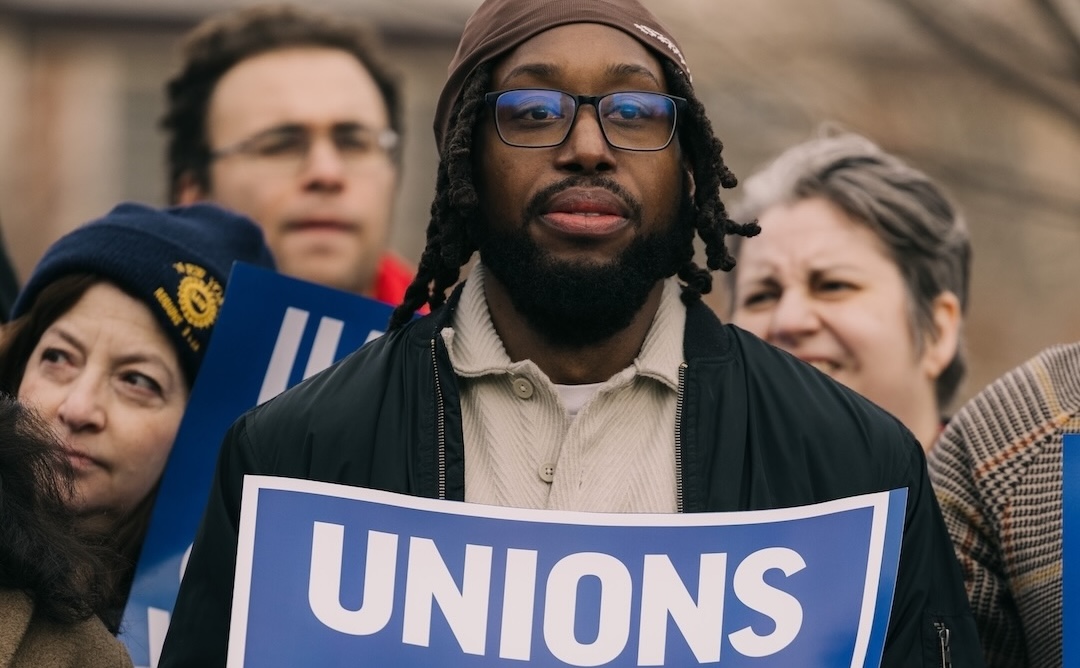
Socialist New York State Assembly candidate Conrad Blackburn: “Why don't we build people up instead of throwing them in jail and breaking them down?” (Courtesy of Andrea Guinn)
- Interview by
- Peter Lucas
After propelling its first two members to public office in districts in Brooklyn and Queens and a part of the Bronx a decade ago with Julia Salazar and Alexandria Ocasio-Cortez, the New York City Democratic Socialists of America (NYC-DSA) chapter has elected ten additional members into city and state office and brought two already elected city council members into the organization. But the organization has yet to win a seat in Harlem.
Conrad Blackburn, a public defender and trade unionist with the United Auto Workers (UAW), is trying to change that. Blackburn, who has been endorsed by NYC-DSA, several of its elected officials, and other progressive groups, is running for New York State Assembly District 70. The district, which is facing an acute crisis of displacement and poverty, has long been occupied by a more moderate part of the New York Democratic Party; it is currently represented by Jordan Wright, whose father Keith held the seat for over two decades.
In 2018, Blackburn moved to New York City to work at The Bronx Defenders, a nonprofit providing legal services for poor people. Frustrated by low wages and a lack of workplace freedoms, he and his coworkers organized a union in the spring of 2020 as a part of the Association of Legal Aid Attorneys (ALAA), a part of UAW Region 9A. A couple of years prior to that, living in Brooklyn for the summer with his family while he studied for the bar exam, he discovered Salazar’s campaign and by volunteering to canvass for her was introduced to DSA.
Jacobin contributor Peter Lucas sat down with Blackburn to discuss the similarities between his upbringing in the South and the current political realities of Harlem, the consequences of corporate negligence in working-class neighborhoods, and suing Eric Adams.
Peter Lucas
Can you tell us a bit about your background?
Conrad Blackburn
I am originally from Florida. I was born in Miami, but my middle and high school years were in Tallahassee. Both my parents immigrated from Jamaica, but my dad left my family when I was five or six years old. I lived with my mom and my little sisters in a single-parent household. We grew up poor. We lived in the projects.
I was fortunate enough to do well in school growing up. I was in classes with a lot of upper-middle- and upper-class children. I was often the only black kid in my classes. When I would visit my classmates’ homes after school, not that far from where I lived, I’d see the big, fancy houses they lived in with both parents. They had food. They had everything that you could ever want. And then, I would go home and see all the things we didn’t have.
We struggled to get food. Sometimes I ate rice-and-ketchup sandwiches for lunch; sometimes I ate bread and butter for dinner. Electricity was not always there. We occasionally had to live without the lights. We would have to boil water to get hot water at times.
I started working at a young age, maybe thirteen or fourteen, just so my mom wouldn’t have to worry about me having some pocket change to ride the bus or get lunch. Growing up in the projects, I was routinely harassed by the police. Walking to school or around the neighborhood, cops would stop me and search me unconstitutionally. They wouldn’t find anything, but they wanted to strip me of my dignity. I never let that happen. I grew up next to people who were drug dealers and made money in other ways in the projects. I saw a lot of destitute poverty.
My mom often struggled to pay our bills. I remember the first time when I realized what it meant when my mom would pick up an envelope and begin to cry. It pained me to see my mother cry over bills, and that was the first thing that radicalized me. I didn’t want to see my mom hurt in that way, and I knew I wanted to do what I could to make sure my mom would never cry again.
Peter Lucas
Do you see a common thread in the struggles that you faced in the South reflected in Harlem?
Conrad Blackburn
I see a lot of the same issues. It boils down to our ability to live a dignified life and all of the oppressive forces — from the state to big developers to corporations — stripping us of that dignity. There are similarities in exposure to pollution and overpolicing. The housing situation is dire here, the same way it was in the hood in Florida.
Many apartments in Harlem are like shoeboxes. When I lived in the South, our place in the projects couldn’t have been more than six hundred or seven hundred square feet. It would take an eternity to get anything repaired by the building. Growing up, they tried to paint over the outside of the building sometimes to cover up the disrepair, like putting a Band-Aid on a stab wound. In Harlem, if you need to make a repair on your apartment, it takes a long time and is often insufficient. Knocking doors for this campaign, we have encountered people who are heating their homes with their stove, because their boiler has been broken for days.
Peter Lucas
How is your campaign reaching these voters? Are you doing something different, as opposed to what you might see in a traditional campaign?
Conrad Blackburn
I am first and foremost an organizer, and I would take that approach in office. In this campaign, we’re not just knocking doors and asking people to support us. We’re knocking doors and asking people what they need.
The most common issue is housing-related: rent, repairs, utilities, and so on. When I met the gentleman who was heating his house with a stove, I asked him: Have you talked to your landlord? Obviously, that’s the first thing you’re going to do if you have an issue. But that doesn’t mean the landlord is going to respond or actually address the problem. Asking this opens the conversation up to further questions like: Have you talked to anyone else in your building? Are they having the same problems? Have you guys made a plan to come together and collectively do something to get your landlord to act?
I often hear that it’s difficult to rely on other people; it’s hard to get them to actually follow up. I get it. Because so many people have to fight so many struggles, they’re too burdened to even think about trying to band together with their neighbors to fight against their landlord.
After these conversations, we put anyone that we encounter having an issue like that in touch with the tenant organizers on our team. The plan is to eventually have the organizations that our tenant organizers work with organize the buildings and lead know-your-rights trainings.
It is a methodical approach to raising people’s collective consciousness, to get them to see they are more powerful together, that they don’t have to accept defeat or accept the fact that landlords are not going to resolve their issues. They can organize collectively and fight.
Peter Lucas
You mentioned the environmental issues facing Harlemites. On your platform, you address business pollution in your “community protection” plank, which isn’t often associated with that.
Conrad Blackburn
I try to include a lot under the umbrella of community protection. Community protection is about protecting the community from things like an abusive police force, the criminal punishment system, and Immigration and Customs Enforcement (ICE). But it’s also about protecting the community from predatory corporations that buy a building to evict all of the tenants, so that they can knock it down to build a new high-rise where they can charge more exorbitant rent, and then in the process of constructing that new building, engage in a level of negligence that leads to things like Legionnaires’ being spread.
This past year, seven people died, and more than a hundred got sick in Harlem after contracting Legionnaires’ disease, and the biggest source of it was a construction project near Harlem Hospital. Legionella developed in the water in the cooling towers for the HVAC systems after proper testing and maintenance protocols were not followed and then spread into the air, making it toxic to live or work by the hospital.
It’s not the first time Harlem has had a Legionnaires’ outbreak, and there’s been another outbreak since. Last month, another outbreak, this time on 3333 Broadway, was confirmed. We live with the fear of our water having legionella in it because of this. If you knock on doors in this district, people will tell you that sometimes when they turn on their faucet brown stuff comes out. So community protection has to include protecting our neighbors from the corporations that dirty our water or air. I want to hold corporations accountable for this sort of negligence.
Peter Lucas
Harlem has a rich political history. How do you situate your campaign in the context of Harlem’s often-radical politics?
Conrad Blackburn
One of the main things that originally attracted me to Harlem is that my politics were formed by the radical leaders of the past in this neighborhood, who led the civil rights movement — people who were fighting for black liberation. And there was an understanding that in order for black liberation to actually hold, we have to fight a class struggle together.
Malcolm X, A. Philip Randolph, Ella Baker — all black socialist leaders — these were the people that were forming and fomenting radical political activism in Harlem. They were all talking about the class struggle being the foremost struggle that leads to everyone being able to lead a life that is dignified.
Peter Lucas
There’s also a history of political establishment in Harlem. You’re running against a political family: Keith Wright held this seat for twenty-four years and his son, Jordan, has represented the district since 2024. What is the political establishment in Harlem like?
Conrad Blackburn
The establishment’s whole goal is to build and conglomerate power for themselves. They want to continue their family legacy and have their names etched in Harlem history. In that pursuit, they are leaving the community behind, as they court money from interests that are not aligned with the people of Harlem. If you are taking money from real estate developers, then your first instinct is to deliver for those real estate entities, not the people. Listening to those moneyed interests has led to displacement, to Harlemites living a less dignified life.
Displacement is the number-one issue in this community. It is this stripping away the rich history of culture and arts and music and food in Harlem.
Peter Lucas
The broader New York political establishment has attacked socialism and DSA, in particular around the question of identity. What do you make of these criticisms?
Conrad Blackburn
It’s ironic they attack DSA for being a gentrifier organization, but DSA has never run a race in Harlem. Darializa Avila Chevalier and I are the first socialists to run in this district. It’s ironic that the machine would say that DSA is a gentrifying force when there are people who have been in power for decades, overseeing an extreme amount of displacement and gentrification in Harlem, because of the policies they endorse, on account of the special interests they are courting.
Part of why they feel they can make that attack is because DSA is an organization that does have a lot of white people. But there are not only white people in DSA. There have been people of color doing amazing work in DSA for years. Nearly all of NYC-DSA’s socialists in office are people of color. The attacks that they’re making ultimately just don’t ring true. It is incumbent on DSA to build power in Harlem, and that’s exactly what I hope this campaign does.
Peter Lucas
How did you come to join DSA?
Conrad Blackburn
In 2018, when I first moved to New York after law school, I lived with my aunt in Brooklyn for a summer to study for the bar. I didn’t know anyone in New York other than my aunts and my family that lived here. It was the same summer that Julia Salazar was running her first campaign for state senate. Seeing somebody openly running as a socialist for a state office was inspiring, so I volunteered. That was my introduction to DSA.
But originally, my conception of DSA was that it was a white-led organization. As someone whose politics are rooted in a black radical tradition, I did not look behind the veil to see what was going on internally in DSA for a long time. But I kept hearing about all of the amazing socialists that they were able to elect to office. I continued to pay attention to what was going on in DSA, supporting socialists who were running for office in the ways that I could.
It wasn’t until later that I got a better sense of the organization. I signed up to be a member; I started going to meetings. I attended the endorsement forums and saw DSA’s democratic process in action. It reminded me of my union, and in seeing that, it clicked for me. I was like, okay, this is great, this is my political home. This reminds me of my union — how democratic it is, how member-led it is.
Peter Lucas
How did you get involved with the UAW?
Conrad Blackburn
I got involved with the UAW through organizing the union in my office. I work at a public defense organization. In my second year working there, a few of my close friends and I got together. We talked about how we were living paycheck to paycheck and couldn’t make ends meet. We didn’t have the protections and freedoms that we wanted in our workplace. We decided that the best option would be to form a union.
It is crazy because there is so much work that goes into making that happen, and we were just a bunch of young kids saying, oh yeah, let’s do it. But we made it a reality by organizing. We went to the ALAA, which represents all of the indigent service providers in the city, and it fortunately had the institutional knowledge to know who to go to unionize. That’s how we got connected with the UAW, of which ALAA is an affiliate, and one of its union organizers led us through the process.
Peter Lucas
Can you tell us a little bit about your legal work?
Conrad Blackburn
I’ve been doing this for eight years now. I started as a criminal defense attorney, which I still practice, and I also did a year of immigration. I worked on deportation defense during the first Trump administration. I did three years of policy work. At my office, policy work is a dual role, so I did my own criminal defense case load at the same time as I was doing policy work, lobbying and legislating trying to get bills changed.
Peter Lucas
And you sued Eric Adams?
Conrad Blackburn
My focus was on prisoners’ rights, which led me to work on the city’s anti-solitary confinement bill, which is now Local Law 42. I worked closely with grassroots organizers and groups like the Jails Action Coalition that have been organizing to stop the ills of solitary confinement for decades. I helped them draft the bill. We knew Mayor Adams was going to veto it, so we successfully secured a veto-proof supermajority.
Once it passed, Mayor Adams issued a whole bunch of illegal executive orders to stop the implementation of the bill. In doing this, he violated the separation of powers doctrine and engaged in executive overreach. I brought this to the impact litigation arm in my office and pressed to take the research to the city council. Initially skeptical, it decided to take the case and sue the mayor. We knew for this case that the city council would be a more credible voice because we know that our clients’ stories often get discounted and shot down. We won; a judge ultimately found that what Mayor Adams did initially with those executive voters was unconstitutional.
Peter Lucas
What is the current state of prisons and solitary confinement in New York?
Conrad Blackburn
Right now in New York City, there are people who are complaining that there’s no heat in some of the housing units at Rikers Island. There are people who are being locked in cells for hours and hours of the day, in violation of Local Law 42, not being fed, the cells that they inhabit are tiny. The beds are not real beds — it’s a piece of metal with a little pad on top of it.
People don’t have regular access to their family members; sometimes visiting hours are constrained because a building will go on lockdown, where people are kept in their cells for twenty-three hours a day and not able to get out. People are not taken to their medical appointments. There are people with significant mental health complications in Rikers that aren’t getting the medications or the mental health care that they need. A lot of young people who are at Rikers Island are not receiving the schooling that they need because of fear of leaving their cell and being attacked. These are the lives people are leading inside of these institutions, and they scream at the top of their lungs but nobody hears them.
Mind you, there are people who are in Rikers Island because bail was set on them, not having been found guilty of anything — legally innocent but still sitting in these types of conditions. Oftentimes this adds to the cycle of violence, because the things people experience when they’re in jail, the kind of torturous things that I was talking about, where you can’t get food or are locked in your cell, and you take that with you when you leave. People suffer so much trauma and torture that is then brought back to the community, back to the home.
If you look at Kalief Browder‘s story, he was sitting at Rikers Island because he allegedly stole a backpack. He was repeatedly found not guilty, taken to court, and taken back to Rikers Island, but then was put into solitary confinement. There,he developed mental health complications from being placed into solitary confinement. After the case was dismissed, he got out, not found guilty, but because of what he went through, he ended up taking his own life. Those are the conditions and the consequences that people face living in jails and in prisons.
Peter Lucas
Where do you think that money should be invested instead?
Conrad Blackburn
We know that poverty drives crime. When people don’t have economic opportunities, when people can’t afford to live a dignified life, they turn to what they know or to what’s easy. Sometimes that is harming other community members, and that’s how crime is formed and fermented.
Instead of spending money on throwing people into cages, instead of spending money on overpolicing our communities, why don’t we spend money on ensuring that there’s free education for people who live in the city? Why don’t we fully fund the City University of New York? Why don’t we build people up instead of throwing them in jail and breaking them down? The more educational opportunities we provide people, the more levers of society they will have access to and can then pursue whatever field of education and work that they want. We have to be able to provide these opportunities to people.