Bernie and AOC Pump the Brakes on Artificial Intelligence
A bill from Bernie Sanders and Alexandria Ocasio-Cortez proposes a moratorium on new AI data centers until oversight mechanisms and legal safeguards are in place. Only federal legislation stands a chance at leashing a monster of this size.
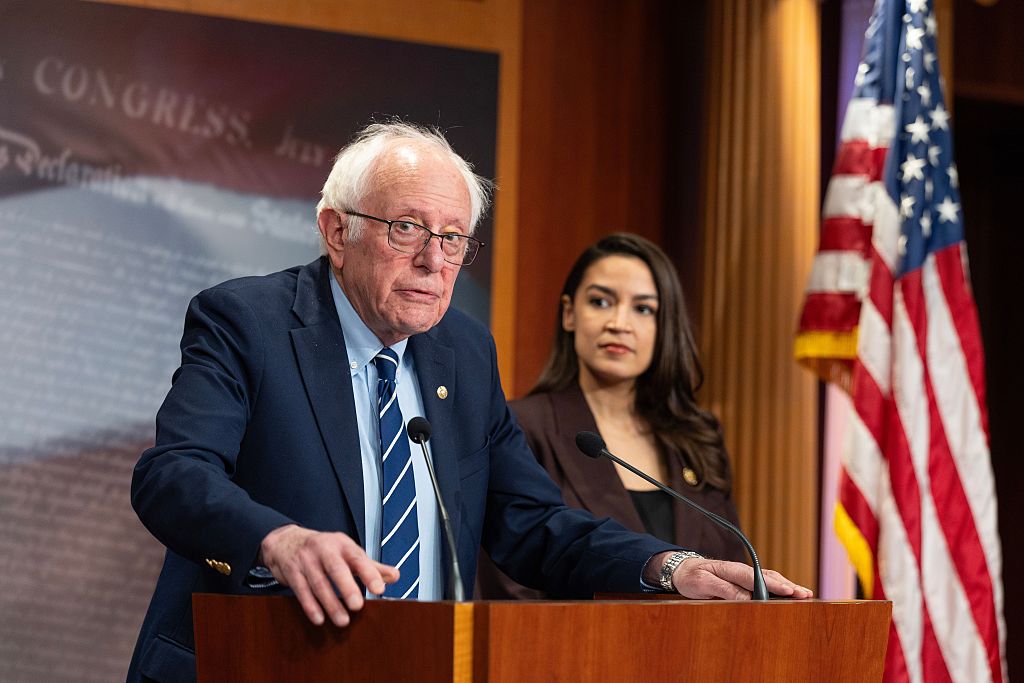
Critical of the wealthy accumulating power at everyone else’s expense, Bernie Sanders and Alexandria Ocasio-Cortez are warning that unregulated AI in the hands of tech oligarchs represents that process in its most radical, existential form. (Tasos Katopodis / Getty Images)
Artificial intelligence is a hungry species. It is designed to steal people’s livelihoods, hoard personal data, and devour enough energy and land to remake and ruin entire towns. Senator Bernie Sanders, long critical of the wealthy accumulating power at everyone else’s expense, has warned with increasing alarm that unregulated AI in the hands of tech oligarchs represents that process in its most radical, existential form. The AI revolution has the potential to dwarf the nineteenth-century industrial revolution in both impact and pace, and perhaps even to dominate human society. But its spoils are not poised to be shared with anyone but tech capitalists and other members of the economic ultraelite.
The executives and venture capitalists spearheading the expansion of AI technology have curried favor with a federal administration that is, so far, cutting them a blank check to build a network of massive data centers, even over the objections of some state and local governments. Among the planned data centers is a Meta facility that Mark Zuckerberg boasted would rival Manhattan in size. The staggering footprint of this infrastructure matches the scale of potential economic displacement; research compiled by Sanders’s staff on the Senate Health, Education, Labor and Pensions Committee projects that AI-driven automation will severely hollow out the American workforce, potentially destroying nearly one hundred million jobs within a decade.
Last week, Sanders and Representative Alexandria Ocasio-Cortez announced a bill to impose a federal moratorium on new AI data centers and on the export of AI chips to countries that do not sufficiently regulate the technology. The proposed moratorium would be lifted only after Congress passes comprehensive AI legislation that establishes safeguards to ensure “the safety and prosperity of the American people.” The Artificial Intelligence Data Center Moratorium Act would also require the Department of Energy to collect and publish all financial, environmental, and operational data related to AI data centers. At the press conference to unveil the legislation, Sanders said:
[The American people] understand that at a time of massive income and wealth inequality when a billionaire class has never, ever had it so good, some 60 percent of our people are living paycheck to paycheck. And the American people understand that the AI revolution, these massive investments, are being driven by some of the wealthiest people in our country and the world, people like Elon Musk, Jeff Bezos, Mark Zuckerberg and Larry Ellison. They understand that these billionaires are investing huge amounts of money into AI and robotics, not to improve life for working families but to dramatically increase their own wealth and power.
If passed and signed into law, the bill would provide federal cover for the more than one hundred local communities that have already enacted their own restrictions on data centers, in addition to the twelve states currently pushing forward with statewide proposals. In Loudoun County, Virginia, local officials recently stripped developers of their ability to build facilities “by-right,” which previously allowed them to build data centers without facing a public hearing or seeking approval from the local planning commission. In the Atlanta metro area, counties like Coweta and Douglas imposed emergency pauses to fend off a wave of server farms until residents could establish protective zoning codes.
Policies like these are attempts to forestall AI-induced harms that include the daily siphoning of millions of gallons of municipal water for server cooling, incessant jet-engine-level noise pollution emitted by industrial air chillers, and the prospect of residents footing the multibillion-dollar bill for the massive electrical grid upgrades demanded by the data centers’ appetite for energy.
Those interventions are largely driven by local concerns and do not capture the full breadth of AI technology’s impact across society. Unregulated AI is becoming a tool for controlling and extracting profit from everyday life. Workers are deprived of work. People grow addicted to AI as a source of illusory companionship amid a mounting loneliness crisis. A nominally democratic system is beset by waves of AI-generated misinformation that undermine civic functioning. And the privacy and safety of Americans as a whole are under constant threat from companies that are collecting unprecedented amounts of personal data to do with as they please. Only federal legislation stands a chance at truly leashing a monster of this size.
Sanders and Ocasio-Cortez’s bill naturally provoked the ire of pro-AI executives and allied media. Last Wednesday, the day Sanders formally introduced the bill to the Senate, the Bezos-owned Washington Post editorial board likened the effort to regulate AI to opposing the invention of the first lightbulb.
China certainly isn’t going to hold back its AI development at Sanders’s behest. And while the new technology will cause disruptions to the job market, that doesn’t mean there will be fewer or worse jobs. Markets respond with new innovations and opportunities much better than government ever could.
Wielding the threat of a cold war to extort American workers and equating “market innovation” with broad social prosperity are both well-worn tactics. In the 1990s, a unified political and economic establishment promised the country that unfettered free trade would usher in a golden age of shared wealth; instead, the North American Free Trade Agreement (NAFTA) allowed companies to shutter thousands of American factories and move their jobs overseas. Time and time again, corporate-led “innovation,” far from lifting all boats, has delivered only new ways to corner the market, replace workers without providing any alternative means of survival, and force the remainder into low-wage gig-economy work where collective organizing is forbidden.
The profiteers of AI technology have all but confirmed their designs. “Probably none of us will have a job. If you want to do a job that’s kinda like a hobby, you can do a job,” Musk said at an event. “But otherwise, AI and the robots will provide any goods and services that you want.” At an Oracle meeting in 2024, Ellison predicted that AI surveillance would help ensure that “citizens will be on their best behavior because we are constantly recording and reporting everything that’s going on.” That is exactly the kind of future that a moratorium hopes to prevent.