Workers at Cocktail Bar Attaboy Are Unionizing
Staff at famed New York cocktail bar Attaboy are forming an independent union in a notoriously hard-to-organize industry.
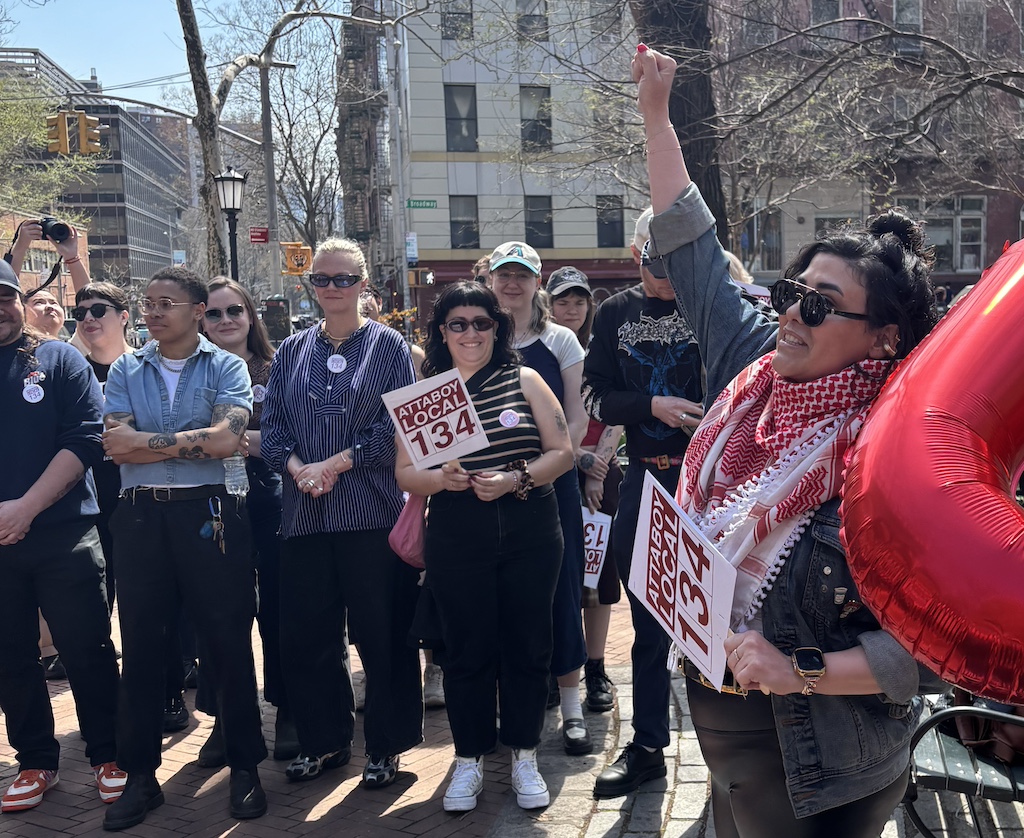
In Lower Manhattan, bartenders and other staff at New York City’s cocktail bar Attaboy gathered to announce that they are forming a union. (Courtesy of Alex N. Press)
In Seward Park in Lower Manhattan on April 4, workers from renowned cocktail bar Attaboy gathered, drifting into a loose semicircle as an ice cream truck jingle played in the background and families enjoying the sunny afternoon looked on. The bartenders and their supporters — many of them service workers at nearby establishments — greeted each other, hugged, and high-fived.
They were there to announce that they are forming a union — Attaboy Local 134, a reference to the bar’s Eldridge Street address — and seeking voluntary recognition from management. If successful, the effort would make Attaboy the first independently owned cocktail bar in New York City to unionize.
“This is fucking terrifying,” Attaboy bartender Samaiyah Patrick told the crowd. “It’s really difficult, but this is work that needs to be done.”
Patrick emphasized that the effort was not meant as a confrontation. “I don’t think of this as an adversarial thing,” she said. “I think of this as workers coming together and sharing their voices, because multiple voices are louder and stronger than one voice.” She added that the goal was voluntary recognition and a contract, not a fight: “It’s not wrong or bad to want to come together and share our grievances and our ideas for how to make the workplace and the industry better.”
Among those gathered were workers from She Wolf Bakery, where employees won a National Labor Relations Board (NLRB) election in 2024, joining the Retail, Wholesale and Department Store Union; they are currently bargaining a first contract. Others in the crowd hailed from Death & Co., an East Village cocktail bar where a 2023 union drive collapsed after management declined to recognize the union, and workers alleged union busting during a drawn-out campaign.
Attaboy occupies a particular place in the modern bar economy. Opened in 2013 as the successor to Milk & Honey — the influential speakeasy founded by Sasha Petraske — it helped define the aesthetics of the craft cocktail boom: small rooms, bartenders building drinks to order, a premium on discretion and control. It is the kind of place where the performance of ease and expertise is part of the product. That performance depends on labor, and workers say the conditions behind it have shifted.
The union drive comes in response to a period of restructuring that began in the fall and has accelerated in recent months, particularly with the bar’s expansion to include an additional room. In interviews, workers mentioned inadequate sick pay and paid time off as specific pressing concerns, but more broadly, they described changes to how the bar is run, often made without workers’ input, as motivating their decision to organize.
“They’re making a lot of rapid changes without consulting their staff,” Patrick told me.
“There has been rapid restructuring, without any consultation, of a long-standing staff who have decades of experience between them,” bartender Zack Gelnaw-Rubin, who has worked at Attaboy on and off since shortly after it opened thirteen years ago, told me. “All of these changes started occurring, and nobody was being consulted.”
Chris Hughes, a bartender who has worked at Attaboy for eight years, described a pattern of decisions coming “down the pipeline from the top” that workers are expected to implement, even when they don’t work in practice. “There have been instances where we’ve ended up doing things that hurt the business, that make it slower, that make the guest’s experience worse,” he said. “In some cases, they are changes we all kind of knew were a bad idea, but there’s no way for us to advocate for ourselves.”
Several workers also described a “staffing crisis” in recent weeks, with people fired or pushed out and not always replaced. Hughes pointed to one case in particular: a longtime worker who was effectively forced out after taking another job to make ends meet. Management, he said, treated that as a sign of disloyalty and fired him.
“It’s a guy who had worked there for years, an essential person on our team,” Hughes said. “And they just fired his ass.”
Independent Unionism in the Service Sector
The experience has led the workers to desire a more formal structure for decision-making — a demand for what they described as “self-management.” In practice, they say that would mean requiring owners to consult staff before making substantial changes to hiring, service, or operations.
Rather than affiliating with an established union, Attaboy workers are going independent. The decision reflects both the low union density in the sector and the track record of recent drives.
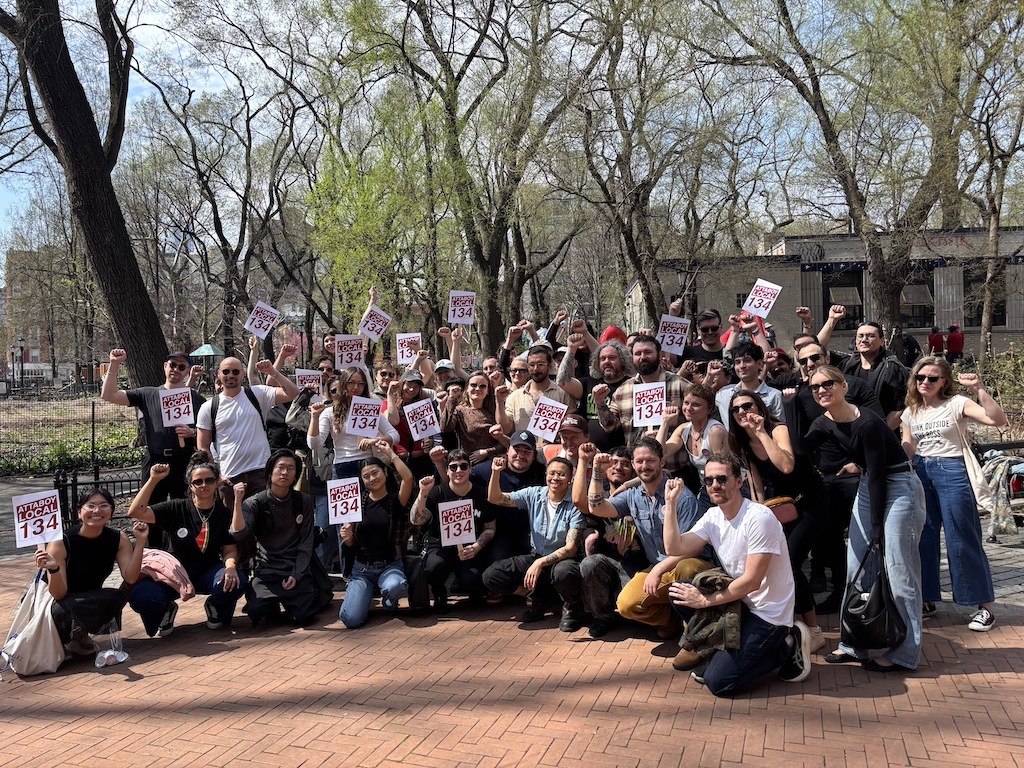
“What we’ve seen in the last several years is that the national unions have had no success organizing in our industry,” Gelnaw-Rubin said. “For a variety of different reasons, their tactics have not worked, and so we wanted to have the freedom to wage our campaign the way we wanted to wage it.”
The workers have been organizing with the Emergency Workplace Organizing Committee (EWOC), a joint project of the Democratic Socialists of America and the United Electrical, Radio and Machine Workers of America that offers organizing assistance to workers who are in the early stages of organizing.
At the Saturday rally, which concluded with members of Attaboy Local 134 emailing management their request for voluntary recognition, one worker framed the independent strategy this way: “We’re going independent, so y’all are our union,” he told the crowd.
That approach is informed by the recent history of similar drives in New York. At Barboncino, a Crown Heights pizzeria, workers went public with a union campaign in 2022 as Barboncino Workers United, aided by EWOC and affiliated with Workers United, the union that also represents Starbucks workers. The owners refused to bargain and ultimately shut the restaurant down. As one worker later wrote, management “chose to close rather than recognize the union.”
At Achilles Heel, a Greenpoint bar, staff say the restaurant abruptly closed earlier this year amid a unionization effort. And at Death & Co., workers alleged union-busting tactics during their 2023 campaign. Food and beverage service remains one of the least unionized sectors of the US economy, with union density around 1.8 percent.
A Test for High-End Hospitality Organizing
What makes Attaboy distinct, and potentially consequential, is its position in the industry. It was named North America’s best bar in 2022 and sits in a tier of high-end hospitality that has proven resistant to organizing. A union win here would test whether that can change.
“We’re doing this for other service workers too,” Gelnaw-Rubin said. “We want to prove to the people in our industry that this is possible and that it’s worth doing — and we want to help them do it too when it’s their time.”
Attaboy workers say they have majority support for the effort and are seeking to form a wall-to-wall union, including front- and back-of-house staff, in a workplace of roughly eighteen employees. Should management fail to voluntarily recognize the union, they are prepared to file for an NLRB election.
The workers described the campaign as in line with the bar’s history. “I’m one of the last staff members who knew Sasha personally,” he said. “He passed away ten years ago, but he was a very big presence.” The current owners, he said, are “protégés” of Petraske, who was known for emphasizing “worker dignity and worker respect.” “I am hopeful,” he added, “that that is going to translate into them taking us seriously and meeting our request that they recognize our union.”
“In the service industry, you work at a place, it’s gonna suck, you’re gonna get screwed over, and then you go get another job, and it’s gonna be the same thing all over again,” Hughes said. “At that point, you either just give up or you have to try to change it.”