Amazon Will Be This Century’s Biggest Labor Battle

Benjamin Y. Fong

With its vast logistics empire deploying robotics, surveillance, and AI to block worker power at every turn, Amazon now sits atop the throne of American capitalism. Organizing it will define the future of the labor movement.
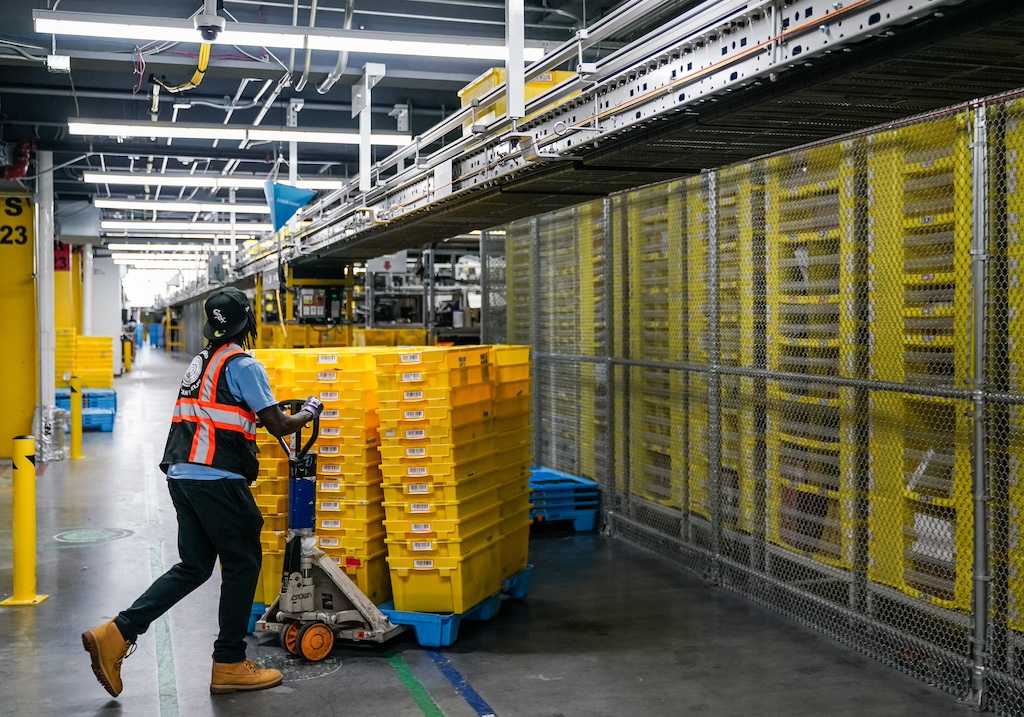
With the US labor movement at historically low levels of unionization, bold strategies are necessary to protect the working class. (Elijah Nouvelage / Bloomberg via Getty Images)

Interview by
Vivek Chibber
Melissa Naschek

Our modern economy is now dominated by massive megacompanies like Amazon and Walmart, with operations spanning many different sectors and employment types. With the US labor movement at historically low levels of unionization, bold strategies are necessary to protect the working class.

On this episode of the Jacobin Radio podcast Confronting Capitalism, Vivek Chibber and Melissa Naschek speak with Arizona State University professor Benjamin Y. Fong about the challenges and opportunities that organizing Amazon presents to the labor movement.

Confronting Capitalism with Vivek Chibber is produced by Catalyst: A Journal of Theory and Strategy and published by Jacobin. You can listen to the full episode here. This transcript has been edited for length and clarity.


Melissa Naschek

You’ve done a massive amount of research on the logistics industry and especially on Amazon. But before we get into that, I just wanted to talk a bit about your new book, Rustin’s Challenge, on civil rights organizer Bayard Rustin and why he’s so relevant to this discussion today?

Benjamin Y. Fong

Bayard Rustin was a civil rights organizer and socialist strategist. He was in the peace movement for many years, worked for peace organizations for two decades, in fact. And then he went on to become the executive director of the A. Philip Randolph Institute and very influential in the labor world.

I would say that maybe more than even a decade ago, Rustin’s more of a known figure. There was a Netflix biopic about him not so long ago that was executive produced by the Obamas. And I think it represents the typical picture of Rustin pretty well. In that picture, Rustin was a civil rights organizer. He was a close confidant of Martin Luther King Jr. And, most famously, he organized the March on Washington for Jobs and Freedom in August 1963. And I think that’s where most accounts of his life end — in the most popular liberal accounts, most of what he did that was important ended in 1963.

The book focuses on the later Rustin. He remained politically active in the 1960s and 1970s. And at this time, he launched what I think is a very exacting critique of new developments on the Left, in the New Left, in Black Power, and other kinds of social movements. He lamented the rise of a new maximalism and moralism on the Left. And at the same time, he also offered a substantive program in the form of the Freedom Budget [for All Americans]. It’s essentially a beefed-up Bernie Sanders platform introduced sixty years before the fact.

There are a lot of interesting things about Rustin. And I would say that the puzzle that most people might confront when reading the book is, well, if he said all these interesting things, why isn’t he remembered [for what he said and did] later in life? Why, in the popular account, does his life end in 1963? And I think that on the Left, there’s a narrative that he betrayed the movement, that he turned to the Right, that he was co-opted by the Democratic Party.

While I think that there’s certainly legitimate criticisms to be made of Rustin, they don’t add up to cause for dismissal. And so I think that the rejection of Rustin on the Left after 1963 is more symptomatic of the Left’s unwillingness to confront many critiques that he launches that we cover in the book.

Vivek Chibber

I think Rustin is an absolutely central figure, not just for the American left generally but for race politics in particular. Rustin’s entire argument was that in order for race justice to go down to the black working class and the Latino working class — which were the two largest non-white communities at the time within the working class — it’s going to require tremendous economic redistribution and it’ll have to center on the expansion of jobs and economic opportunities for them.

But if that’s going to happen, it’s going to have to require massive political pressure on the government. And that pressure is not going to come just from mobilizing black Americans. It’s going to have to be a class-wide movement. And that’s why it’ll have to be what King called a poor people’s movement.

And Rustin, of course, agreed with this, but I think to his credit, what he really offers us today is a concrete economic and political program in what was called the Freedom Budget, which was an actionable program and not just an abstract call for racial justice.

On this particular issue, there is no more important figure in the history of American racial struggles and racial rights than Rustin, because he found a way of marrying the cause of racial justice to the struggle for universal justice within the American political economy, bringing the civil rights movement and the movement for racial demands in line with the broader movement for justice.

And if there’s anything that we need today to recover on the Left, it’s to come back from the elite capture of the movements, their splintering of the Left into all these different sectional struggles, and bring them together under the umbrella of one broad struggle for justice. And I think there’s nobody more important than Rustin for that.

Benjamin Y. Fong

And to preview the topic we’re talking about in just a bit, labor was a late entrant into the civil rights movement in its iconic period. George Meany’s AFL-CIO [American Federation of Labor and Congress of Industrial Organizations] famously did not support, did not sponsor the March on Washington, even though Walter Reuther paid for the sound system. And after the fact, Meany was very apologetic about that.

I think that he saw that it was a mistake. And very quickly, they turned and supported the Civil Rights Act of 1964, the Voting Rights Act of 1965. And even in accounts from people at the NAACP [National Association for the Advancement of Colored People], for instance, they would say stuff like, yeah, we had a few lobbyists on the Hill, but the AFL-CIO had one in every congressperson’s office.

And so they really lent weight to the civil rights movement at that key moment. And I think Rustin saw that there was a chance to better embed the labor movement and the civil rights movement organizations together.

All in on Amazon

Melissa Naschek

So Ben, while you were finishing and publishing this book, you were also working a lot on studying Amazon in particular, along with developments in the logistics industry, and specifically the question of why Amazon is so important in today’s labor movement. Why do you think that’s the case?

Benjamin Y. Fong

I tend to make great hay of the CIO, which was the Congress of Industrial Organizations. It was a breakaway labor federation that started in 1935. And the CIO organized all the basic industries in the country: auto, steel, and electrical manufacturing.

Pretty quickly, by 1938, many of the core industries were organized. I think this moment is the closest thing to a working-class revolution that we’ve seen in this country. And what the CIO did was to strategize from the beginning in saying that they wouldn’t have a seat at the political table in America until the big corporations of the day were organized. And then it was companies like GM (General Motors), Ford, US Steel, and GE. And in a very short amount of time, they organized these companies and these industries. And it, again, amounted to something of a revolution.

I would say that if there’s going to be a similar labor upsurge today, the labor movement also needs to have its sights set on the big corporate targets. So the big employers in the country, in order, are Walmart, Amazon, Target, Home Depot, and Kroger. But all of these are big retailers with sophisticated logistical operations.

And I think that if the labor movement wants to see big gains, it needs to take on big targets. But that’s just a general conception. One might ask the question: Okay, so Walmart actually employs more people than Amazon, why not Walmart? What about Home Depot? What about Target? These are all very viciously anti-union employers.

I would say three things make Amazon a special case. The first is that it’s the largest company in the country by revenue, and it’s growing at a phenomenal rate for a company of its size. It’s set to be the first trillion-dollar company in annual revenue by 2027 or 2028, I think. So it’s on a trajectory that’s very similar to General Motors, which was by far the largest employer in the country when the CIO was organizing.

Melissa Naschek

So when you say “on a similar trajectory to General Motors,” you mean in the 1930s?

Benjamin Y. Fong

Yes, insofar as it is a template organization of the capitalism of the day. General Motors back then represented manufacturing dominance in the way that Amazon represents logistical dominance today.

Second, it’s a very unwieldy company. It’s the second-largest retailer by revenue. It’s the largest cloud computing company by revenue. It’s the largest parcel carrier, period. For a while, it was only the largest private parcel carrier, but it recently passed the United States Postal Service in terms of parcel volume, which is kind of shocking.

And as a result of all of these tentacles in different industries, it impinges upon a lot of different union jurisdictions. So the Teamsters obviously care about organizing Amazon warehouses, but in grocery, Amazon’s becoming an increasingly big player. It’s a threat to UFCW or the United Food and Commercial Workers. In health care, it’s got a new pharmacy division. It’s got one that’s medical. It’s a threat to SEIU [Service Employees International Union], NNU [National Nurses United]. In so many different realms, Amazon is threatening union jurisdictions.

Melissa Naschek

When you say it’s a threat, what does that mean?

Benjamin Y. Fong

It’s a nonunion employer. It’s a nonunion employer in industries where there is some union density. So UFCW is strong at Safeway, Albertsons, Kroger, companies like this. And in Amazon’s play in grocery, it’s threatening their union hold.

Melissa Naschek

So the fear is that by Amazon continuing to expand, it will threaten the power of existing unions, or just that it poses a potential new ground for members. Yeah.

Benjamin Y. Fong

I mean, whenever there’s a new nonunion entrant into a particular industry, it threatens union dominance and their ability to have strong wages and working conditions in that industry. And again, the unique thing about Amazon is that it’s doing it in so many different industries at the same time. If there was ever a moment for labor movement unity around a particular target, I think Amazon’s got to be it.

And the last thing I’ll mention is that there’s an existing organizing effort already in place at Amazon in a way that there’s not at these other companies. When UFCW took on Walmart in the OUR Walmart campaign in the mid-2010s, there was some worker activity, but I would say that there’s nothing compared to what exists now. There’s a lot going on in the Amazon world, and I think any big Amazon campaign needn’t start from scratch.

Vivek Chibber

One thing to keep in mind is that it’s not just that it’s a large company that employs a lot of people. There are two other dimensions to it that I think are worth keeping in mind.

One is that, if we stick with the theme of racial justice, if you look at the labor force, the demographic facts about the people who work for Amazon, Walmart, Target, and places like that, it’s the most multiracial working class you’ll see in America. It’s workers of every ethnicity and every race. And so to unionize them, to bring them together under contracts that are generous with decent conditions is not only a massive step forward for working people generally, but also in particular for the sections of the working class that are of color. This is the biggest step toward racial justice and not just economic justice that you can imagine.

So if we’re committed to racial justice, it has to take labor organizing at its core because the Latino and black minorities are overwhelmingly of working-class conditions. And for them, their class position encompasses every important dimension of their life. And it’s not just of workers of color, it’s also women. So immediately, if you take up this struggle, you’re taking up all the key components of wider social justice.

The second thing is that these have become the nerve centers of American accumulation because they’re vertically integrated. They’re not just retailers. If you unionize them, you’re automatically creating an opportunity to sink deeper into the manufacturing and sectors that they’re connected to. And you’re going to change working conditions and the conditions for organizing there.

So like Ben was saying, they are like GM, one of the largest employers, the way GM used to be and the auto industry used to be in the 1930s, 1940s, and 1950s. It’s also the place where you find workers of color and that immediately connects to their lives.

But then the third thing is that just like those industries back then in the 1940s and 1950s, if you organize here, it has linkage effects to all the different industries that go backward and forward from this particular one.

Now, the dilemma, of course, as Ben will, I think, talk about is it’s easier said than done. Because they’re trillion-dollar employers. They also have virtually unlimited union-busting operatives and techniques available to them.

And really, I think that unless the existing unions pour money into organizing these people and showing them that they’re not on their own dangling in the wind, taking on corporations with revenues bigger than most countries’ GDPs — unless you do that, it’s going to be a very uphill struggle.

Benjamin Y. Fong

There’s one last thing. You mentioned the blue-collar warehousing workforce, probably on the order of a million people in total for Amazon in the country. That’s in addition to probably 300,000 to 400,000 contracted third-party delivery service drivers.

But there’s also the corporate workforce of about 200,000 to 300,000 people. They just experienced some pretty drastic layoffs. About 10 percent of the corporate workforce has been laid off since November. And from the corporate workers that I’ve talked to, they’re in dire straits. They’ve lost a lot of their previous motivations to work at Amazon. And I think they’re ripe for organizing at a moment when Amazon’s a bit ahead of its skis in terms of its AI deployment.

Organizing Logistics

Melissa Naschek

Yeah. So, both of you kind of touched on the fact that Amazon is a multidimensional company, right? On the one hand, it’s a retailer. On the other, it’s a delivery service. It’s part tech company. And I mean, it freaking makes movies now. It is very varied.

I think probably one of the most important roles it plays in the kind of social division of labor is as a logistics organizer. And Ben, you mentioned that now they are officially the single largest parcel delivery company, even outstripping USPS, which is crazy and very concerning.

What do you think are some of the most important developments happening in the logistics industry, especially developments that are impacting the workers there and the labor movement’s prospects there?

Benjamin Y. Fong

Let me just define what logistics is first. It’s originally a term from the military. It’s talking about the deployment of goods to battle sites like weapons, arms, shelter, and food. Well, you know, just like getting the kind of things that you need to fight a war beyond just military strategy. And in this context, it just means the movement of goods around the country, getting things where they need to be in order to be sold.

It used to be a pretty simple industry. If you procured something from a supplier or a vendor, you’d store it in a warehouse for a while. It was a very manual operation.

I think one defining feature of the retail revolution, wherein companies like Walmart and Home Depot and Amazon eventually came to dominance, is that they have really perfected the logistics process. They’ve made it tremendously sophisticated compared to what it was in the postwar period.

I’ve tried to track Amazon’s automation game, its deployment of different robotics technologies, in order to combat a dominant narrative that you hear in the organizing world and in the business world that Amazon and other logistics companies are on the cusp of what they call “dark warehouses,” which is to say warehouses where packages are primarily sorted by robotics technology, and you’ve got like a skeleton crew of maintenance people. But for the most part, human workers are not part of the equation.

Melissa Naschek

It sounds a lot like how AI is being discussed.

Benjamin Y. Fong

Yeah, precisely. And it’s treated as this existential threat for warehousing and transportation more generally. I would say that it’s overwrought.

If there’s going to be one company where this is happening, it’s definitely Amazon. They’re spending way more on automation and robotics upgrades than any other company. Your average third-party logistics company with just a normal warehouse, they’re not really incentivized to automate in the same way.

They have pretty thin margins, and so they’re not going to spend the kind of capex that Amazon does on improving their warehousing operations — by capex, I mean capital expenditure, which refers to the amount that a company spends on investing in its own business.

And in an article for Jacobin last year, I tried to do a comprehensive analysis of Amazon’s robotics game, and really their one big win was with the Kivas. These are the mobile units that are used to store inventory. They basically completely reorganized inventory management at Amazon, made a whole bunch of warehousing worker roles much more productive than they were before. Some estimates say they were three to four times more productive after the introduction of the Kivas. It was a huge win.

And starting around 2021, when Amazon’s package volume really started to grow pretty significantly with the pandemic, they basically rolled out Kivas to every sortable fulfillment center in their network. And this did involve a tremendous amount of worker displacement, but it was masked mostly by company growth, which is to say, Amazon’s been displacing work, automating away work all the time. It’s just growing so fast that we don’t really see it in the numbers.

Melissa Naschek

That’s interesting because that was pretty much your argument, Vivek, about why the doom and gloom predictions about AI are probably overstated.

Vivek Chibber

Yeah. Well, there’s AI writ large, and then there’s going to be AI in particular sectors and in particular establishments like Amazon has. And the more specific you get in what you’re examining, the harder it is to predict what the effects are going to be.

There are going to be some establishments in some parts of the economy that will experience significant job loss because of AI. And then in the economy as a whole, though, if you look at it, I’m much more cautious about the gloom and doom, because the people who get displaced will almost certainly find jobs elsewhere. The question is what the quality of those jobs is going to be and what the ability to organize them is going to be.

So I think this is where Ben’s insights into this are really interesting because I do think Amazon is going to try to bring in AI, robotics, and is already doing it as much as possible. And through experimentation, it’s going to see what the limits of that are. We simply don’t know how far it’s going to go.

What is pretty obvious is that they’re not going to, even in Amazon, be able to displace human labor to the point where organizing becomes a nonissue for them. That hasn’t happened anywhere as far as I know, any time. All it does is change the terrain of organizing for us.

Another really big issue about Amazon is not the extent to which it’s displacing human labor with robots, but how it’s using AI to monitor those workers and make organizing especially difficult, because it ensnares them in this matrix of monitoring and information and using all kinds of force against them, which just ramps up the obstacles by ramping up the risks and the exposure to managerial interference.

That is really not being examined very carefully right now because the number of labor journalists in the country is now vanishingly small, almost nonexistent. So who’s going into these establishments, these warehouses, and really doing the important work of figuring out how information technology is being used, not just to displace labor, but to control labor. That’s where I think a lot of the action is going to be.

Benjamin Y. Fong

I think that’s absolutely right. And I think in terms of the question about the ways in which technology is being deployed to impact workers, I think the much bigger problem is the way in which new automation at fulfillment centers in particular is constraining work processes in such a way that workers don’t have any contact with each other.

So your standard picker, packer, stower roles at Amazon fulfillment centers, they’re literally locked in place for 95 percent of their workday. They’re twenty feet away from the closest coworker. They have no interactions with them whatsoever.

This presents a huge organizing problem. I feel like organizing relies on talking to other people. If you don’t talk to any of your coworkers all day, if you’ve got your headphones on the whole day, there are no chances for that organizing opportunity.

Melissa Naschek

Vivek mentioned that there are all of these ways in which work has been organized at Amazon, or technology has been introduced in order to curb organizing. Are there other sorts of methods or technologies that they’ve deployed that you think are significant in that regard?

Benjamin Y. Fong

Oh, for sure. One of my favorites is the Netradyne system, which every Amazon delivery driver knows about.

Melissa Naschek

Doesn’t sound good.

Benjamin Y. Fong

It’s very dystopian. Every Amazon DSP [delivery service partner] van is fitted with a Netradyne system with cameras all over it, and it judges things like how long you spend at each stop delivering a package, how long on the breaks you take. Literally, if your eyes leave the road for six seconds while you’re driving, you get written up for that as well.

Almost every aspect of your job is analyzed through the system. Then not only that, but Amazon produces reports about these companies’ drivers to them, and then ranks them in order of their efficiency on the road.

Melissa Naschek

That’s crazy.

Vivek Chibber

Yeah. It’s a way of intensifying competition between the drivers and putting the fear of God into them. If you’re on the bottom of this list, you’re going to be the first one out the door.

Melissa Naschek

Then it’s like workers who you’ve probably never even met before are pushing you to conform to be the most perfect worker you could possibly be by probably trying to push it even beyond what is humanly possible.

Vivek Chibber

It’s the newest version of the oldest trick that there is in management, which is that you have a “rabbit” inside every part of the shop or every shop inside the establishment who is setting a goal for all the other workers. Then you judge the other workers against the pace and against the speed that the “rabbit” is working at. The idea is you rank them just like this. Then the ever-present threat is the ones who are toward the bottom of it are going to be laid off at some point.

Benjamin Y. Fong

Obviously, most people hate it. They don’t actually believe in the self-optimization.

Melissa Naschek

I mean, who would like what you just described?

Benjamin Y. Fong

Well, I do think that there are some Amazon employees who buy in. I’m involved in an Amazon worker research project where we’re talking to workers. I think some people do believe that the company can be made more efficient, and they believe in the mantra of efficiency.

And so I would say that there’s a select few who internalize this self-optimization stuff. But I think most people hate it. But you don’t actually have to believe it for it to work. You could still see the list and want to avoid being in the bottom 10 percent, so you’re not fired.

Shifting Terrain

Melissa Naschek

We’ve covered a lot of the dangerous technologies that Amazon is introducing that are going to make things a lot more difficult to organize there. Are there any positive developments that could be good for labor?

Benjamin Y. Fong

There’s actually been an interesting reorganization in the logistics field that’s actually become something of a boon for organizing that wasn’t there in the 1990s, let’s say. So traditionally, big retailers like Walmart and Target, they would third-party their distribution centers. So they would have their distribution centers run by a third-party logistics company, and that third-party logistics company would then hire workers from other 3PLs — third-party logistics companies or temp agencies.

And the whole thing was very fissured. David Weil has this term workplace fissuring that makes it really difficult to organize when you’ve got all these temps working at these warehouses.

Melissa Naschek

Right. Then you have all of these companies that are effectively part of the same entity but legally are separate, which poses specific organizing challenges.

Benjamin Y. Fong

Precisely. I mean, it’s been a huge problem for labor all through the neoliberal period. And one interesting thing about Amazon — but increasingly also of Walmart and Target as well — is that they have re-internalized those operations, [bringing them back] into the company.

So when you go to an average Amazon warehouse, most of the people there are directly employed workers, which is to say they work for Amazon and not for some third party. And this is a new dynamic. And you might wonder why Amazon wants to do it. It’s because they want precise control over every part of their operation.

If you third-party something, it tends to be cheaper, but you lose quality control, you lose the efficiency gains that you can have over a directly employed workforce. And because Amazon’s done it, Walmart has increasingly re-internalized some of its third-party operations, same with Target. And it’s a new moment of possibility, I would say, for warehouse organizing.

Vivek Chibber

Well, let’s just lay out exactly how. So Ben, if you were to compare these two scenarios where you have these retailers who in their warehousing and transportation rely on third parties, and now that they’re internalizing it so that everybody is now working for them, how concretely does this change the landscape for organizing?

Benjamin Y. Fong

Well, within the constraints of existing American labor law, you have to organize the company that directly employs people. And so part of the problem for labor, as this workplace fissuring dynamic has developed, is that they’re organizing increasingly small shops because the third parties hire fewer people than the larger companies, whereas the average Amazon fulfillment center employs 3,000, 4,000 people. And that’s just a much larger shop to be organized than the smaller third-party providers.

How Organizing Has Changed

Melissa Naschek

We’ve talked a lot about technology and to some extent the internal organization of work within these Amazon warehouses. But in some of your other pieces, you talk about a lot of other factors that impact what working at Amazon is like and the conditions for organizing at Amazon.

One thing that really caught my attention was your discussion about geographic and spatial distribution of the warehouses themselves. So, how are other conditions like these similar or different in these megacorporations now compared to the GMs of the past, especially when labor was ascendant?

Benjamin Y. Fong

We’re obviously in a very different moment than the postwar period. And that geographic decentralization that you spoke of, it’s a very important organizing factor, but I would argue that it doesn’t fate organizing to failure because of that. So, in the CIO period, again, the period of labor upsurge in the 1930s and 1940s, most of the unions were focused overwhelmingly on place.

And this made sense at a time when you had tremendous fixed capital investments in large manufacturing facilities. So, again, GM, Ford, GE, US Steel, they had these huge plants employing thousands of workers, sometimes tens of thousands of workers. And if you could organize those places, you would essentially have control over the company.

And I say organize, not just in terms of organize the workers and withdraw their labor. They wanted to seize control of the means of production in order to shut down the operations to show that they had actual physical leverage over the company. And they did it for the most part.

These were operations that didn’t just strike, they shut down their operations for a certain amount of time. This kind of focus made a lot of sense in the postwar period, where manufacturing dominance was built on these centers, on these places. And as a result, because unions were successful in this period, I think many labor organizations internalize this idea that you have to focus on the four walls of a particular facility and say, you organize the workers there.

This made a lot of sense. This is also codified in labor law as well, that you focus on place, that you run elections through individual places. But it makes much less sense today. I mean, outside of its two or three key air hubs, there is no place in the US that Amazon would not cut bait on if there were union organizing present at it. They would immediately abandon the facility.

Melissa Naschek

I think in one of your pieces, you talked about what happened in Quebec, if I’m remembering correctly.

Benjamin Y. Fong

Yeah, so in Quebec, which has much better labor law than the US, they organized a warehouse, one warehouse in the province. And because labor law forced Amazon to the table, they were set to negotiate.

But before they did so, they not only closed that one warehouse but they also shuttered their operations in the entire province of Quebec. It’s real Keyser Söze, that kind of stuff.

Melissa Naschek

Yeah. That’s pretty stunning. I mean, it goes to show why we talk about it as class war.

Benjamin Y. Fong

But it’s the kind of thing they can do because they don’t have manufacturing facilities. They have warehouses, which are sometimes quite capital intensive. But sometimes they are quite cheap operations, where if there’s a problem, they don’t need to move big, heavy equipment. They don’t need to move all this investment in this one place.

They can just say, well, there’s a warehouse down the street and we can just go over there.

Vivek Chibber

So Ben, if what you’ve described as being the kind of the typical organizing strategy that came out of the manufacturing era is no longer sustainable or even sensible in the kinds of workplaces that we see today in not just Amazon, but in the Walmart and the logistics sector and in warehousing in general, what kinds of organizing principles and strategies are emerging that are adjusting to this new reality and might work?

Benjamin Y. Fong

I think key to formulating any successful strategy on a corporation is to understand what they care about, what they really care about, and what would upset them enough to bring them to the table. In the case of Amazon, but not just Amazon, Walmart, Target, et cetera, what they care about is the efficient flow of inventory goods and packages through their distribution networks. That’s what they care about.

And any particular node in that chain is not as important as the overall flow. And they’ve built redundancies into their system to make sure that there’s no disruption. And so what labor needs to do is to map out where these facilities are, to understand their relation, and to maximize its disruptive impact, not over particular facilities but over the overall flow of inventory through these systems.

And I think it can be done. I think that the knowledge is there as to where these facilities are and how they’re related, but the organizing needs to be different in order to maximize disruptive impacts.

Melissa Naschek

In what way do you think it needs to change?

Benjamin Y. Fong

I’ll give you an example. The Teamsters are very focused on delivery stations right now. Delivery stations are the last link in their supply chain. Packages are fulfilled at fulfillment centers. They generally go to sortation centers and then they end up at delivery stations where they’re picked up to go to your lobby or doorstep. Delivery stations are interesting because they’re a mix of drivers operating out of the facility and warehouse workers.

They tend to be located in or near urban settings. Drivers tend to share associational networks with other drivers at USPS, at UPS. These are unionized workforces.

And so, there’s a lot of beneficial factors for organizing involved at delivery stations.

Melissa Naschek

The description you just laid out stands in stark contrast to the earlier one of people working silently with headphones on.

Vivek Chibber

Also, it sounds like there’s this web of all these different arteries that these giant corporations like Amazon and Walmart have, any one of which is no more important than the other, but they all eventually have to meet at the delivery station.

The delivery station is the final node and it’s a center of these networks so that if you clog up the delivery station and stop things there, everything else stops as well. It has a strategic centrality, right?

Benjamin Y. Fong

That’s the idea. The problem is that if you organize a delivery station and go on strike, you’re impacting a very limited geographical area, which Amazon will get around by sending drivers from other delivery stations to that location just for the day. They have the capacity to staff up on any given day in order to build in that redundancy to their system.

Melissa Naschek

Damn, I thought we got them.

Benjamin Y. Fong

What delivery station organizing can do and the direction I think it’s headed is in thinking about upstream facilities that one could organize at or pick in order to maximize disruptive impacts across a broader geographical area. This is something that can be done under existing labor law even, and it’s a kind of strategic thinking throughout the network that could be extended all the way up to inbound facilities.

I think that’s the kind of North Star of this kind of logistics organizing: thinking about organizing not just at particular nodes but maximizing disruptive impacts through the entire supply chain. I think this is something true of all the big retailers — Walmart, Home Depot, Target — all these companies have very sophisticated logistical operations that are very efficient. If you can figure out how to maximize disruptive impacts across their entire supply chain, you have some degree of leverage over them that’s greater than organizing at particular facilities.

Vivek Chibber

There’s an important point here to keep in mind because Melissa brought up the historical perspective on strategies that were useful and discovered during the heyday of manufacturing and the smokestacks versus the ones today. When these place-based strategies came about that Ben has talked about — like in Flint, Michigan, with the sit-down strike — they literally just took over the factory and you couldn’t replace them with scabs because they were inside the factory. You couldn’t negotiate.

These strategies were stumbled upon. Essentially, once the energy to do something and to organize came in, workers kind of stumbled into these strategies almost by accident. The key here for us is that if the labor movement pours the resources and the energies into organizing, they’ll find it because no matter what, it is still capital and it still has to make its profits and it’s still got to go through the people who are doing the work.

In some way or form, I’m pretty confident they’re going to come up with the right strategy if they are committed to doing the organizing. One final point. In the 1930s and ’40s, when these gigantic mills and factories were established, which employed ten, twenty, sometimes forty thousand people, it’s interesting that the labor movement looked at that and said, we don’t know how we’re going to organize this.

Because when the labor movement was born in Europe in the 1880s and ’90s, they were organizing small establishments, small shops of the kind we’ve had under neoliberalism. That’s where they cut their organizing teeth. When these new technologies came about that created these gigantic factories and establishments, they looked at them and said, we don’t have the know-how, the skills, and the knowledge to navigate this, until they figured it out.

Now, when we look back, we say, that was easy. We could do that. Now, in this new landscape of the fissured workplace and small shops and just-in-time and all that, how are we going to organize it?

The interesting thing is you’re sort of going back to a kind of small-shop capitalism, which is where the labor movement was born. All of which is to say, it’s been done before. It’s just a question of figuring out, as Ben is saying, where do the key nodes lie that make them vulnerable? Then you go about doing it.

Benjamin Y. Fong

I should add one gloomier point, which is, when in the winter of 1937, when GM workers were occupying the key strategic places within the Flint facility, the company wanted to send in the police. It was because Governor Frank Murphy held them back that that didn’t happen.

They eventually reached a settlement in February. This is one of the things that’s credited with the success of the CIO, that they were generally friendly political administrations, which we do not have right now, of course.

Vivek Chibber

Except in New York [laughing].

Melissa Naschek

Classic. You walked right into that one [laughing].

Benjamin Y. Fong

But I do think it speaks to a kind of violence that the labor movement hasn’t encountered for a long time and which the kind of disruption along supply chains would most assuredly bring. I think that any moment of labor upsurge right now, when we effectively don’t have a functioning labor law in the country, would incite these kinds of things. It’s worth just mentioning that.

Looking Ahead

Melissa Naschek

Well, I wanted to bring up something that could also be a gloomy point. It could be an optimistic point, but it’s something else that you talk about in your pieces, which is that some research that has come out in the last few years showing that actually the labor movement has a massive reserve of cash right now, but they don’t seem to be using it.

Are there hopeful signs that they will use this money to tackle these huge organizing projects like Amazon?

Benjamin Y. Fong

Well, I can’t speak to that directly. But yeah, there is a lot of money out there. Chris Bohner with Radish Research is the relevant reference. He’s done a lot of good work on union finances.

In that article you mentioned, I talk about the other side of the ledger: union expenditures. Basically, every two years, unions spend on the order of half a billion dollars on elections. I would argue that in this upcoming midterm, where they’re about to spend $500 million, two things are happening: one, the political winds are in their favor; and two, their influence has been severely diminished because of an overall rise in individual contributions, and they probably don’t need to spend that whole chunk of money on just the election and could maybe prioritize some other campaign.

Melissa Naschek

Right. I think you cited some statistic about labor’s diminishing share of essentially like added financial value to electoral campaigns right now.

Benjamin Y. Fong

Yeah. This was from a recent report from the Center for Working Class Politics about union candidates. It’s mostly about why unions should run their own members for office and how to do so. There are some very interesting examples out there.

But there’s a prefatory section in the report about the impact of unions’ contributions. Unions have spent about the same amount over the last decade, but because of the rise of other PAC and individual contributions, their influence over particular candidates has been severely diminished.

In the 1990s, it was something like 15 percent of candidates’ contributions, and today it’s on the order of 2 percent.

Vivek Chibber

I think it’s understandable why there is this inclination to spend so much on elections because unions feel that labor law as it exists right now is so hostile and creates a landscape that’s so difficult, almost impossible to navigate unless they have some assistance, some help from the legal angle. When they take on a UPS or a Walmart or an Amazon, it’s just really, really, really up against it. And so they’d like to see some help from the labor law angle to make it a workable situation.

The difficulty is this: while it’s totally understandable, it’s also the case that if you look at how much money would have to be poured into organizing, even with friendly labor laws, it’s just orders of magnitude more than what they’re spending now. And I think the essential lesson is that whatever else they do, they have to start really strategically prioritizing these organizing drives. Otherwise the law itself, even if it’s changed, isn’t going to help them very much.

Benjamin Y. Fong

This order of magnitude question I think is very, very important. In an average year, let’s say under [Joe] Biden, and in the last couple of years of the Biden administration, unions were doing very well in terms of NLRB [National Labor Relations Board] elections. There were more workers going through elections. There were more wins.

But even in those good days, there was something like 100,000 to 120,000 workers every year voting in NLRB elections. In order for a 1 percent increase in union density, we need to organize somewhere between 1.2 and 1.3 million workers. We’re just not up to the task right now.

Melissa Naschek

How optimistic are you that the labor movement will successfully organize these new megacorporations like Amazon?

Benjamin Y. Fong

Well, it takes the institutional will. And if unions can see the writing on the wall, that this is a real existential threat and that real resources need to be committed in order to make it successful, then I think it can be. But that requires very hard conversations within institutions that are threatened from all sides.

In that kind of situation, it makes sense that unions would be very protective over what they do. It makes sense that union members would not necessarily want to spend a whole bunch on organizing, but rather want their union to service them. So there’s all sorts of countervailing pressures here.

But if the political will is there, and if the money is there, I think a campaign can be very successful.

Vivek Chibber

I think there’s another thing to keep in mind, which is that unions are always affected by the broader political culture — it instills in them a sense of how isolated they are or how much support they’re going to have, because every strike requires support outside the workplace. This is true in the 1930s, and it’s true now. And we’re living in a moment when public opinion has never been as favorably disposed toward unions as it is today.

It’s remarkable that when union density in the private sector is in the single digits, public support for unions, the last I saw, was over 70 percent, which means that there is a kind of background condition which will make them more optimistic, more hopeful, and more inclined to take on these behemoths than you had in say the ’90s and early aughts, when there was this sense of pessimism and isolation on their part, because in fact, the overall culture was so much more hostile to them.

I really do think with a younger generation of trade union organizers, with these currents inside the Left that are finally starting to see the centrality of labor to get anything going again, and with the change in the broader culture, one used to joke that with labor, you should be optimistic of will but pessimistic of intellect. I’m actually moving to the point where I’m becoming optimistic of intellect as well. You’re not seeing it yet, but all the conditions are lining up where labor organizing would take off.

Another historical point to note, when unions were growing in the late-nineteenth, early-twentieth century, it was never bit by bit. You went from situations where virtually no one was organized to five years later, you’ve got 20 percent of the labor force organized. It’s explosive when it happens, and that’s because morale is so important in labor organizing.

When people see the effect, the possibility of successful organizing here or there, they take it up. I think that with all the conditions the way they are now, a general real understanding in the culture that unions were the reason anything improved in the twentieth century, the understanding on the part of the workers that the bosses are just out to get us, and with the changes that Ben has talked about inside the ecology of these organizations, these corporations, where it looks like things might be shifting to where the conditions for organizing are becoming friendlier, I think it’s possible. I really do think it’s possible that something like an explosive growth in unions might be on the agenda in the not-too-distant future.

Benjamin Y. Fong

Things change very fast in the world of labor. After GM was organized, they got a one-page contract, which basically said, GM recognizes the [United Auto Workers] as a bargaining representative of certain sectors of workers. That’s all it said. No wage gains or anything.

After that, Myron Taylor from US Steel was so scared by this that he sat down with John Lewis and said, “Let’s get this organized.” Then you saw sit-down strikes throughout the country and industries unconnected from auto. It was a radial crisis in America. There was a lot of fear from the corporate class.

I think that if Amazon were organized today, you’d see something just like that. It would change the political calculus in America, and you’d see a spark of union activity all over the country.