The UAE Is a Cornerstone of Coercive Capitalism
As the US-Israeli war machine embarks on a new adventure in Iran, it’s worth examining one of the key states facilitating this aggression. The United Arab Emirates has pioneered a militarized corporation-state at the center of our international disorder.
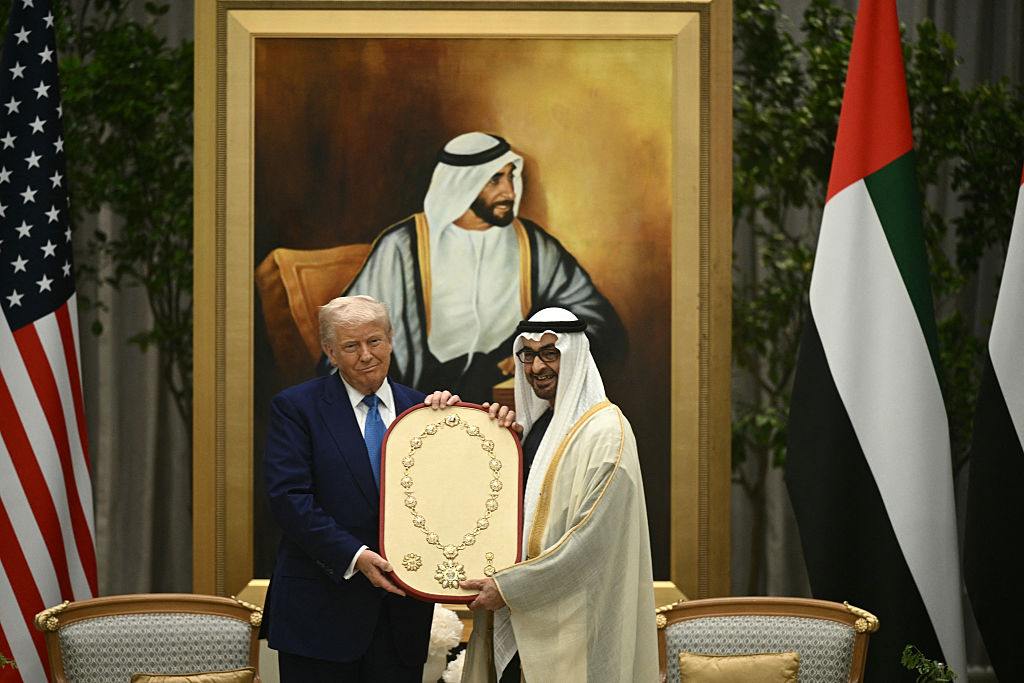
As explosions light up Middle Eastern skies, the UAE’s military fortunes remain grafted onto the American war machine. When the smoke clears, the alliance and the arms deals will continue. (Brendan Smialowski / AFP via Getty Images)
On September 23, 2024, President Joe Biden designated the United Arab Emirates (UAE) a major defense partner, a largely rhetorical title previously held only by India. The designation came during a visit by Sheikh Mohamed bin Zayed Al Nahyan (MBZ) to the White House — the first ever by an Emirati president. On May 16, 2025, Donald Trump’s secretary of defense, Pete Hegseth, reaffirmed the partnership in the UAE’s capital of Abu Dhabi, signing a letter of intent for comprehensive and long-term “bilateral force readiness, interoperability, and innovation.”
In some ways, this partnership is MBZ’s crowning achievement. The Al Nahyans, monarchs of a small state in a turbulent neighborhood, have spent forty years making themselves indispensable to the world’s strongest safety net: the American military-industrial complex. This agreement basically guarantees that for the foreseeable future the UAE will continue hosting American bases, fighting alongside American troops, receiving American training and weaponry, and jointly inventing the most high-tech tools of violence.
This “unprecedented cooperation” with a repressive monarchy not only reveals the American empire’s true nature, rarely hidden all that well, but sheds light on how the Emirati elite protect themselves and prosper. The UAE certainly is a “connectivity hub and security pillar across continents” but only in the political doublespeak of globalized exploitation and militarism.
Indeed, the Emirati elite derive power from the wealth and war it facilitates. Abroad it co-opts Western politicians, soldiers, and cultural institutions while helping criminal groups and Russian oligarchs evade Western sanctions. At home, it oversees an arbitrary surveillance state while subjecting millions of migrant workers to modern slavery.
The Royal Dilemma
The UAE is a relatively young political actor. It is a union of seven monarchies (emirates) that emerged after the British quit their Gulf protectorate system in 1971. Each emirate retains self-government while a federal state has progressively taken over shared diplomatic, security, and infrastructural affairs. Oil-rich Abu Dhabi and cosmopolitan Dubai dominate the federation’s power structures to the detriment of the smaller “Northern Emirates” of Ajman, Fujairah, Ras Al Khaimah, Sharjah, and Umm Al Quwain. The royals violently suppress freedom of expression and handpick which citizens are even allowed to vote for their purely advisory legislature.
Yet monarchical rule is defined by existential precarity. The UAE occupies a strategic location in a region of states and empires with much larger armies and the will to use them. Domestic labor pools, water resources, and agricultural yields are woefully inadequate for a high-income economy. Royals have to balance diffuse, personality-driven patronage networks of ambitious relatives, powerful merchants, and parochial tribal groupings. After spending up to 150 years facilitating British trade in exchange for relative security, these often fractious tribal confederations could only survive by integrating into formal state institutions, reliable security frameworks, and emerging globalized markets.
The balancing act between centralist Abu Dhabi and self-sufficient Dubai is also crucial, and the UAE’s current strength owes much to the close, decades-long working relationship between the emirates’ respective rulers, MBZ and Mohammed bin Rashid Al Maktoum (MBR). At the same time, the Al Nahyans and Al Maktoums are acutely aware that the Northern Emirates’ relative poverty and marginalization can easily translate into calls for political change.
Hereditary monarchs have thus had to craft an “Emirati” state and identity without the participatory politics that would dilute their monopoly on power. To guard against both their neighbors and their subjects, the ruling families have spent fifty years making themselves indispensable to international commerce and coercion.
Anchoring Global Capital
The ruling families are economic gatekeepers. They run a corporation-state where royal wealth, state power, and private capital are inseparable. Royals are simultaneously executives of vast corporate conglomerates and ministers of the state institutions that regulate them. They fill their cabinets and boardrooms with advisers from prominent merchant families and provide the families with monopolies based on lucrative government contracts and “agency rights” that require foreign companies to affiliate with Emirati citizens.
This aristocrat-oligarch alliance offers Emirati citizens a social contract of “wealth first, politics later,” yet the average Emirati is losing out to countless foreign experts snapping up jobs in the corporate-state apparatus facilitating these monopolies. Globalization has provided the elite with enough surplus labor to undermine the development of a robust Emirati middle or working class and the rights that each would demand. Conversely, foreign professionals and policymakers cannot escape the fact that access to this prosperous economy is tied to their political silence: the Emirati surveillance state has been more than willing to arbitrarily deport foreigners or even strip dissidents of citizenship.
Most important, the ruling elite has much to gatekeep. The UAE’s GDP has increased more than twentyfold since independence. Abu Dhabi’s oil, the world’s sixth-largest reserve, undergirds astronomic economic growth and institutional consolidation. MBZ’s father, charismatic founding President Sheikh Zayed bin Sultan Al Nahyan, guaranteed his federal experiment by pumping oil revenues into the federal budget, rural development, and a comprehensive welfare system.
The Al Nahyans channel this wealth into influence through the gargantuan Abu Dhabi Investment Authority (ADIA) and Mubadala sovereign wealth funds (SWFs). The SWFs fund everything from gas pipelines to green cities and fighter jets to humanitarian aid. During the 2008 financial crisis, American and European governments even asked the Gulf SWFs to save their corporations: George W. Bush directly requested $300 billion for bailouts, ADIA bought a 4.9 percent stake to shore up Citigroup, and Gulf SWFs supplied a third of Europe’s bank relief funds.
In contrast, Dubai’s influence is tied to global shipping and finance. Dubai has limited oil reserves but a long history as a maritime trade hub. With the oil glut and the rise of Asian markets in the 1980s, Dubai’s central planners globalized this hub through concerted investment in physical infrastructure and institutional standardization.
Kafala and Dark Markets
MBR and his advisers pioneered (and profited from) free-trade zones like the Dubai International Financial Centre, flagship brands like Emirates Airlines, and prestige attractions like the annual Dubai Shopping Festival. Dubai’s DP World now controls about 10 percent of global container traffic, while Dubai International Airport is the busiest airport for international transit in the world. As Abu Dhabi and the other emirates emulate this diversification, the UAE’s specialized and interconnected free zones offer economies of scale in retail, wholesale, reexport, logistics, and investment.
Foreign companies and professionals have thus flocked to the UAE, where they also benefit from low labor costs. But this breakneck industrialization and wealth accumulation is built upon modern slavery, the Gulf’s traditional kafala system. Employers directly sponsor migrants then trap them in company compounds and private homes by stealing their passports and demanding payment for exorbitant recruitment fees.
This predominantly South Asian labor force comprises over 80 percent of the UAE’s population, enduring exploitation and discrimination to send vital remittances back home. Even police raids and deportations have not stopped workers from organizing and demanding rights in a country where unionization is illegal.
Kafala is a tender spot for the UAE’s international image, but the UAE has largely placated consumers by touting inadequate, systematically unenforced labor reforms, creating an illusory “Ministry of Tolerance and Coexistence,” and aggressively policing migrant voices and visibility. Abu Dhabi’s Saadiyat (Happiness) Island is a prime example, where marginal improvements in working conditions gave cover for New York University, the Guggenheim, and the Louvre to set up branches despite continued passport stealing and recruitment fees.
At the other end of the totem pole, the free zones’ real estate and construction booms combine with lax regulation to create a haven for the money laundering so essential to globalization. Western crypto barons, post-Soviet kleptocrats, African blood gold smugglers, and various of the world’s gangsters, fraudsters, and torturers have all found refuge and secrecy in the UAE.
With Emirati royals and businesses often directly facilitating this corruption, there are few societies that haven’t been robbed from a penthouse in Dubai. Sheikh Tahnoon bin Zayed Al Nahyan, MBZ’s brother and the UAE’s national security advisor, handles the most sensitive transactions like paying National Security Agency hackers to spy on dissidents or investing $500 million in Trump’s cryptocurrency venture.
As with kafala, the government manages its image as a dark money hub by offering piecemeal, poorly enforced financial reforms. Under American pressure, it has even cracked down on specific actors like al-Qaeda in the 2000s and Iran in the 2010s. However, when an influential watchdog, the Financial Action Task Force (FATF), added the UAE to its “gray list” in 2022, the Americans and Europeans successfully lobbied for its removal only two years later. Money laundering is clearly too essential to both Emirati influence and global capital for there to be any interest in real financial reform.
Facilitating Global Militarism
The other side of the coin is even bloodier. When the United States and Israel attacked Iran on February 28, 2026, Iran’s retaliation highlighted the United States’ transnational military footprint. Swarms of missiles and drones descended on Israel, Iraq, Kuwait, Bahrain, Qatar, Saudi Arabia, and the UAE. America’s major defense partner alone intercepted 137 missiles and 209 drones, with debris raining down on Dubai International Airport, Jebel Ali Port, and Palm Jumeirah and Burj Al Arab luxury hotels. The causes and course of this regional war cannot be understood without recognizing decades of mutual reinforcement between American militarism and Gulf monarchism.
The UAE is perhaps the most successful of the Gulf states in the postindependence scramble to buy advanced weaponry, modernize fractured tribal forces, and obtain a new imperial guarantor. Early on, Emirati leaders recognized the primacy of the American military-industrial complex and effectively offered it the keys to the region. Explicitly threatened by Saddam Hussein in 1990, the UAE began providing military facilities, finances, and partnerships that significantly augmented American capabilities in the Middle East right as Washington was becoming the “global policeman.”
The UAE opened Abu Dhabi’s Al-Dhafra Air Base to the US Air Force, where thousands of American troops are now permanently stationed, and Dubai’s Jebel Ali deepwater port to the US Navy, making it now the Navy’s busiest international port of call. It bankrolled Lockheed Martin’s advanced F-16 Block 60 fighter jet and began spending tens of billions on American and French weapons, including big-ticket items like Reaper drones, Black Hawks, and Patriot and Terminal High Altitude Area Defense (THAAD) air defense systems that just shot down hundreds of Iranian assets. Emirati forces also gained operational experience and built important relationships alongside US/NATO personnel in the Gulf War (1990–91), Somalia (1993–95), Kosovo (1999–2001), and Afghanistan (2001–2021).
Though Dubai’s financial networks were helping both the Taliban and US proxy governments launder money, the UAE’s multipronged investment in Afghanistan garnered it a reputation among Western officials as their most professional and dependable Arab partner. In Afghanistan and elsewhere, the UAE honed its ability to project both “hard” and “soft” power. While its F-16s and special forces participate in complex military operations, it rolls out slick public relations campaigns, surges reconstruction funds and dedicated humanitarian specialists, and provides military training and crucial economic loans to embattled allies.
MBZ is the chief architect of this “Spartan” image. Having attended the distinguished British Royal Military Academy Sandhurst, he has effectively controlled Emirati defense policy since the Gulf War. He developed the Emirati military almost symbiotically with Western material, operational, and social networks, hiring dozens of retired Western soldiers as advisers, paying the US Marines to train his elite presidential guard, and partnering with foreign companies to build a domestic war industry practically from scratch. He has offered secrecy and patronage to the world’s many arms dealers and mercenaries, including Blackwater’s Erik Prince, Russia’s Wagner Group, and Colombia’s roving band of Desert Wolves. Unsurprisingly, MBZ has applied this militarism to his hold on Emirati society, culminating in the introduction of conscription in 2014.
The Business of War
By the 2010s, the success of MBZ’s state-centric, globally connected militarization empowered him to pursue the ideology and interests of Emirati autocracy more aggressively. This worldview is deeply hostile to the checks and balances of political Islam, espoused in different ways by the Muslim Brotherhood and Iran, and equally disdainful of the unpredictability of democratic movements more broadly.
For the Emirati elite, this anti-Islamist and antidemocratic bent carries an existential, even visceral character. Yet it is largely in line with Western interests in the region, namely oil and Israel. Western policymakers recognize that despite their democratic rhetoric, participatory politics and fair elections in the Arab world could elevate ideas like resource sovereignty and Palestinian solidarity. Autocrats have been far more reliable partners for neoliberal extraction and Israeli normalization.
As such, the West had little to say when MBZ railroaded ninety-four Emiratis in a mass trial to destroy Al Islah, the Emirati version of the Muslim Brotherhood, and initiated an era of unrelenting police repression. Similarly, Western governments raised few objections to the Gulf states’ armed intervention against Bahraini protesters and their violent coup against Egypt’s democratically elected Brotherhood government. As the UAE destroys Libya, Yemen, and Sudan, actively helps Russia evade Western sanctions, and transfers US technology to the Chinese military, talk of a rift between the West and the Gulf belies how profitable this perpetual insecurity has been.
While the West’s many Gulf-funded think tanks advertise an age of zero-sum, multipolar competition as a way of telling policymakers to double down on Gulf investments, the reality is that hubs of coercive capitalism like the UAE have been “multipolar” all along. Laundromats and war profiteers are inherently blind, and the UAE is less picking sides than business. “Geopolitics” and “national interests” obscure the confluence of interests between rentier networks like the Al Nahyans, the Trumps, and the Kremlin oligarchs.
As explosions light up Middle Eastern skies, the UAE’s military fortunes remain grafted onto the American war machine. American THAADs, not Chinese HQ-19s, are shooting down missiles over Dubai. Once the dust settles, munitions will be replenished, deals will be struck, and saber-rattling will continue — if not with Iran than with the next enemy. Representative government and economic justice will remain the real threats to the US-Israeli-Gulf alliance.