Trump Doesn’t Even Know What Victory Over Iran Would Mean
Donald Trump has begun suggesting that his war on Iran may be over “very soon” as oil prices soar. Trump will proclaim victory no matter what happens, but he won’t be able to say what “victory” means, let alone persuade anyone else that he succeeded.
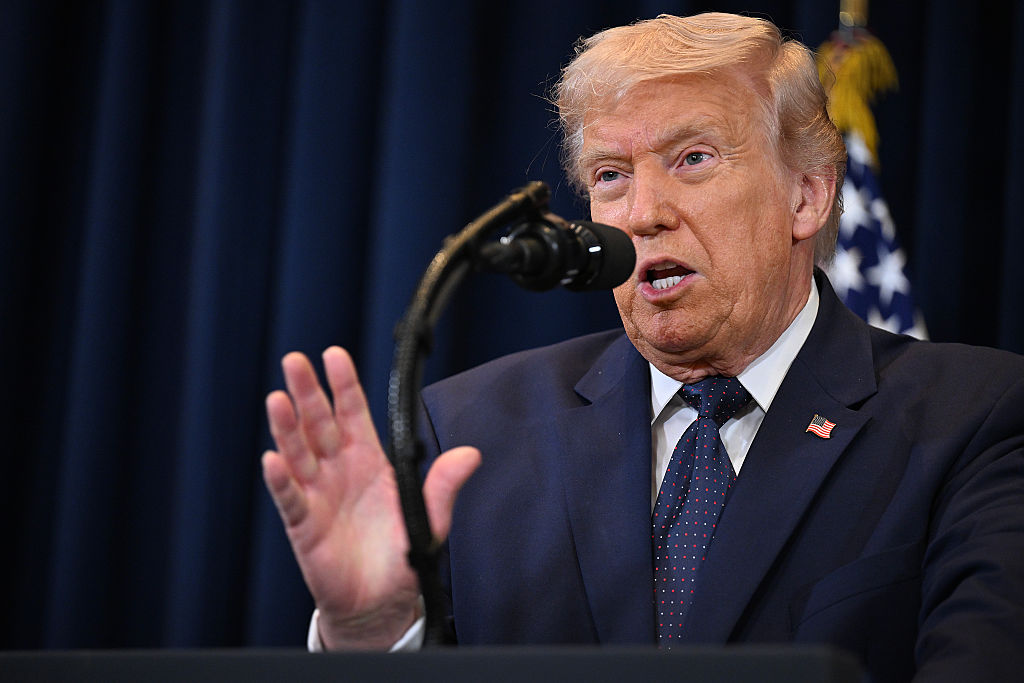
No matter how it ends, the end result is not going to be anything positive for the standing of the US in the world. (Roberto Schmidt / Getty Images)
- Interview by
- Daniel Finn
Afshin Matin-Asgari is a professor of Middle East history at California State University, Los Angeles, and the author of Axis of Empire: A History of Iran–US Relations. He spoke to Jacobin about the US-Israeli war on Iran, discussing its impact on the Iranian people, the end goals that Israel and the Trump administration may have in mind, and the way the war is likely to end.
This is an edited transcript from Jacobin’s Long Reads podcast. You can listen to the interview here.
Daniel Finn
You’ve just published a book about the history of relations between the United States and Iran, which appeared shortly before Donald Trump launched this attack in alliance with Israel. How would you situate the US-Israeli war against the long-term historical background? How much of a departure does it represent from the previous pattern of US-Iranian relations?
Afshin Matin-Asgari
It’s true that the US had already attacked Iran last summer during the Twelve-Day War, joining Israel in carrying out massive bombing raids. But in terms of long-term relations between Iran and the US, this is still a very radical departure. I ended my book by covering last summer’s war, and I said that the Islamic Republic was facing an accumulation of domestic problems as well as problems with the US and Israel, with both the US and Israel poised and waiting for their next move. In some ways, this war could thus be seen as a continuation of what they did last summer, but overall it’s definitely a radical departure.
Daniel Finn
What has the impact of the war on Iran’s civilian population been so far? Can we gather any realistic picture from the outside of what the state of Iranian popular opinion might be?
Afshin Matin-Asgari
The state of popular opinion is much more difficult to gauge, but the impact has obviously been devastating. The last numbers that I saw for civilian casualties were 1,200 or 1,300, and that was a few days ago, so it must have increased since then.
Neither the US nor Israel are restricting themselves to hitting military targets. They are destroying civilian infrastructure: schools, hospitals, and people’s homes have been hit. Since the internet is down and communication is very difficult, we don’t know exactly what is happening. I have family members about whom I haven’t heard anything. The last messages I received from them said that they were being bombed and I don’t know now if they are alive or dead.
If Trump and [Benjamin] Netanyahu expected some kind of popular uprising, clearly nothing like that has happened. It can’t happen during the bombing. But it would be hard to gauge the state of public opinion. I think we have to wait some time for that because events are moving so fast. There are reports coming out of people driving through the streets of Tehran after Israel hit the oil depots with darkened skies during the day. It’s a very grim picture.
Daniel Finn
There have been various political currents organized in the Iranian diaspora outside the country. In particular, the monarchist tendency has been prominent, organizing demonstrations and intervening in the media. The son of the former shah has been a regular presence on US and other television channels, offering what appears to be enthusiastic support for the US-Israeli campaign and putting himself forward as a potential leader of Iran in the event that the Islamic Republic falls.
Can we gather any sense of how that stance would be regarded by the Iranian people inside the country?
Afshin Matin-Asgari
Again, it’s difficult to generalize. Monarchism, as you mentioned, is represented by Reza Pahlavi, the son of the last shah of Iran, who has been living in exile, mostly in the US, for nearly fifty years. Monarchism did not really have grassroots support in Iran until it developed some kind of foothold in recent years.
Of course, we have to distinguish between the Iranian diaspora and what is happening inside the country. Monarchism has emerged at the forefront of opposition in the diaspora because of the support it receives from the Trump administration and Israel.
I was at a demonstration two days ago in the city of Santa Ana in Southern California, near where I live. There was an antiwar rally of about a hundred or so people, and a counterrally of about a hundred or so monarchists. They attacked us and tried to beat us up. I left unscathed, fortunately, but they have a presence in this country.
On the ground in Iran, on the other hand, do they have a presence? It’s very doubtful. There don’t seem to be any monarchist organizations. We hear from Iranian civil society dissenters and oppositionists inside of Iran, none of whom are monarchists. But I would say there is a broad and diffuse monarchist sentiment even inside Iran.
My guess is that as this war continues and its impact is hurting civilians, as people see their family members being killed by US and Israeli attacks, the monarchist argument that this war is a positive thing will become more and more unpopular. They go out and say, “Thank you, Donald Trump.” It’s a very strange form of gratitude: “Thank you for bombing my country,” as if that bombing campaign were going to liberate Iran and deliver it into the hands of somebody on a silver platter. Nothing like that is going to happen.
My own sense is that the position of the monarchists is going to weaken after so blatantly aligning themselves with two foreign enemies that are devastating the country. But we now have a strange situation where the successor to the supreme leader, Ali Khamenei, has been chosen and it is Khamenei’s son. This is a very ironic twist — as if monarchy has been restored in the guise of the Islamic Republic.
Daniel Finn
That brings up the next question that I wanted to ask about, the question of a potential leadership crisis in Iran. We have seen the targeted killing of numerous senior political and military leaders, including Ali Khamenei. Last Sunday, there was an announcement, which under the circumstances appeared to be quite rapid, that his son was going to be appointed to succeed him in that role.
How will those assassinations affect the functioning of the Iranian state, and what implications does that appointment in particular have for the way that the Islamic Republic may function over the coming days and weeks?
Afshin Matin-Asgari
It’s very difficult to predict. I had been thinking that over the past year or so, some kind of transition was underway, regardless of the foreign-imposed war. The supreme leader was eighty-six years old, so there had to be a transition sooner or later. Would it be toward greater inclusiveness and flexibility or a more hard-line approach? That wasn’t clear, but it was clear that things were going to change in some significant fashion.
Now, the US and Israel have forced the transition by assassinating the supreme leader, along with members of his family. Mojtaba Khamenei, his replacement, has obviously seen his parents and other family members assassinated by these enemies, so this makes the question very personal.
Is this a decision made in the middle of a crisis as a message of defiance? Would things have been different if the war had not happened? It’s a moot point, because the war has happened. Is this a message that the Islamic Republic is sending to show resolve and determination? That seems to be the case.
There was an expectation that the regime might fall or stutter if the supreme leader was killed. The Israelis in particular have a playbook, according to which killing a country’s leaders is very easy and on their agenda. They have put a target on whoever would replace Ali Khamenei, and now they are saying quite blatantly that they’re going to kill the next supreme leader.
But the regime appears to be more resilient than they anticipated. This is not something that I’m endorsing or rejecting; it’s an observation, and I am not the only one saying this. It seems that the regime can sustain itself, continue the war, and inflict pain and damage on the whole region. If their backs are up against the wall, they are at least going to raise the cost of this war to their adversaries, and so far they’ve been successful in doing so.
Daniel Finn
There has been speculation in the media that Ali Khamenei may have resigned himself to the prospect of being killed because he was staying in his usual residence despite the prospect of an attack on Iran. Do you think that idea of having consciously resigned himself to being killed, almost courting the idea of martyrdom in a way, seems realistic or plausible?
Afshin Matin-Asgari
No, I don’t think so. I have heard that interpretation and I can see why people might think that, because obviously the supreme leader, his family, and top military commanders left themselves exposed. They did not go into hiding in bunkers, spread out across the country. They stayed where they were and they were all assassinated together.
But there’s no reason to think this was deliberate. Why should Ali Khamenei have chosen to die with his family members? That would have been a very irresponsible decision for him to make, since he was in some ways the pillar of the regime. In no way would the massacre of Khamenei along with his family members and top military leaders serve the cause of strengthening the regime. Yes, the regime has survived, but I don’t think it helped them become stronger.
In a strange way, if we use the argument that Khamenei chose martyrdom, we are saying he wanted to die, which absolves his murderers of the crime that they committed in killing him along with members of his family. I am no supporter of Khamenei, but this was a brazen, criminal act that the US and Israel committed. I think Khamenei should have been answerable to the people of Iran, not taken down by the US and Israel. And I don’t think he chose to die — I don’t believe that explanation makes any sense.
Daniel Finn
Over the last weekend, the Iranian president Masoud Pezeshkian issued a statement where he offered an apology to neighboring states for missile and drone strikes that were carried out on their territory. Donald Trump was quick to present that as a surrender, and other figures in the Iranian state were just as quick to issue statements clarifying that they were going to continue launching attacks, at least on US military bases in those countries.
Do you think that statement from the president reflected divisions that may be opening up within the Iranian power elite?
Afshin Matin-Asgari
Yes, there clearly is a difference of opinion. This was before Mojtaba Khamenei was chosen as supreme leader to replace his assassinated father. Pezeshkian came out and said, “We’re no longer going to attack neighboring countries.” But then Revolutionary Guards commanders and other officials — including the head of the judiciary, who is a powerful figure — said that those attacks were going to continue, and indeed they did continue.
It does show some kind of disarray or disagreement within the leadership. It’s not clear exactly who is in charge. Looking at personalities and individuals could be misleading, even if it’s the new supreme leader we are talking about. Some kind of consensus might be forming, and it should be forming if the regime can continue its resistance, but we don’t know for sure yet.
We are judging a rapidly evolving situation and it’s very difficult to see how the leaders of the Islamic Republic will respond. What is clear is they have been able to resist, and it seems like every day that they continue to resist, they are increasing the cost of the war and the opposition to it is growing internationally, even in the US.
Daniel Finn
Israel’s leaders do appear to have a coherent goal in mind, which is quite simply precipitating state collapse in Iran, whatever the consequences might be for the country itself or for its neighbors. They seem to be comfortable with the idea of Iran descending into the conditions that we previously saw in countries like Syria or Afghanistan.
That may be the Israeli position, but can you identify any coherent strategy that is guiding the Trump administration? There has been a lot of speculation about whether they may have been bounced into this by Israel expressing a more forceful and coherent view of what it wants to achieve. What do you make of those factors at play?
Afshin Matin-Asgari
The idea that Israel is the prime mover behind this war is pretty much the consensus of anyone taking a serious look. Israel’s game plan seems to be the destruction of the Islamic Republic as a state, no matter what the consequences are. I don’t think it cares about the prospect of chaos, of disintegration, of Iran turning into another Syria — in fact, that’s what they want. They’re far enough away that it’s not going to affect their borders immediately.
As we see with their bombardment of Iran, the Israelis want to turn the whole region into another Gaza, where their war planes can come and go, killing whoever they want and doing whatever they want. That clearly seems to be the Israeli game plan. What Trump wants is different, and I don’t think Trump or whoever his advisors may be thought very clearly about what their war goals are.
They make contradictory statements: first they say this is about the liberation of Iran, then they say they want to trim down the regime. First they say Iran was building a nuclear bomb and they had to defend themselves, then Marco Rubio essentially blames Israel, claiming that Israel was going to start the war and the US had to get in because it would have been involved anyway.
The Trump administration seems to be in a massive bundle of confusion and contradiction. As the war continues, this is going to work against them. We may very soon, and not in a matter of weeks, get to a point where Trump has to somehow disengage himself, despite his bluster.
We know that the majority of US public opinion is already against the war and that opposition is increasing. We see the cost of this war as oil prices are going up and chaos spreads. The pushback against Trump’s war is growing. I think they know that they have caught themselves in a corner and that things are not going their way.
Daniel Finn
From the perspective of Iran’s leaders, what would it mean to succeed — or at least to survive, which may amount to the same thing — in the face of this onslaught by the US and Israel, and what are their prospects of doing so?
Afshin Matin-Asgari
They do seem to have a prospect of survival. If they survive — if the war ends with the Islamic Republic still standing in some way — I think they can claim a great victory. Again, it’s not something that I would celebrate, because the cost is being borne by the people of Iran, and nobody asked them if they wanted to be in this war or not.
The survival of the Islamic Republic is going to be a very significant political victory for the regime and a defeat for both Israel and the US. As we know, Trump has said that he has Cuba on his target list and he may even invade Cuba before this war ends. But if the US cannot topple the Islamic Republic, the unhinged, militaristic binge that Trump has embarked on is going to receive a check. The cost, as I say, is borne by the people of Iran, but clearly the Islamic Republic would rightly claim a major political victory.
Daniel Finn
It’s difficult enough at this point to talk about what the long-term consequences are going to be for Iran itself, or for its immediate neighbors, but looking at this war from a global perspective, what do you think the lasting consequences are going to be for the world system and the place of the United States in that system?
Afshin Matin-Asgari
Again, these are very difficult questions, because the outcome of the war is not predictable. But what is clear so far is that nobody in the world, except of course Israel and the Trump administration, really supports or approves of this war. If the Islamic Republic can survive, it’s going to be a huge setback for Trump and his neo-imperialist turn in US foreign policy.
This is very unlike the first Trump administration, and totally contrary to what Trump promised. He promised to keep the US out of foreign military adventures like this, and now he’s involved in them to the hilt. I think he’s going to suffer a major setback and the US position globally is going to suffer setbacks too.
Nobody supports this idea of total disregard for international law, attacking countries and kidnapping their leaders as in Venezuela, murdering the leaders of other states, and redrawing the map. No matter how it ends, I don’t think the end result is going to be anything positive for the standing of the US in the world.