Everyone Is Missing the Point of SCOTUS’s Tariffs Decision
The Supreme Court’s rejection of Donald Trump’s tariffs will likely have little effect on the administration’s tariff regime. It will, however, further empower the conservative legal movement and its favorite deregulatory tool.
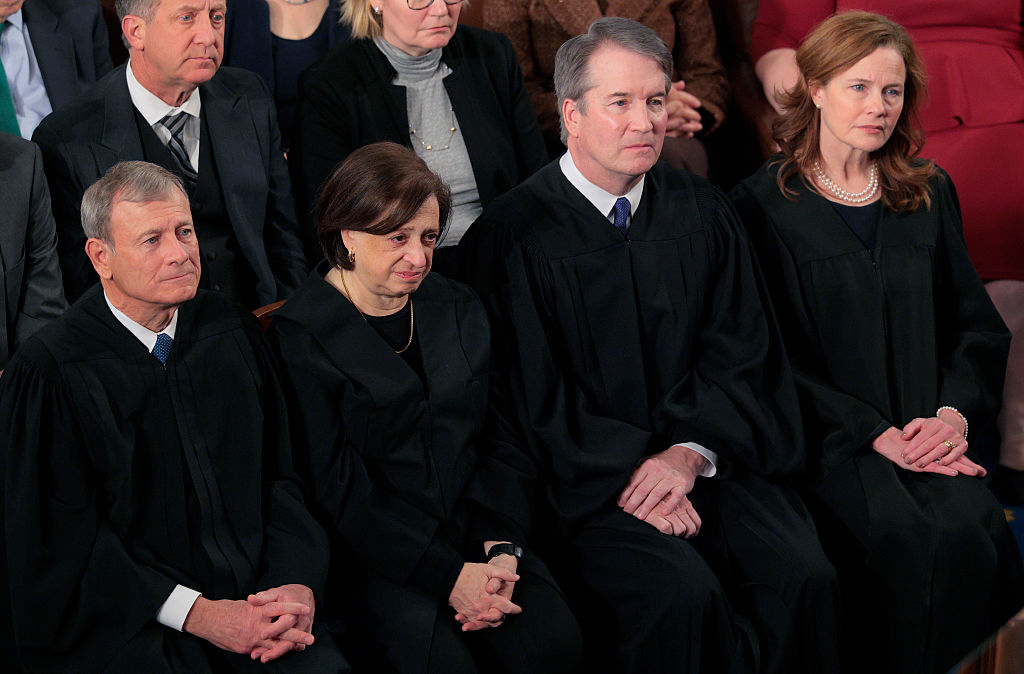
Observers from both left and right have rejoiced over the Supreme Court’s ruling against Donald Trump’s tariff regime. But only the latter have reason to celebrate.(Chip Somodevilla / Getty Images)
Last month, on February 20, the long-anticipated tariffs decision finally landed. As we predicted in a previous article, the Supreme Court ruled against the Trump administration in Trump v. Learning Resources, Inc., holding that the president lacked the authority to impose his sweeping “Liberation Day” tariffs under the 1977 International Emergency Economic Powers Act (IEEPA).
In a 6–3 decision, the majority comprising three of the court’s conservatives and all three of its liberals, the court concluded that the president had improperly usurped a power that really belongs to Congress — a constitutional allocation, Chief Justice John Roberts wrote, that reflects the framers’ deliberate choice to vest control over trade and taxation in the legislative branch.
The reaction to the decision was immediate and, as expected, loud and partisan. Trump called justices in the majority a “disgrace to our nation” and described them as “very unpatriotic and disloyal to the Constitution.” Vice President J. D. Vance, decried the ruling as “lawlessness from the Court, plain and simple,” while pundits and other conservative commentators accused the justices of exceeding their constitutional authority, engaging in judicial overreach, and delivering an activist ruling.
Voices on the liberal left, on the other hand, rushed to celebrate a rebuke of executive aggrandizement. Democratic leaders celebrated the court’s decision as a victory for consumers and congressional authority, framing it primarily as a blow to executive overreach and a win against the rising cost of living. Neal Katyal, who argued against Trump’s tariffs before the Supreme Court, did the rounds on liberal cable news stations declaring the ruling a “complete and total victory” and a “reaffirmation of our deepest constitutional values and the idea that Congress, not any one man, controls the power to tax the American people.”
Yet this commentary misses the deeper stakes of the case. It was never just about one strongman’s overreach or one round of tariffs. It is mainly about the Supreme Court’s new favorite deregulatory weapon: the major questions doctrine, a judge-made tool that purports to defend democracy while steadily chipping away at the administrative state and its capacities.
This is the same dangerous legal doctrine deployed in 2022 to block the Environmental Protection Agency’s regulation of the carbon emissions that lead to climate change and, in 2023, the Biden administration’s proposal for student loan forgiveness.
As we expected, the three liberal justices distanced themselves from the section of Chief Justice Roberts’s opinion that invoked this doctrine. While Roberts argued that Trump had to lose because a question with such “vast economic significance” as the Liberation Day tariffs must be explicitly authorized by Congress, the main liberal concurring opinion, written by Justice Elena Kagan and joined by justices Sonia Sotomayor and Ketanji Brown Jackson, asserted that the major questions doctrine was not necessary to invalidate the tariffs because “the crucial provision of IEEPA, when viewed in light of the broader statutory scheme and with a practical awareness of how Congress delegates tariff authority, does not give the President the power he wants.”
Central to Kagan’s opinion was the fact that several other statutes explicitly delegate tariff powers to the president. Thus we can infer that Congress generally does not hide the authority to issue tariffs in vague language about “regulating . . . importation,” as the Trump administration claimed in this case. Kagan also emphasized that no other president has ever tried to use IEEPA in this way.
As the conservative libertarian justice Neil Gorsuch pointed out in his concurrence, this seems a lot like the major questions doctrine “in all but name.” After all, the major questions doctrine also draws on “the broader statutory scheme” and “practical awareness of how Congress delegates” its authority.
In the major questions doctrine cases against the Biden administration, the conservatives on the court concluded that if Congress wanted to give executive agencies the power to authorize actions as significant as far-reaching student debt relief, carbon emissions caps across entire industries, federal vaccine mandates, or a nationwide eviction moratorium, Congress would have said so clearly. They also pointed out that none of the statutes invoked to justify these executive actions had been used for such actions before.
Kagan and the liberals vociferously objected to the conservative-led opinions of the court in these cases. In last week’s tariffs case, Gorsuch challenged Kagan to explain why she and the liberals were now taking a different position. Kagan responded in a footnote: “I’ll let Justice Gorsuch relitigate on his own our old debates about other statutes, unrelated to the one before us.”
The primary problem for Kagan, the liberals on the court, and the liberals and progressives celebrating this ruling is that although they can try diligently to frame it as a victory for their principles, it isn’t: it’s a victory for conservative principles that happens to come through a decision against Donald Trump. Kagan wrote convincingly and consistently in the earlier major questions doctrine cases about the dangers of an unelected judiciary policing congressional delegations of power to the executive branch: for better or for worse, so much of modern government is based on such delegations and creative executive interpretations of them. Unleashing the Supreme Court on these delegations is tantamount to unleashing it on government itself.
This, of course, is the whole point of the major questions doctrine. This is why free-market conservatives and their legal activists rushed to oppose the Trump administration in this case. As we recently wrote,
conservative groups see the tariffs case as an opportunity to institute long-standing legal protections for neoliberal economic policies. The US Chamber of Commerce, the Cato Institute, the Goldwater Institute, and the National Taxpayers Union Foundation are among the libertarian and free-market advocacy groups that took the trouble of writing friend-of-the-court briefs against the Trump administration.
Crucially, while these groups dislike tariffs as a policy, they knew — like we and many others did — that this Supreme Court case would not stop Trump from levying tariffs under other legislative authorities and probably wouldn’t require the administration to refund businesses that already paid tariffs. These expectations were accurate: the Supreme Court did not mandate refunds and, as soon as the opinion was announced, Trump signed a new executive order imposing tariffs under the Trade Act of 1974. More litigation will follow, and Trump is more likely to succeed given that this legislation does, at least, explicitly authorize tariffs. This outcome, however, will not make the conservative assault on the Liberation Day tariffs any less successful, because the assault was never against tariffs in and of themselves. It was a campaign to empower the judiciary at the expense of the elected branches.
Conservatives claim that this is about defending the Constitution and the separation of powers. It is really about defending the right to get rich off other people’s labor without interference from the state. Liberals, in their eagerness to give Donald Trump a bloody nose, have been duped by this rhetorical maneuver.
They might only come to realize this when a Democrat comes back into the White House and tries to do one of the various somewhat useful things that the Biden administration tried to do, only to be obstructed by a Supreme Court that now has a new, much-praised, and bipartisan precedent in its arsenal — a precedent that ultimately gives more power to the court, and less power to us.