Politics After Literacy
Postliteracy won’t replace reason with madness, but it might give us madness of a new and different type.
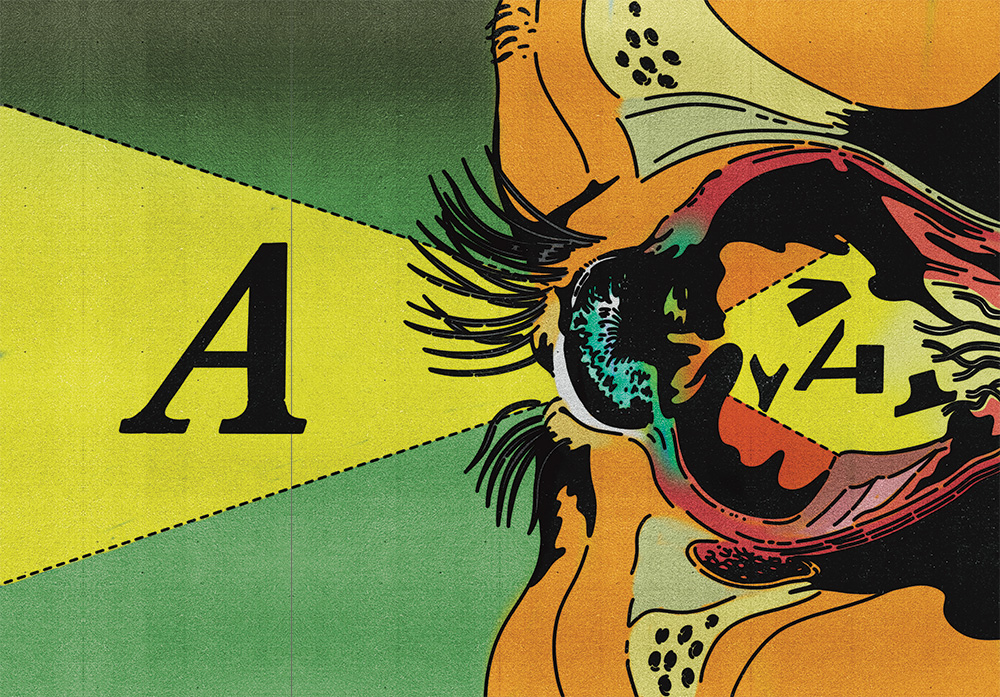
Illustration by Benny Douet.
In 1931, the Soviet neuropsychologist Alexander Luria traveled to the foothills of the Alay Mountains, in the barren borderlands between Uzbekistan and Kirghizia, to find out how the locals thought. He was trying to prove the theory that “mental processes are social and historical in origin” — that the way we think, not just the content of our thoughts, is determined by the kind of society we live in.
The society he found in the Alays was very different from his own back in Moscow. In the dry hills, illiterate pastoralists kept cattle; in the green valleys that jeweled the hillsides, illiterate peasants grew cotton. For centuries, essentially no one who lived here had been able to read or write. But that was changing. When Luria arrived, the Soviet government was busy forcing herders and peasants into collective farms, where large numbers of rural people were being taught, for the first time, to read. He spent the next year among these people, bothering them with a series of annoying tests.
What Luria found was that just a few years of basic literacy education in an agricultural school had massive cognitive effects. In one of his early experiments, he showed people a group of geometrical figures: complete and incomplete circles and triangles, squares, and rectangles drawn with straight or dotted lines. He asked them to group the shapes together. Even if they didn’t have any training in geometry, nearly half of the peasants who’d learned to read sorted the shapes geometrically: squares with other squares, circles with other circles. Meanwhile, none of the illiterate subjects considered the shapes geometrically at all; they related them to objects.