Joe Rogan Hosted Canada’s Free Market Champion
Canadian Conservative Party leader Pierre Poilievre recently appeared on The Joe Rogan Experience. He offered a blend of anti-government populism and free-market triumphalism in a pitch that was aimed at US capital as much as Canadian voters.
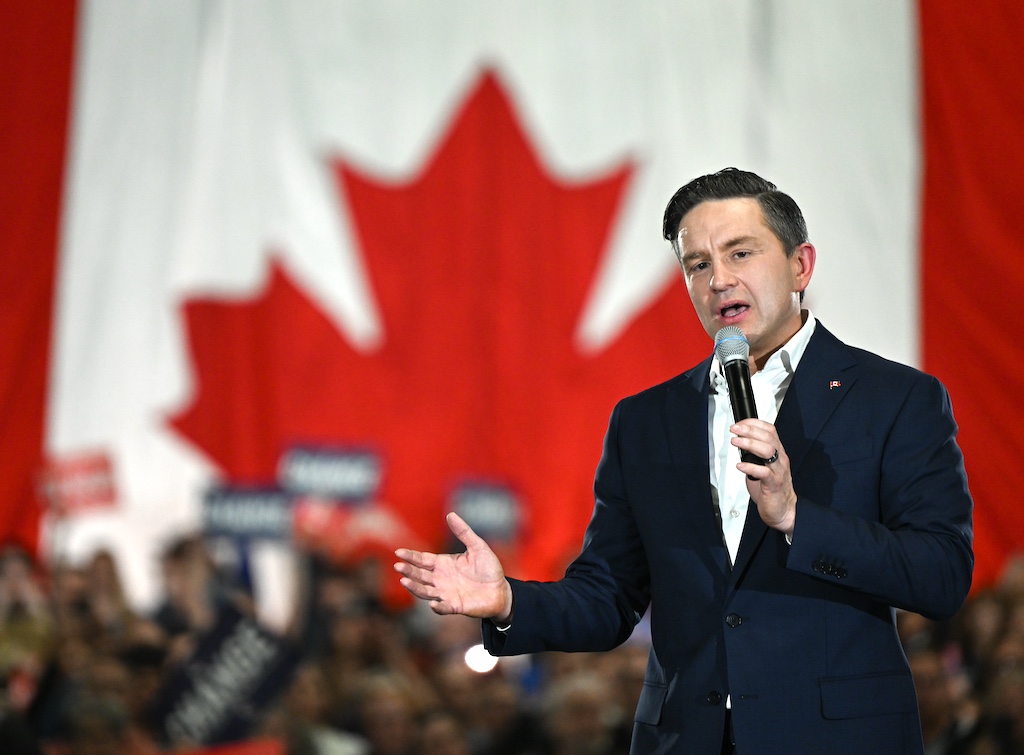
Conservative leader Pierre Poilievre attempts to separate material realities from capitalism and to implicate the state and bureaucracy as the cause of working-class struggles. (Artur Widak / NurPhoto via Getty Images)
For many Americans, and indeed the wider world, Canadian Conservative Party leader Pierre Poilievre’s appearance on Joe Rogan’s podcast was probably their first exposure to his particular brand of Canadian neoliberalism. While Poilievre is no stranger to the broader right-wing podcast world, with his multiple appearances on Jordan Peterson’s podcast over the last few years, his access to Rogan’s twenty million YouTube subscribers and an average of eleven million listeners per episode on Spotify, is a coup, both for domestically shoring up and internationally expanding his ideological influence. Indeed, at the time of writing, the interview, which ran 2.5 hours long, has garnered over 1.5 million views on YouTube in twenty-four hours.
As I have previously argued, Poilievre has often been dismissed by mainstream journalists or treated as too extreme for the broader Canadian electorate. He is often depicted as little more than a reactionary right-wing virtue signaler, the champion of the Freedom Convoy, or a right populist fighting against “woke tyranny,” but such portrayals gloss over his consistent commitment to a project of restructuring the state through austerity. Understanding that project — and what he aims to achieve by appearing on Rogan — helps clarify what’s at stake.
Poilievre’s Ideological Project
Autobiographical detail was front and center in giving color to his life and politics on Rogan’s podcast. Central to this narrative is his experience as an adopted child of schoolteachers — an experience he typically argues was his most formative, leading him to the belief that “it is voluntary generosity among family and community that are the greatest social safety net that we can ever have. That’s kind of my starting point.” On Rogan, he links this upbringing to a broader working-class experience: one on a shared street of “normal hardworking folks” like electricians, oil workers, and police officers who were “getting screwed over” because “the government didn’t listen to people like them.”
Poilievre casts his lot with the historic Western alienation of Alberta, a political tradition anchored in its dependence on oil extraction and its nondiversified economy. The antagonism between the Alberta and federal governments suits Poilievre’s tendency, shared with many Alberta conservatives, to make the case that all problems and inequalities in modern capitalism find their source in government. By taking up the mantle of the Albertan alienation, Poilievre is able to graft a free-market politics onto a David and Goliath template: the aggrieved West versus Ottawa’s heavy-handed big government.
To make his case, he employs a few of his usual tactics to separate material realities from capitalism and to implicate the state and bureaucracy as the cause of working-class struggles. Poilievre has had a lifelong reverence for the works of Milton Friedman, particularly Capitalism and Freedom and A Monetary History of the United States. He reliably name-checks the former, arguing that it led him to “develop a philosophy based on just maximizing personal financial, religious freedom, let people make their own decisions.”
Drawing on Friedman, he champions a neoliberal theory of the state, and his politics are indebted to Friedman’s theories of inflation — both of which he rehearses on Rogan. He argues that government is meant to be “narrowly focused” and then lists a night-watchman-state level of services: roads, military, borders, police, and a basic social safety net.
What Poilievre means by social safety net is never clear, as he also advocates for dismantling the welfare state and replacing it with Friedman’s negative income tax. This vision of the state is cast in Friedman’s language of the “massive increase in the cost of government, which is really like appropriating the private voluntary economy into the coercive government economy.”
In response to COVID lockdowns and communal well-being — a particular pet peeve of Rogan and friends — Poilievre states that “too many governments in the Western world have gotten way too bossy, they’re just looking for every excuse to boss people around.” However much these measures may have come with social costs — they are not beyond debate — for Poilievre they are grafted on to an indictment of government itself.
The Old Libertarian Playbook
For Poilievre, the source of all problems is the government and the bureaucracy, which he treats as some sort of alien force outside material bounds of capitalism. Because the central banks and state “print money,” they are the principal drivers of inflation, undermining the quality of life of the working class.
Poilievre is never subtle in his advocacy of this Friedmanite account of inflation. On Rogan, he is quite explicit in his claim that government spending and inflation are “the biggest fraud perpetrated on the working-class people in the last one hundred years.” Inflation becomes the meta-explanation for all working-class struggles in his performative populist telling, in which farmers and factory workers understand inflation, while government experts do not. The latter are, of course, focused solely on growing power to exercise it over citizens, which, in Poilievre’s account, is a power devoid of any structural relationship to capitalism.
Here again, the answer is boilerplate neoliberal thought rooted in Friedman and James Buchanan’s public choice and constitutional political economy: balanced-budget amendments and structural constraints on politicians and bureaucrats rather than capitalism and capitalists. He praises Bill Clinton’s balancing of the budget in the 1990s, with its policy of matching every new dollar of spending with a dollar of cuts — a policy that is the backbone of Poilievre’s platform. As Poilievre puts it:
You’ve been in deficit now for twenty-five years. This is about internalizing scarcity. Every creature in the universe, every bird in the trees, every fish in the seas has to live with scarcity, maximizing use of scarce resources. The only creature who doesn’t do that is the politician because he’s always using someone else’s money. I want the politicians and bureaucrats to live with scarcity. And that’s what I would impose by law on my government.
He also engages in the contemporary right-populist projection of special interests and enemies: he would cut foreign aid drastically, eliminate what he calls inflationary decision-making, and end corporate welfare (in reality, he would pair subsidy cuts with lower corporate tax rates). But he reserves particular focus for what he deems the other problem in Canada (and the wider Western world): international students and refugees.
“Fake refugees,” as he calls them, are taking lots of taxpayer dollars fraudulently, while international students are “causing the housing shortage.” While nowhere near as violent as Donald Trump’s rhetoric on immigration, Poilievre is willing to play a similar game, even while stating Canada does not need to go down Trump’s Immigration and Customs Enforcement (ICE) route.
Endearing Himself to the American Right
Poilievre spends a lot of time explaining the Canadian political system — how parliament works and his role as the leader of the opposition — while presenting himself as a plausible alternative to Prime Minister Mark Carney. He is attempting to sell himself to the American right as a more orthodox free-market counterpoint to Carney’s technocratic economic management, a pitch that may misread the political moment.
Large swaths of the MAGA base have turned against neoliberal orthodoxy, which is widely understood to be responsible for deindustrialization. The pitch does make sense, however, as a bid to segments of US capital — one that doubles as a signal of economic competence and fiscal discipline to audiences back home.
Predictably, this involves his consistent disavowal of Trump’s paleoconservative embrace of tariffs as well as an insistence that Trump should “knock that shit off” in reference to his taunting of Canada as the fifty-first state. This differentiation is largely tactical: it reaffirms his commitment to a freer global-market status quo and ties in with a further embrace of continentalism.
Simultaneously, he positions Canada as a natural supplier of resources to the American economy in the context of global instability and rising energy costs. He appeals directly to American capital, underscoring the cost of doing business under Trump’s erratic trade positions and the constraints on cross-border goods and investment.
He also positions himself as aligned with the American military-industrial complex, arguing for a close economic relationship grounded in supplying American military might with Canadian resources:
I don’t think he can make his stuff without Canadian minerals. . . . But like night-vision technology, you need to have germanium for that. You need to have gallium to make semiconductors and radar. You need to have aluminum for armored vehicles and airplanes. . . . You need cobalt for heat-resistant alloys and fighter jets. You need tungsten for armor-piercing ammunition. We have it all.
And what I want to do is unblock those resources, produce them in abundance for ourselves and our allies — make, you know, $200,000 paychecks for our trades workers, build up an enormous strategic stockpile of it so that we have tons of leverage in international relations. And if, God forbid, there is ever a global conflict, we would have all the resources necessary to win it.
Poilievre’s vision of a Canadian-American economic alliance is predicated on an intensification of resource extraction and an embrace of the war economy. He is not making his case only to Canadian voters but also to American business interests. Poilievre leverages Rogan’s podcast to present himself as a staunch ally of US hegemony, albeit one who distances himself, at least rhetorically, from Trump’s turbulent statecraft. This is his vision of working-class uplift: one tied to the expansion of extractivist industry and deeper integration with US-led geopolitical interests.
Rogan’s podcast was a purposeful choice for this performance. Poilievre can appeal to several far-right and populist spheres of influence and utilize the breadth of Rogan’s reach to further legitimate himself outside of Canada. As the contours of global capitalism and international governance shift, Poilievre is positioning himself as a more reliable ally to American capital than Carney.