Workers Can Organize Outside the NLRB
When it comes to reversing labor’s decline, union elections through the National Labor Relations Board have proven woefully insufficient. We need strategies for building workplace power that aren’t dependent on the NLRB.
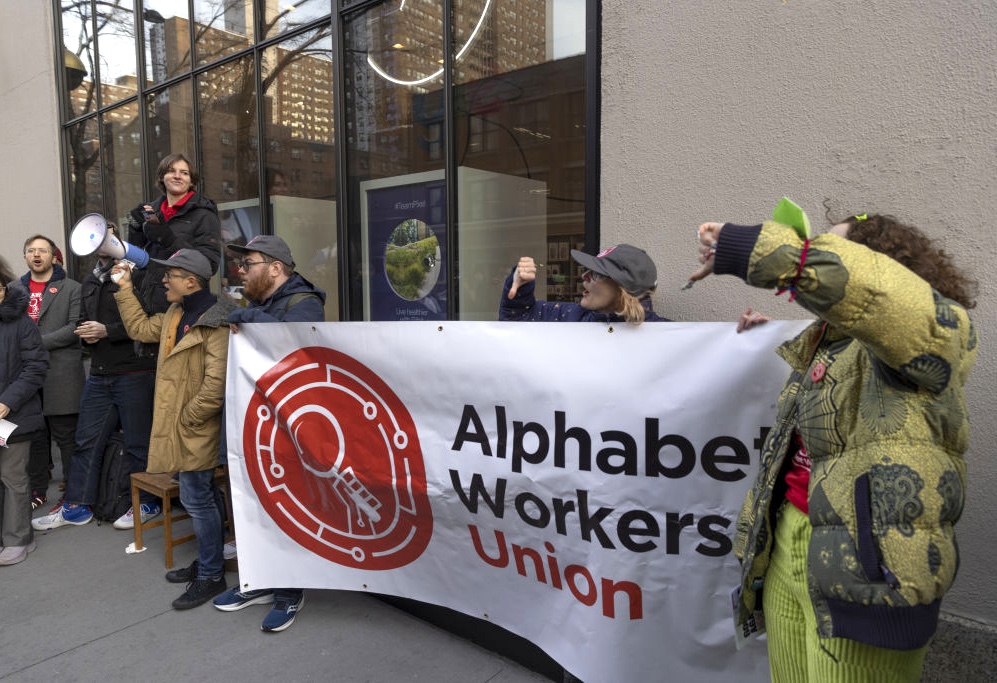
Demonstrators during an Alphabet Workers Union rally in New York. (Victor J. Blue / Bloomberg via Getty Images)
The Emergency Workplace Organizing Committee (EWOC) started about six years ago at the beginning of the COVID-19 pandemic as a way to help nonunion workers fight for safety improvements on the job. It has been successful, with over 8,000 workers reaching out to EWOC for support in developing organizing campaigns.
EWOC has worked with hundreds of these campaigns before handing them off to unions to continue. Those cases typically try for a National Labor Relations Board (NLRB) union election, with the ultimate goal of bargaining a contract; in other cases, workers organize for wins but don’t have the goal of an election and a contract. We have worked to better understand the latter campaigns, which we have come to call “premajority unionism.”
Some workers choose to organize this way because the traditional path is impossible or unrealistic — like public sector workers in states without collective bargaining rights, where winning a union election and contract is not legally possible. Other campaigns are located at huge corporations where winning either a giant election or many smaller elections will take years, if it happens at all. Some workers are classified (or misclassified) as independent contractors and thus can’t legally go through the NLRB election process. And other workers may not find a union willing to take on their campaign, so they continue on their own with a premajority strategy, at least for a while.
But all workers can and should get organized, no matter who their boss is. The premajority strategy, as we define it, involves a group of workers organizing to fight for and win workplace improvements but not necessarily win an election, get official certification, or sign a contract.
This organizing strategy has been given other names over the years, including “minority unionism.” We call it “premajority” because the ultimate goal should always be to obtain majority worker support. The Industrial Workers of the World have deployed a similar strategy called “solidarity unionism,” but premajority unionism is distinct in that workers may eventually pivot to a traditional contract strategy down the line.
EWOC published a report on premajority unionism in 2022, now updated for the second Trump administration era. The report includes seven historical and contemporary case studies of these kinds of campaigns.
What does premajority organizing look like? Workers can conduct worker education, sign members up to the union, collect dues, elect stewards, and publish workplace newsletters. They can organize their coworkers to sign petitions on issues, march on the boss, wear buttons and T-shirts to demonstrate solidarity, and even engage in work stoppages, working-to-rule, or extended strikes. (The case studies outlined in the report include further examples of such actions.) The goal is to get management to engage in informal bargaining and give concessions before a union election is won.
Traditional Organizing Is Not Enough
The traditional NLRB election strategy for the private sector has seen some success in recent years, at least compared with the prior decades. The number of elections, win rate, and number of organized workers grew from 2022 to 2024. Nearly a hundred thousand workers were organized through these elections in 2024, and the union election win rate was an excellent 77 percent, the highest in many decades. Organizing gains slowed down a bit in 2025, as unions ran fewer elections during Donald Trump’s first year back in office.
This is not organizing nearly enough workers at the scale necessary to grow the labor movement. The new union membership numbers for 2025 have been released and the union membership rate rose very slightly by 0.1 percent to 10 percent. We need ten times as many successful elections and a million or more workers to join unions every year to begin to increase the union membership rate among a huge US workforce of almost 150 million workers. The NLRB election strategy has for decades yielded a union membership rate that has increased year to year only three times since 1980.
Another challenge is negotiating a first contract, which takes on average well over a year, if workers get a contract at all. One study has found that 30 percent of campaigns still don’t have a contract after three years. It’s unclear how many never get a contract, but the figure is certainly too high to tolerate. Workers that win their election but don’t get a contract (as well as pro-union workers who lose their elections) are essentially lost to the labor movement under its current system. Premajority organizing strategies enable these workers to be union members and remain in the game.
Since the passage of the National Labor Relations Act (NLRA) in 1935, union organizing has largely been channeled into this NLRB-based contract approach. It was successful for a while, but union density peaked in the 1950s, and actual membership started to shrink in the 1980s under an anti-union offensive by capital.
It would be great to see many more successful NLRB elections, but that increased level of activity is not on the horizon, particularly given how staff-intensive these elections are. An analysis of labor movement finances found that unions could afford to hire tens of thousands more organizers, and they absolutely should. But increased staffing is not a panacea.
Moreover, Trump’s NLRB will likely become less functional, less well funded, and less well staffed over time — not to mention less friendly to workers — so this is not promising terrain to dramatically expand organizing. Even under much friendlier administrations, with a better NLRB, the labor movement has not grown.
Labor law reform, such as the PRO Act, could improve the situation, but unions have tried and failed for decades to get it. The labor movement will likely get better union election and contract negotiation processes only when we are larger and disruptive enough to win them. The unfortunate reality is that union membership is both too small and concentrated in too few states. About half of union members live in just seven states, and eleven states have union membership rates below 5 percent. This has translated into political weakness for labor.
Multiple Organizing Strategies Are Necessary
The labor movement needs other strategies to grow. Unions are very popular. Annual Gallup polls have found a 67 percent or higher approval rate for the last five years. Unions have even higher rates of approval among younger workers. The interest among workers is there, but they need help getting started.
Past surveys have found that nearly half of nonunion workers want to join a union, but it would take hundreds of years to reach the tens of millions of workers who want to organize using traditional organizing methods.
Workers generally count as union members when they have successfully organized for union recognition and then pay dues when they get a contract, but that is too narrow a path that leaves out too many. Adopting a more open concept of who counts as a union member could help bring millions of interested workers into the labor movement.
That alone is just a start, as we need those workers to actually organize at work, and they need help doing so. EWOC has tried to fill this need by offering organizing training and mentorship to any workers who want them, and this kind of support work should be expanded.
Anyone who advocates a single strategy as a guaranteed solution for labor movement revival should be met with skepticism. Premajority organizing isn’t the only way forward, but it may become an increasingly important strategy to add to the mix. It has the advantage of being immensely scalable: any group of workers anywhere can start organizing right now — without becoming bogged down in the bottleneck of NLRB proceduralism — to win shop floor victories and build power in their workplaces.