The Labor Movement Must Go All In on Organizing Amazon

The CIO unionized General Motors in 1937 and saved the labor movement. Today's unions need to do the same to Amazon if there is any hope of stopping the slow death of American labor.
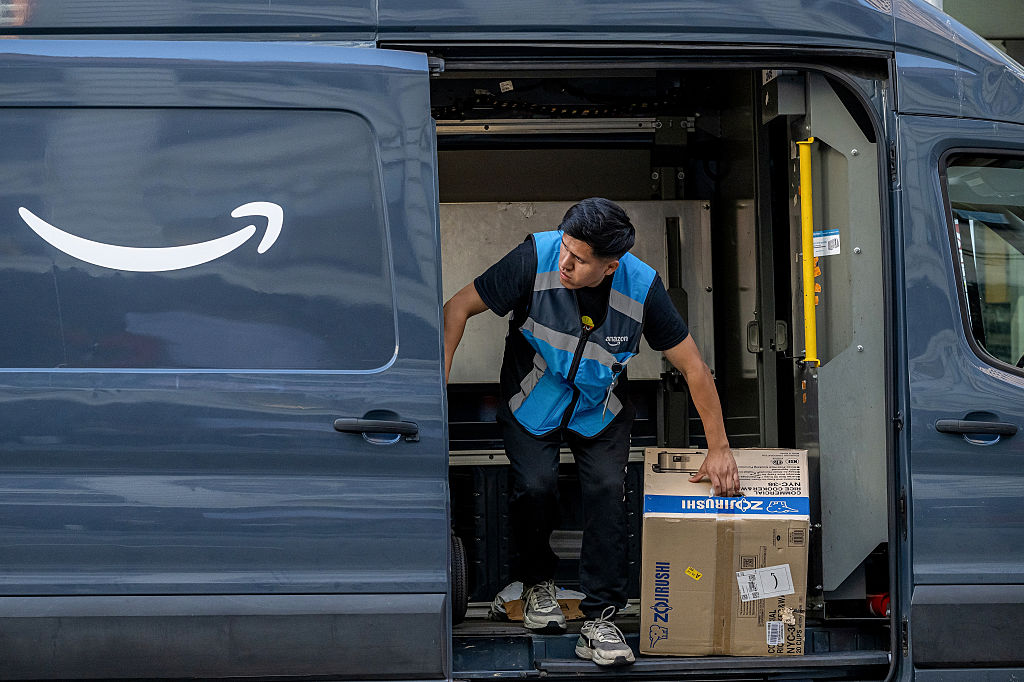
Every era has its defining labor struggle. Ours is Amazon. (David Paul Morris / Bloomberg via Getty Images)

There’s only one time in American history to look to if we’re seeking a rapid and lasting revitalization of unions, and that’s the rise of the Congress of Industrial Organizations (CIO) in the mid-1930s. There were many things that made that particular moment successful, but one of the key ones was that they took aim at the commanding heights of the economy. The CIO leaders understood that labor would not have a seat at the political table until General Motors (GM), Ford, General Electric, US Steel, and the like were organized. These were the biggest employers of the day, and they set the labor standards. Their organization in the 1930s amounted to the closest thing to a working-class revolution we have seen in this country. And the breakthrough moment came with cracking the anti-union shell of GM in the winter of 1937.

If we want to see a similar labor upsurge today, then organized labor must have its sights set on one crucial target: Amazon. Every era has an iconic labor struggle that is both situated in a leading industry of its day and representative of the broader fortunes of labor. In the twenty-first century, that struggle is with Amazon.

An Existential Problem for the Labor Movement

In two or three years, unless there are major operational hiccups, Amazon is set to be the first company in history to record $1 trillion of revenue annually. It is today simultaneously the second largest retailer by revenue, the largest private parcel company by volume, and the largest cloud computing company by revenue. It has single-handedly reshaped the logistics, transportation, and retail sectors, and it is aiming to do the same for grocery, health care, and pharmacy.

It is also a direct threat to the largest union contract in the country. In 2023, the Teamsters won significant gains on that contract with United Parcel Service (UPS), which covered 330,000 workers. In the same year, Amazon leapfrogged UPS in terms of total package volume, and since then UPS has been floundering, announcing layoffs of almost fifty thousand people in 2025. The UPS contract is up in 2028, and by that time, Amazon is expected to be the largest parcel company period, surpassing even the United States Postal Service.

But it’s not just the Teamsters and postal worker unions that are affected: in grocery, Amazon is a threat to the United Food and Commercial Workers; in health care to the Service Employees International Union. Indeed, one could make an argument that no union is unaffected by Amazon’s growth, given the breadth of industries the company has its tentacles in.

For all of these reasons, the fight to organize Amazon is an existential one not just for the Teamsters but for the labor movement as a whole. I don’t mean that as a platitude; I mean that it’s very difficult to imagine labor exiting its current death spiral unless unions as a whole commit to tackling this massive and metastasizing problem. Either Amazon is organized, or it will be the weight on labor’s chest as it struggles for its last breath.

Of course, one could argue that this is true of all of the unorganized large employers — Walmart, Home Depot, Target, etc. While these companies would no doubt become active organizing targets in any true moment of labor upsurge, none presents the starting point that Amazon does. None of their corporate ambitions so span across union jurisdictional boundaries as do Amazon’s. And at none of these companies is there an extant network of dedicated organizers or such widespread hunger for unionization as there is at Amazon. Of all the fights institutional labor could pick, this one is screaming out for prioritization.

An Order of Magnitude More

The organizers inside and outside of Amazon warehouses, at this point mostly but not exclusively working with the Teamsters, are doing invaluable work, and again one central reason it makes sense to focus labor’s energy and resources on Amazon is that these organizers have laid the groundwork. No scaled-up effort at organizing Amazon need (or should) start from scratch.

At the same time, that work is much too small to get Amazon to the table, and it is growing much slower than the company is. Again, without in any way detracting from the commitment and skill of the organizers involved, any objective assessment of this endeavor must conclude that labor is simply outmatched at present.

Part of the problem is that Amazon presents an organizational structure that labor is not traditionally suited to tackle. Insofar as the National Labor Relations Act regularized labor-employer relations, it did so by focusing unions in one place — winning majorities within the four walls of a particular worksite. At mid-century, when the large employers had huge investments of fixed capital in manufacturing plants, this was a fine focus, but it makes much less sense after deindustrialization.

In Amazon’s case, no single workplace is too valuable to cut bait on should a legitimate threat of unionization be on the table (save perhaps for their key air hubs). Last year in Québec they demonstrated that they will not only shut down individual unionized sites but that they’ll take retribution on an entire province. This is not a company at which the traditional organizing tactics will work. To my mind, the only thing that Amazon truly cares about on the distribution side is package flow, and so the only way of bringing the company to the table is to demonstrate control over that package flow. And that means networked rather than site-specific organization.

This brings us to the bigger problem here: that current institutional commitments and resources are an order of magnitude smaller than is needed to legitimately rise to the challenge. A real organizing effort at Amazon is not something that can be scraped together from spare parts. It requires a cohesive vision, unified execution, diligent and capable organizers, and money — lots and lots of money. If we are not honest about this fact, then we are playing to lose.

And for those in doubt, the money is most assuredly there. As Chris Bohner has demonstrated, unions are sitting on a lot of cash, and I’m wholly in agreement that now is the time to spend it. But we can also wonder about certain expenditures on the other side of the ledger. As a report from the Center for Working-Class Politics and the Center for Work and Democracy shows, union PAC spending in elections has been pretty consistent over the last decade: just under $500 million every two years, but over $500 million in 2024. At the same time, the union share of campaign contributions has fallen dramatically, given increased spending on elections by individuals and independent expenditures: “In the late 1990s, the average Democratic candidate received nearly 15% of all donations from unions; by 2022, this had fallen to just 3.4% — a roughly fivefold decline in importance.”

This means that labor is about to spend about half a billion dollars on a midterm election that a) it probably doesn’t need to influence, given the political winds, and b) that it bears little influence to impact anyway, given the severely diminished weight of its political expenditures. How else could half a billion dollars be spent?

Between Past Errors and Future Irrelevance

The organizers who have dedicated years of their lives to the project of organizing Amazon and who no doubt will spend many years more doing so deserve support, reinforcements, and a credible path to victory. There is only one institution that can provide those things, and the scale of the task requires that that institution loosen the purse strings. The money is there, and if ever there was a time to commit to a labor movement resuscitating campaign, this would be it.

I know that every union has its own internal political constraints. I also know that the specter of big, flashy campaigns in recent memory, like that of OUR Walmart, hangs over any conversation like this. For plenty of good reasons, what Rich Yeselson has called “fortress unionism” has settled for many into a sensible defense mechanism against big ideas.

But there’s simply no way any union would or should commit to a top-heavy campaign like OUR Walmart, there’s an existing base of worker activity at Amazon that never existed in the Walmart effort, and avoiding the key choke points (as the OUR Walmart campaign did in focusing on stores) is simply a nonstarter in the case of Amazon, where all organizers understand the integrated nature of the company’s distribution network.

Labor is not fated to the errors of the past, but it is absolutely fated to imminent institutional irrelevance should it not find a path to reversing the union density trend. And if history is any guide, it will not find that path with easy fights on the margins. Its future goes through and not around the major employers of the day, and today that means running the gauntlet of Amazon. Before the resources begin to dwindle, and before we reach a union density point of no return, organized labor as a whole must commit to this fight with its very survival in mind.