Netanyahu’s Iran War Is Also the War of Global Neocon Elites
The war on Iran is a joint effort by segments of the US, Israeli, European, and Arab ruling classes that are committed to global and regional domination — not just the result of Israeli pressure on Donald Trump.
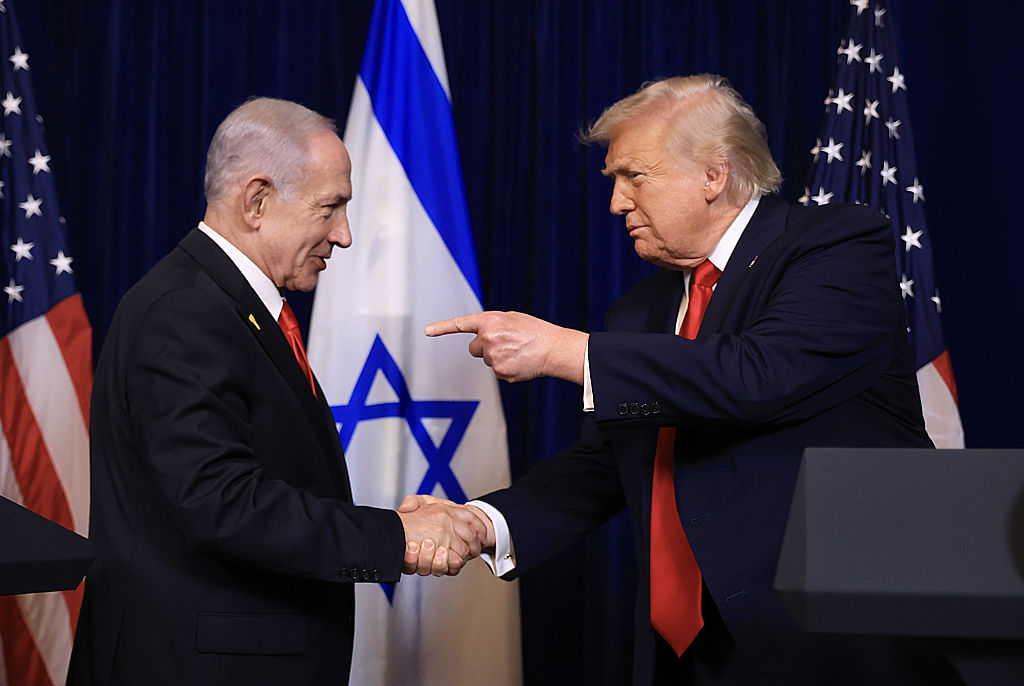
While it is clear that Benjamin Netanyahu’s lobbying for an attack influenced Donald Trump to act against Iran, the idea that Israel dragged the US into war is wrong. (Joe Raedle / Getty Images)
On the second day of the US-Israeli war of aggression against Iran, US secretary of state Marco Rubio indicated that the decision to go to war was the result of Israeli, rather than American, calculations. “We knew that there was going to be an Israeli action, we knew that that would precipitate an attack against American forces, and we knew that if we didn’t preemptively go after them before they launched those attacks, we would suffer higher casualties and perhaps even higher those killed, and then we would all be here answering questions about why we knew that and didn’t act.”
The statement, casually made, was interpreted by many as an admission of guilt; the United States is doing Israel’s bidding in the current joint bombing campaign. While it is clear that Israeli prime minister Benjamin Netanyahu’s persistent lobbying for an attack influenced Donald Trump to make decisions in June 2025 and now act against Iran, the idea that Israel dragged the United States into war, or that this is solely Israel’s war with the United States blindly following, is wrong.
This war represents the peak of efforts by a neoconservative alliance within global elites that includes supporters in the US national security establishment and the Israeli military and political leaders as well as in the conservative petro-dollar Arab regimes of the Gulf and European Atlanticist circles. This pro-interventionist stance does not reflect the views of the entire Western capitalist class but rather significant segments, which are primarily driven by the energy and arms industries.
According to this worldview, which has remained consistent over the past thirty years, American dominance in the Gulf region is essential for maintaining stable energy prices and supplies as well as securing the West’s military and economic advantage worldwide. The neocon alliance now faces a strategic opening after the shifts since October 2023, when many members of the “axis of resistance” were gradually weakened or broken apart. Netanyahu and his allies saw this as a unique chance to eliminate this obstacle for the West.
Netanyahu as Neocon in Chief
Netanyahu has always been a key proponent of this worldview. He has spoken out against the Iranian regime since at least the 1990s. Prior to that, his focus was on promoting an understanding of counterterrorism in Washington. The presentation of shared US-Israeli interests in combating extremism in the Middle East, both state and non-state, has been Netanyahu’s core message since his earliest days in politics. He has consistently downplayed the Palestinian issue and highlighted the regional conflict between Israel and Iran as the central contradiction in the Middle East.
According to this regional view, it is the Iranian regime’s anti-Zionism that represents the main contradiction in the region, rather than Israel’s ongoing occupation and dispossession of the Palestinians. When Palestinians are portrayed as part of a global jihadist brand, whether Iranian-led or similar to ISIS, rather than as a people fighting for national rights, it becomes easier to keep them dispossessed.
While Netanyahu has long pursued regime change in Iran, a few years ago his stance was not widely supported in Israel. Many in the security community believed that the 2015 Joint Comprehensive Plan of Action (JCPOA) was enough to manage the nuclear issue and that the rivalry with Iran could continue without causing a regional war. However, the last two and a half years of ongoing conflict — including a genocide in Gaza, the decapitation and weakening of Hezbollah’s power in Lebanon, the collapse of the Syrian Ba’athist regime, and the Twelve-Day War against Iran last summer — has shifted the views of these Israeli generals, turning all doves into hawks.
Netanyahu’s maximum power doctrine, along with Trump’s complete disregard for international law and his unconventional thinking, exemplified by his intervention in Venezuela, made the military option against Iran more attractive and plausible for the Israeli establishment. As long as “there’s no daylight” between Jerusalem and Washington, Israeli security interests are being served.
A Global Network of Interests
“America First” commentators like Tucker Carlson craft a narrative suggesting the United States was duped into this war, in contradiction with genuine MAGA anti-interventionist views. They argue that in light of Trump’s long-standing stance against regime change and prolonged Middle Eastern conflicts, the only explanation for this decision is Israeli manipulation.
This narrative, sometimes echoed on the Left, often veers into conspiratorial territory, implying Netanyahu has secret leverage over Trump or invoking Jewish networks such as Chabad as promoting the war and hinting at global Jewish domination, as Carlson repeatedly does. Occasionally, even the administration’s explanations deflect to these patterns. This emphasis on outside influence implicitly exonerates the United States and overlooks the fact that neocon warmongering isn’t an Israeli or Jewish movement but rather an international, multicultural coalition of capital.
While Netanyahu wields significant influence over Trump, there are other figures, such as Lindsey Graham, Mark Levin, and Secretary Rubio, who are very close to the president and are staunch Iran hawks and interventionists. They promote militarism and interventionism from a global perspective that seeks to eliminate all regimes that do not submit to US dominance.
Cuba is frequently cited as the next target of such regime-change efforts. From this very American perspective, the attempt to weaken and reshape Iran into a more compliant stance toward the United States resembles the successful effort to redirect oil-rich Venezuela toward US interests through the clinical coup conducted by the United States two months ago.
Another sign that the war on Iran is a global effort rather than just an Israeli project is the support this criminal war of aggression is receiving from liberal democracies in the West. Friedrich Merz, Germany’s right-wing leader, called Israel’s war in June the West’s “dirty work” and last week joined Trump at the White House to show support for the current campaign. This approach can be linked to Germany’s unique politics regarding Israel and Berlin’s utter abandonment of international law during the Gaza genocide, but the anti-mullah sentiment also reflects an independent view of the German political establishment, which has deep economic and political ties to Iran that span centuries.
Merz is trying to pull Trump back into the Ukraine war and sees this heightened willingness to act as a positive sign for the North Atlantic partnership at large. The conservative-leaning European mainstream sees an opportunity in this war and chooses to ignore the risks to their interests — namely, economic hardships and another refugee crisis.
The Arab Gulf states, which are suffering the heaviest fire from Iran, also played a role in bringing about this war. There is an argument about whether Saudi Arabia indeed pushed for this war or was trying to prevent it, in line with its recent conciliatory posture toward Iran. There was probably a mixture of messages pulling in both directions. Yet it is safe to assume that influential voices within the Gulf monarchies that have Trump’s ear have advocated for such a campaign at this time of Iranian weakness. Now that this conflict has begun, they would want to see it carried through; otherwise, their business model as technology and financial hubs could be jeopardized.
The Dog and the Tail
A narrative is emerging suggesting that Israel, the tail, is wagging the dog, the United States, which has little to gain from this war. While this might accurately describe the personal dynamic between Netanyahu and Trump — with the former having more experience in world affairs and decades of insider connections within the Republican Party and US foreign policy establishment — it is incorrect to generalize the US-Israel relationship in this way.
The way to see this war is as a joint effort by segments of the United States, Israel, European, and Arab ruling classes, which are committed to global and regional domination. The core of this alliance is in the United States and its security apparatus, which is far too big a dog to be wagged.