Neocons Have Shaped Washington’s Iran War Plans
As the US attacks Iran, Donald Trump is following a blueprint laid out by a long-standing force in US foreign policy: the neocons who backed the Iraq War more than 20 years ago.

The US war on Iran follows a road map drafted by a revived neocon network of Iraq War defense hawks, Israel lobby allies, and dark money groups. (Sasan / Middle East Images via AFP via Getty Images)
As President Donald Trump continues to bombard Iran, he’s following a plan laid out in a “Project 2025”–like manifesto written by a long-standing force in US foreign policy: the neocons who backed the Iraq War more than twenty years ago.
It’s part of a dark money–backed network of neoconservatives and Israel lobbyists that has been working quietly over the past year to push the Trump administration to launch a military intervention in Iran, releasing memos and polls urging action.
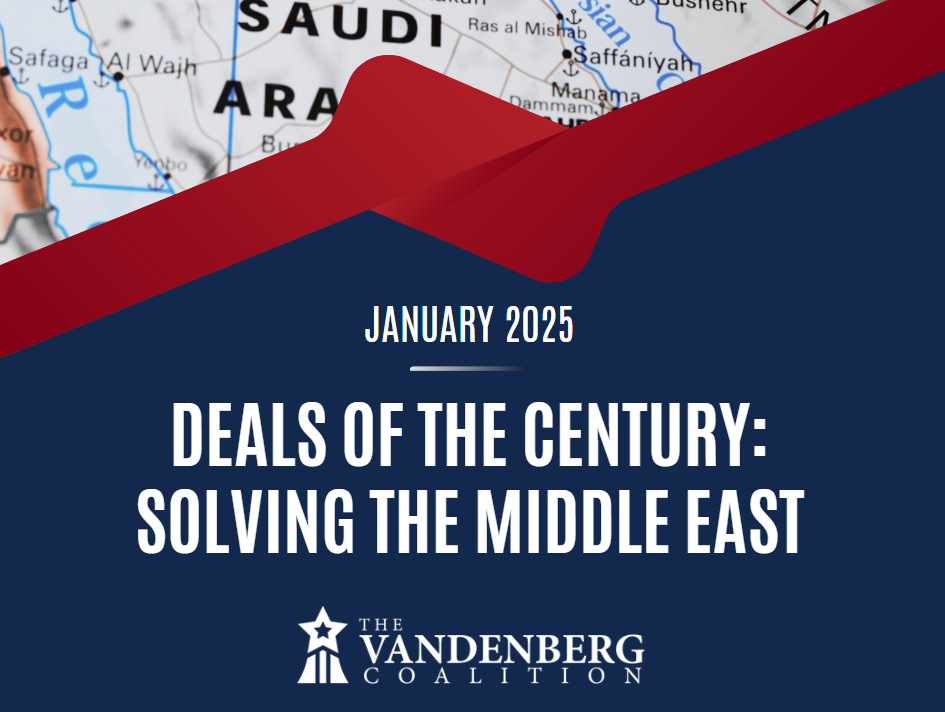
In the first weeks of Trump’s presidency in January 2025, a think tank called the Vandenberg Coalition released a white paper outlining a new agenda for US foreign policy. Called “Deals of the Century: Solving the Middle East,” the document was a “neocon manifesto” for a second Trump presidency, advocating for the United States to provide even more arms to Israel and take a “radically different” stance on Iran. It was a hawkish road map designed to influence a president who had ostensibly embraced isolationist messaging in his campaign.
The Vandenberg Coalition, formed in 2021 during President Joe Biden’s time in office, advocates for an interventionist foreign policy and increased defense spending. Over the past year, it has released a flurry of reports on Venezuela and Iran, cheering on the capture of Venezuelan president Nicolás Maduro and releasing a document in January that called for strikes against Iran.
The Neocon Network Around Trump
The organization is chaired by Elliott Abrams, a prominent neoconservative power broker. Abrams, who served in George W. Bush’s administration, was a major figure in the push for US intervention in Iraq leading up to the 2003 invasion. By that time, he had already been convicted — and later pardoned — for his role in the Iran-Contra scandal.
Despite his involvement in some of the most brutish and damaging US foreign policy decisions over multiple decades, Abrams has continued to wield significant political influence in Washington, serving as the special representative for Venezuela and Iran under the first Trump administration and then being nominated by Biden to serve on the US Advisory Commission on Public Diplomacy, which oversees US “public diplomacy,” or propaganda efforts, abroad.
As Vandenberg Coalition chair, Abrams now helms a think tank with deep ties to the Trump administration that has formed part of a renewed neocon lobby — the ecosystem of conservative and fossil fuel–backed dark money groups that has been pushing for military intervention in Iran, closely intertwined with the Israel lobby.
The group’s advisory board includes a number of emeritus members currently working in the Trump administration. Among them are Trade Representative Jamieson Greer, Associate Director for Homeland Security Brian Cavanaugh, Pentagon General Counsel Earl G. Matthews, and Deputy Special Presidential Envoy for Middle East Peace Morgan Ortagus.
Sitting members on the board include a variety of private sector defense industry representatives and members of other hawkish think tanks that have pushed for regime change in Iran, notably the Foundation for Defense of Democracies and the American Enterprise Institute.
The Vandenberg Coalition’s board also includes David Milstein, a senior adviser to Trump’s Israel ambassador, Mike Huckabee. Despite having little public prominence, Milstein has had an outsize role in Israel policy, as Responsible Statecraft exposed last year. A hard-line Israel supporter, Milstein has worked diligently to silence any criticism of it in the State Department (which is hardly known as an enemy of Israel).
Milstein is the stepson of Fox News host Mark Levin, a prominent conservative commentator who has served as perhaps one of the most vocal advocates for regime change in Iran in right-wing media (and who Trump is known to watch).
The degree of overlap between the Israel lobby and explicitly neoconservative think tanks like the Vandenberg Coalition is now a notable feature of the foreign policy influence machine in Washington, said Eli Clifton, senior adviser at the Quincy Institute for Responsible Statecraft, an anti-interventionist watchdog group.
“And I think what’s more clear now, especially with the war in Iran, is that this is about advancing Israel’s policy objectives in the region,” Clifton added.
The Iraq War Playbook
In the lead-up to the Iraq War under the Clinton and then Bush administrations, an organization called the Project for the New American Century was essential in getting the war drums beating for an invasion. The outside group — whose supporters went on to work in the Bush administration — sent a barrage of letters pushing for a war in Iraq between the late 1990s and 2003.
The Vandenberg Coalition, Clifton noted, is a similar “letterhead organization.” It has disseminated letters to lawmakers demanding additional intervention in Iran and released polling numbers purporting to show widespread support for Trump’s war (though, according to most reputable independent polling, the conflict is actually immensely unpopular).
The funding for these efforts is largely secret. In the last few years, the Vandenberg Coalition has reported an annual revenue of between $1 and $2 million, according to its tax forms — not an insignificant figure but one that pales in comparison to peer organizations like the Foundation for the Defense of Democracies, which reported $32.5 million in revenue in 2024.
Donors include the foundations of George Seay, a close Trump ally and significant supporter of Israel. But given the few transparency requirements in the world of 501(c)(3) nonprofits, the group does not have to disclose its private donors, and at least $2.4 million has been funneled to the group over the past several years through donor-advised funds, secretive charitable vehicles that conceal the funders’ identities.
“There’s quite a lot of money that’s coming through these shops,” Clifton noted.