Jürgen Habermas’s European Illusion
The late Jürgen Habermas saw Europe as a vehicle for a social democratic, postnational politics. But as the real European Union increasingly diverged from this ideal, Habermas’s thinking failed to reckon with the project’s fundamental limits.
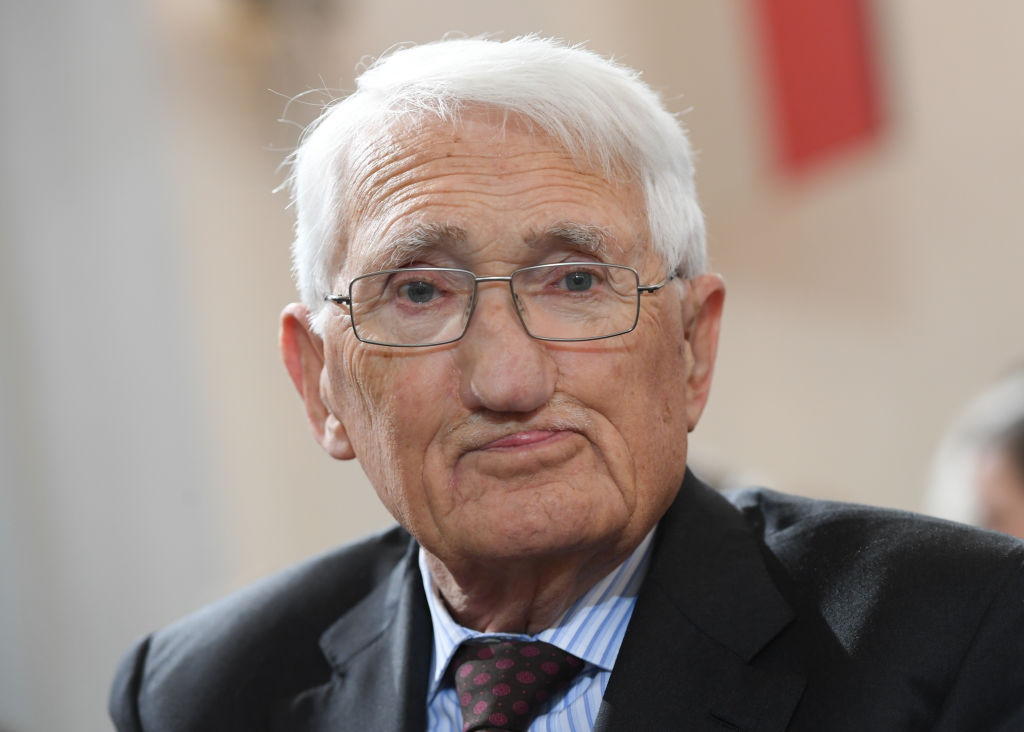
Jürgen Habermas was among the leading thinkers of the German center left and its cosmopolitan Europeanism. But his thought also reflected the contradictions of this postnational outlook, including its severe blind spots regarding Israel. (Arne Dedert / picture alliance via Getty Images)
By the time he died this past Saturday at age ninety-six, Jürgen Habermas had become something of a reviled figure for much of the Left. His liberalism, centered on a belief in communicative rationality, was perceived as an abandonment of the more radical impulses of the Frankfurt School — Sam Moyn, for example, wrote that Habermas’s “global philosophical legacy was to accede to the end of history, in various ways, with consequences that critical theory hasn’t recovered from.” But the animosity toward him was sharpened by the statement that he and several of his colleagues at Frankfurt University produced in November 2023, which criticized the attribution of “genocidal intentions” to Israel.
Centrists have generally been more positive about Habermas’s legacy, though in the last few years some of them have also been willing to trash him — not so much for his position on the genocide in Gaza as for his position on the war in Ukraine. For those who insisted that the war could only end with Russia’s defeat and who wanted Germany to provide Ukraine with more weapons, Habermas’s two interventions in the Süddeutsche Zeitung — one in 2022 in which he criticized the new hawkishness of German elites and another in 2023 in which he called for negotiations to end the war — were enough to completely discredit the nonagenarian philosopher.
However, for many centrists and even some on the Left, especially perhaps in the United States, one aspect of Habermas’s thought that redeems him at least somewhat is his “pro-Europeanism.” More than perhaps anyone, Habermas gave an intellectual basis to the idea of the European Union as a progressive project, though “pro-Europeans” tend to overlook how critical he was of the really existing EU even as he continued to believe it was necessary and possible to transform it. Yet Habermas’s commitment to the EU, even as it diverged further and further from the cosmopolitan project of his imagination, illustrates the deeper parochialism of his thinking.
Postnational?
Habermas’s starting point for thinking about Europe was that globalization had led to a “de-bordering” and ended a historical constellation based on the “territorial principle” and centered on the nation-state — and, in doing so, hollowed out democracy. In a series of essays written in the 1990s and 2000s, he argued that the EU was, or at least ought to be, a way to regain the ability to regulate markets and pursue redistributive policies now that, in the context of what he called the “post-national constellation,” the nation-state was no longer able to do so. But, crucially, he thought that, rather than simply “re-bordering” and reestablishing the “territorial principle” at a regional level, the EU would actually transcend it altogether.
Influenced by Immanuel Kant’s writings on cosmopolitanism, Habermas argued that the EU could function as a kind of basis for, or step toward, the transformation of international politics into domestic politics. In other words, uniting Europe was a precursor to a form of world society. A European federal republic would be the “starting point for the creation of a regime of a future Weltinnenpolitik [“world domestic politics”] based on international treaties.” It would be an “an important stage along the route toward a “politically constituted world society” and could “re-embed” liberalism not just on behalf of Europeans but for the whole of humanity with the “cosmopolitan goal of creating the conditions necessary for a global domestic policy.”
Habermas’s faith in the idea of postwar Europe as a progressive project was part of his wider belief in history — and especially German history, as a paradigmatic case — as a learning process. He pointed to the way that, in the nineteenth century, European states “gradually created national consciousness and civic solidarity” and suggested that doing so again on a European level would be not just possible but a natural evolution. “Why should this learning process not continue on, beyond national borders?” he asked. Yet while seeing the construction of “Europe” as analogous to that of the nation-state, the idea of a learning process also implied that it was qualitatively different and normatively superior.
Rebordered Europe
Habermas was making these arguments at the turn of the millennium in a moment of idealism and optimism — but also hubris — among “pro-Europeans.” In the context of the transformation of Europe after the end of the Cold War and the enlargement of the EU to include Central and Eastern European countries, some of them began to imagine that the whole world could be remade in the image of the EU. It is not just that such optimism about the EU has been shattered since then, but also that the whole nature of the project and its relationship with the rest of the world now looks quite different. Today the EU resembles a Fortress Europe, more than the cosmopolitan Europe that Habermas imagined it was or might become.
In those first two decades after the end of the Cold War, it was still just about possible to believe that the removal of borders within Europe was a precursor to a borderless world. But during the last decade, and especially since the refugee crisis in 2015, the EU has come to see a hard external border as the necessary corollary of the removal of internal border checks. Tellingly, the budget of Frontex, the EU’s border agency, went from €142 million in 2015 to €1.1 billion in 2025. Thus the illusion that the EU was an attempt to go beyond the “territorial principle” has been shattered, and it is now clear that it does not so much “deborder” as “reborder.” In fact, what it seems to have done is to have redrawn borders along civilizational lines.
After the euro crisis brought to a rather abrupt end the “pro-European” optimism of the two decades after the end of the Cold War and the EU appeared to become what the Italian economist Luigi Zingales called “a bad version of the IMF,” Habermas engaged in an ongoing debate about it with Wolfgang Streeck. With the publication of his book Buying Time, published in German in 2013, Streeck had become Germany’s leading left-wing Euroskeptic. Habermas, like much of the European center left, had long believed that Keynesianism was no longer possible at the national level but was possible at the European level. Streeck thought that the way that the EU had constitutionalized neoliberal economic preferences in the form of the eurozone’s fiscal rules meant that it was now only possible at the national level. Habermas accused him of nostalgia.
Yet centrists who now claim Habermas as a “pro-European” tend to overlook how critical he was of the really existing EU. In fact, Habermas agreed at least to some extent with Streeck’s analysis of the EU as both neoliberal and undemocratic. Further integration along existing lines, which many centrist “pro-Europeans” were arguing for at the time, would produce what Habermas called “market conforming executive federalism.” What he wanted instead was a truly democratic political union that would have the power to redistribute at the regional level. The problem was always how to get there. Already in 2005, voters in France and Netherlands had rejected the European constitution that Habermas said the EU needed.
Germanocentric
Nevertheless, Habermas’s continued faith in the EU, even as it diverged further and further from the cosmopolitan Europe he wanted, was indicative of how Eurocentric — and ultimately Germanocentric — a thinker he was. He seemed to see the world through the prism of European history and Europe through the prism of German history. It is perhaps understandable that someone who was born in 1929 and had grown up during the Third Reich and its aftermath could never quite escape the aspiration for the whole world to learn the lessons of German history, centered on the Nazi past, that he and his generation had.
Like many others in Germany, he had an idealized image of a liberal West pivoting on France, the United Kingdom, and the United States — a West whose political culture, he wrote, Germany had only embraced after its defeat in 1945 (the eastern half of Germany had only been included in it after the collapse of communism; hence his description of 1989 as a nachholende Revolution, or “catching up revolution”). A significant part of his philosophical project was to integrate Anglo-American liberal philosophers like John Rawls into German philosophy as a counterweight to what he saw as an anti-liberal, anti-modern tradition that ran from Friedrich Nietzsche through to Martin Heidegger and influenced French poststructuralism — a tradition that he criticized in The Philosophical Discourse of Modernity.
Habermas became more optimistic than his mentors Theodor Adorno and Max Horkheimer. But for him, like them, the dialectic of Enlightenment was one in which the world beyond the West, and, moreover, the West’s entanglements with the world beyond the West, played little part. In particular, unlike French poststructuralism (which Robert Young suggested we call “Franco-Maghrebian theory”), the Frankfurt School was never really interested in, or influenced by, the history of colonialism. (Postcolonial scholars like to point out that, in Structural Transformation of the Public Sphere, Habermas said nothing about where the coffee in eighteenth-century London coffeehouses came from.)
Similarly, while understanding antisemitism was always central to the Frankfurt School’s work, it had little to say about wider questions of race and racism, even though, as Robin Celikates has argued, it would have been quite well-positioned to make a constructive contribution to them. In the last few decades, for example, there has been an extensive debate among scholars about how to understand the relationship of Kant’s racial theories — often seen as a key influence on, or even the beginning of, what became scientific or biological racism — with his wider thought. Yet while Kant’s writings on cosmopolitanism were so central to Habermas’s own thinking, not least on the EU, this was not a debate in which he participated.
Habermas was skeptical of nationalism because he viewed the nation through the prism of Europe’s experience with it, culminating in World War II. But even as he imagined that a European identity could be constructed in much the same way as national identities had once been, he overlooked the possibility that European regionalism might replicate some of nationalism’s pathologies. He seemed to imagine, as many “pro-Europeans” do, that, unlike national identities, the European identity centered on the EU was a purely civic identity — a continent-wide version of the idea of “constitutional patriotism” that he popularized. He ignored the ethnic/cultural elements of European identity that did not simply disappear after 1945 and influenced what became the EU.
This deep structure of Habermas’s thinking — a kind of universalism but from a Western perspective — may also help to explain his response to the last two controversies in which he intervened before his death. In the case of Ukraine, it made him sensitive to the dangers of escalation of the war and the remilitarization of German society to which it might lead. (Perhaps Habermas also sensed that, against the background of the war, the self-exonerating attempt to equate Russia with Nazism — an approach that had already prompted the Historikerstreit in the 1980s — was being normalized again.) But in the case of Gaza, it made him more focused on the dangers of a renewed antisemitism than on the genocide of a people for whom, it seems, there was simply no place in his thought.