Germany’s Gen Z Is Revolting Against Militarism
Across Germany, tens of thousands of high school students went on strike on Thursday to protest the likely reintroduction of military service. Germany’s political leaders want a new generation of soldiers, but young people are against it.
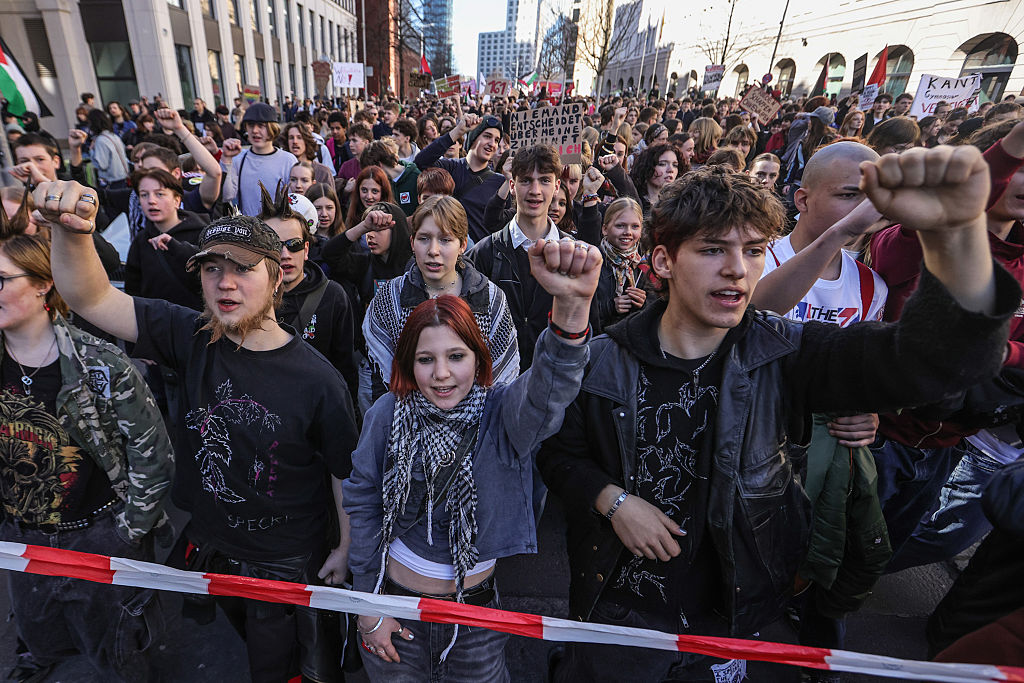
German ministers today routinely talk about making society ready for war and reintroducing military service. As Thursday’s school strike showed, the country’s youth are against the idea. (Omer Messinger / Getty Images)
It’s a sunny Thursday morning in Berlin’s central business district. In the shadow of shopping malls and corporate HQs, a large group of high schoolers has gathered. From a makeshift stage, two of their comrades start leading chants aimed at the German chancellor: “Friedrich Merz, suck my balls,” “Send Friedrich Merz to the front line,” and “Conscription — never again!”
The students are joined by a growing number of supporters, including representatives of the national teachers’ union, left-wing parties, and pacifist groups. Signs of solidarity with the Palestinian liberation struggle abound — to the dismay of the Berlin police, who blast announcements warning protesters that they risk arrest when covering their faces with keffiyehs. The crowd heads toward the historically left-wing neighborhood of Kreuzberg, swelling to about ten thousand protesters. It’s the second major school strike against Germany’s anticipated reintroduction of conscription, which has been suspended since 2011. In a coordinated nationwide action, over fifty thousand high schoolers and supporters in some 130 towns and cities took to the streets on Thursday. Their motto: “The rich want war — the youth, a future.”
The protests come just days after the US-Israeli attacks on Iran, which many here worry may develop into yet another war with global reverberations. Germany’s new government has not been shy in its own military ambitions, setting in motion the country’s largest militarization drive since World War II. Chancellor Merz has vowed to turn the armed forces into the “strongest conventional army in Europe.” To finance this ambition, Merz’s governing coalition has amended the federal republic’s strict constitutional spending rules (the “debt brake”) to allow for a massive increase in military spending. Berlin is committed to hiking military spending to 3.5 percent of its GDP by 2029 — an estimated €152 billion a year, exceeding the projected defense budgets of France and the United Kingdom combined.
In addition to direct military spending, the government has unveiled a €500 billion climate and infrastructure package, a significant part of which is dedicated to war-proofing Germany by creating a network of public shelters and upgrading the country’s rail, water, and highway systems to enable speedy and smooth troop movements. Flush with cash, Germany’s armed forces, the Bundeswehr, have been on a historic spending spree, ordering dozens of new F-35 fighter jets (whose designated purpose is to deliver US-owned nuclear arms stored in Germany in case of a nuclear conflict), Chinook helicopters, Tomahawk cruise missiles and missile launchers, Kamikaze drones, missile and air defense systems, armored vehicles, sensors, ammunition, as well as establishing a €35 billion space force. One key beneficiary of this historic splurge has been Germany’s biggest arms manufacturer, Rheinmetall, whose stock price has risen a staggering twenty-one-fold since 2022. As the mighty German car industry is facing a sustained crisis, auto plants around the country are now repurposed for arms production.
While scaling up the country’s military-industrial complex is one part of the equation, Merz’s plans also require a massive increase in personnel numbers. Berlin has vouched to raise the Bundeswehr’s combined active-duty strength from around 184,000 (as it is currently) to at least 260,000 by 2035. To encourage voluntary enrollment, it has introduced attractive salaries and perks for recruits while simultaneously introducing further cuts to the welfare state. Critics argue that such measures in effect exert pressure on young people from working-class and financially precarious backgrounds to sign up for military service. The Bundeswehr also maintains its practice of recruiting minors, with seventeen-year-olds making up one-eighth of recruits in 2025. According to human rights organization Terre des Hommes, “this makes the German Armed Forces one of the armies with the most underage soldiers worldwide.”
Despite these measures, the army has been struggling to meet its recruitment targets. This past December 5, the Bundestag (parliament) passed a law requiring all eighteen-year-old men to fill in questionnaires concerning their interest in military service, as well as to complete mandatory medical exams beginning in July 2027. Notably, the new law also contains a clause allowing the government to reinstate military service, which has been suspended since 2011, if recruitment targets are missed. Polling revealed these measures to be immensely unpopular with German youth, with 63 percent of eighteen- to twenty-nine-year-olds rejecting the new conscription law. On the day of the law’s passing, Germany’s streets erupted in outrage. Students skipped class and joined mobilizations in over ninety cities across the country in what became the first “school strike against conscription” (Schulstreik gegen Wehrpflicht). Thursday’s demonstrations show that the movement is enjoying sustained momentum, and that resistance to the new regulation is unlikely to wane anytime soon.
Repression and Unwanted Applause
Ostensibly surprised by the intensity of the backlash, the German political class reacted with a mix of embrace and dismissal. Defense Minister Boris Pistorius, a Social Democrat, directly addressed the striking students in a video message on Instagram, arguing that “freedom of expression is one of the major achievements of our democracy” — one that would have to be defended, at times, with arms. His party colleague Siemtje Möller was more blunt, calling the protests “pure populism, or simply nonsense.”
Meanwhile, politicians from Merz’s conservative Christian Democrats are pushing for an even faster introduction of conscription. In a recently published report, the parliamentary commissioner for the armed forces, Henning Otte, identified recruitment as a key challenge for the Bundeswehr and demanded a timely roadmap for the reintroduction of military service. As politicians from the ruling coalition like to point out, the reintroduction of conscription would not overrule the constitutionally guaranteed right for individual refusal. Those unwilling to serve would still be able to replace their military service with various forms of civilian service. However, many students are expressing doubts at such guarantees, pointing out that similar constitutional protections had existed in Ukraine but were immediately suspended after Russia invaded.
Students participating in the school strikes have faced various instances of repression. Stefan Düll, principal of a south German high school and president of the pro-establishment conservative teachers’ union Deutscher Lehrerverband, has warned students that participating in the strikes would be “unexcused absence” and could be punished with disciplinary measures “including expulsion.” Düll also called on schools to better inform their students about “the threat of Russia and its supporters.” In the east German city of Halberstadt, students were reportedly locked into a classroom to prevent them from attending the demonstration. In Berlin, the police arrested several students after the demonstration. In the northeast German city of Rostock, students were reportedly barred from demonstrating during school hours by the authorities, and in Munich some protesters had their signs removed by the police.
Unwanted applause has come from sections of the far-right Alternative für Deutschland (AfD) around neo-Nazi firebrand Björn Höcke, who have sought to capitalize on the movement’s energy. In a stunning parliamentary speech, Höcke argued that a Germany full of drag queens and mass immigration did not deserve to be defended, while admitting that he was not opposed, in principle, to military service. In the eastern state of Saxony-Anhalt, the AfD parliamentary group actively endorsed the school strikes — prompting organizers to immediately distance themselves from such attempts to co-opt them.
As movement scholar Simon Teune points out, school strikes have a long history as a political tactic employed by students in Germany and beyond. As early as during the German revolution of 1918–19, students organized themselves in councils, inspired by the spread of workers’ and soldiers’ councils. In 1919, they called for a big school strike aimed at abolishing corporal punishment and improving learning conditions in schools. More recently, Germany saw a large wave of school strikes for climate, with more than a million participants during the largest actions in September 2019. Some cadres of the current school strike against conscription were already involved during this earlier wave of mobilizations. While the climate strike movement was ultimately embraced by the German political mainstream, the present anti-militarist movement will be less easy to co-opt.
A Class Question
Despite massive pressure from different corners of the political spectrum, the movement has remained exceptionally disciplined in framing the conscription law above all as a question of class. In many cities, the strikes are led by coalitions of left-wing youth groups and student unions, with support from local unions and peace organizations. The movement has also received support from the democratic socialist Die Linke party, the only force in parliament to unequivocally reject the conscription law. On stage, the movement’s leaders never tire of pointing out that while military spending is projected to make up as much as half of the country’s federal budget in years to come, areas such as education, health care and social security are expected to see further budget cuts. There is a sentiment that the government has already done very little to address the concerns of young people, such as climate change, the housing crisis, and education, and is now asking for an even larger sacrifice: participation in the armed forces. On the sidelines of the Berlin protest, student representatives Kiran Schürmann and Selma Kuhlmann point out: “We know that this is not about values or democracy — it’s about the interests of German capital and its desire to control trade routes.”
Students have insisted on the internationalist nature of their struggle, connecting their action to anti-militarist movements in Spain, France, and beyond. During the demonstration in Berlin, speakers expressed solidarity with anti-imperialist struggles from Latin America to Palestine and in face of the recent US and Israeli–led attacks on Iran. As the demonstration reaches its destination, an activist from Sudan takes the stage. “Long live the Gen Z” he shouts, earning enthusiastic applause from the crowd. Several protesters are waving Straw Hat Jolly Roger flags borrowed from the Japanese manga series One Piece, a symbol of the Gen Z uprisings in Nepal, Madagascar, Kenya, and Morocco. Following the speech, a young punk band begins playing. Some protesters separate themselves from the crowd and gather in front of a police vehicle to show support to their arrested comrades. The organizers announce that they have already planned their next school strike. It will take place on May 8 — the anniversary of Germany’s liberation from fascism. The symbolism could not be more apt.