America’s Holy War in Iran

For roughly half a century, a certain strain of American evangelical theology has taught millions of believers to read conflicts like Trump’s war with Iran not simply as geopolitics in action but as prophecy unfolding in real time. I was one of them.
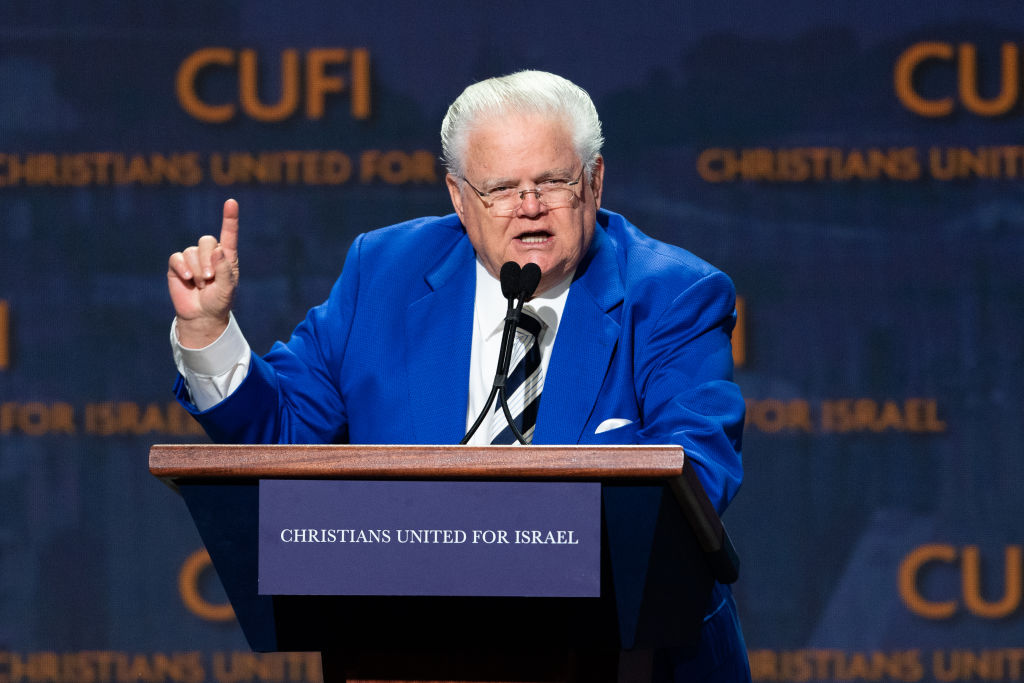
After the Cold War ended and the Satanic Panic died down, doomsday prophets needed a new geopolitical antagonist. Increasingly, their attention turned toward Iran. (Michael Brochstein / SOPA Images / LightRocket via Getty Images)

This week, Secretary of State Marco Rubio characterized the leadership of Iran as “radical Shiite clerics” who make geopolitical decisions based on “pure theology.”

That’s deeply ironic because an American combat unit commander reportedly told officers at a briefing last Monday that the war with Iran was, in fact, part of God’s plan. President Donald Trump, the commander allegedly explained, had been “anointed by Jesus to light the signal fire in Iran to cause Armageddon and mark his return to Earth.” Since the launch of Operation Epic Fury, the Military Religious Freedom Foundation (MRFF) has been inundated with dozens of similar complaints from service members across every branch of the military. The reports describe an “unrestricted euphoria” among commanders who believe they are not just fighting a war, but fulfilling the Book of Revelation itself.

One popular tweet circulating this week attempted to explain these End Times furies with a photo of the Left Behind book series beloved by American evangelicals: “I don’t think enough people realize how much Republican foreign policy is actually shaped by this fictional book series,” it read.

It’s a funny line. It’s also not quite right.

The Left Behind novels — the evangelical thriller series written in the 1990s by Tim LaHaye and Jerry B. Jenkins that became a series of poorly made films starring Kirk Cameron and (somehow) a Nicolas Cage reboot — didn’t invent the apocalyptic worldview resurfacing in today’s headlines. They merely dramatized and popularized it. For roughly half a century, a certain strain of American evangelical theology has taught millions of believers to read conflict in the Middle East not simply as geopolitics in action but as prophecy unfolding in real time.

The intellectual architecture of this worldview actually dates back to the nineteenth century. In the 1830s, Anglo-Irish preacher John Nelson Darby developed a system of biblical interpretation known as dispensationalism. Darby proposed that human history unfolds in the Bible in seven distinct divine “dispensations,” or periods in which God deals with man differently, from Adam and Eve, to the Great Flood, to the crucifixion and resurrection of Jesus Christ, and so on. The seventh and final age, or the Kingdom Age, is believed to culminate in a climactic period of global upheaval before the Rapture, when believers would be magically transported to heaven. Then, as the story goes, the Antichrist would rule the world for a period of time until Jesus returns and rules a new paradise on Earth for a thousand years.

Dispensationalism migrated to the United States and eventually flourished in American evangelical culture. For most Christians, this theology is not especially persuasive. Catholic, Orthodox, and many Protestant traditions interpret the Book of Revelation symbolically, rather than as a literal forecast of twenty-first century geopolitics, or as a metaphor for the politics of the time when the New Testament was written. Many biblical scholars, for instance, believe that the references to “the Beast” in the Bible refer to the Roman Emperor Nero, notorious for his state-sponsored persecution of the early church.

The Scofield Reference Bible, published in 1909, embedded Darby’s interpretive notes alongside scripture, helping generations of readers treat biblical prophecy as a coded map of world events. Certain strains of rapture-obsessed evangelicalism spread further due to the influence of Hal Lindsey’s bestselling 1970 book The Late Great Planet Earth. Lindsey perceived the creation of the modern state of Israel in 1948 and then the return of Jerusalem to the Israeli state as pivotal events that signaled that the End Times were near. Central to the modern interpretation of this worldview is the Old Testament book of Ezekiel 38, which describes a coalition of nations — traditionally identified by prophecy “experts” as Russia, Turkey, and Persia (modern-day Iran) — descending upon Israel in the “War of Gog and Magog.” The Soviet Union, Lindsey speculated, might represent the mysterious northern coalition described in the Book of Ezekiel, and he foresaw the coming of Armageddon sometime during the Ronald Reagan administration of the 1980s.

It’s largely forgotten now, but The Late Great Planet Earth made a huge splash in America after the chaos of the 1960s, the uncertainty of the Cold War, and the existential threat of nuclear war had many people seeking answers, especially mystical ones. Lindsey explained his theology on a prime-time television special in 1974, with an audience of seventeen million, and Orson Welles narrated a documentary film version a few years later. Other cultural artifacts spread dispensationalism’s ideas of the Rapture, Armageddon, the Antichrist, and the Beast — ranging from William Butler Yeats’s oft-misunderstood 1919 poem “The Second Coming” to the 1976 horror film The Omen, which invented the idea that the Antichrist would be the son of Satan bearing a birthmark with the numbers “666.” Even 1980s heavy metal groups liked to reference Biblical prophecy — Iron Maiden’s 1982 thrash metal hit “Number of the Beast,” for instance.

The Left Behind novels released in the mid-1990s weren’t even the first to dramatize the final stage of dispensationalism. That would be a quartet of Christian horror movies released in the 1970s and ’80s called A Thief in the Night that focuses on a group of characters who miss the Rapture and have to live through the seven-year “Great Tribulation,” in which they must take the Mark of the Beast as administered by the United Nations or be executed by guillotine. I was one of tens of millions of evangelicals who were haunted after attending A Thief in the Night watch parties at church. Soon afterward, my father bought a Scofield Bible and Hal Lindsey’s oeuvre and became obsessed with dispensationalism. He was later convinced Barack Obama was the Antichrist.

In the aughts, Obama’s election struck some prophecy interpreters as a sign. The Cold War had ended, and the Satanic Panic died down, so dispensationalists and doomsday prophets needed a new geopolitical antagonist. Increasingly, their attention turned toward Iran. Among the most prolific voices in this tradition is Oklahoma pastor and author Mark Hitchcock. This post-9/11 Hal Lindsey has spent years arguing that modern Iran sits at the center of the Bible’s end-times scenario. In books such as Iran: The Coming Crisis, The Apocalypse of Ahmadinejad, Iran and Israel, and Showdown with Iran, Hitchcock presents Iran as the modern incarnation of “Persia,” a nation explicitly named in the prophetic war described in Ezekiel 38. “He stands only 5-foot-4 and smiles incessantly, but behind that charismatic persona beats the heart of a genocidal terrorist,” he wrote. “[Mahmoud] Ahmadinejad plans to hasten the return of the Islamic messiah by ushering in his vision of the apocalypse.” Hitchcock argues that the current geopolitical tensions are the “perfect buildup” for his scenario, and the destruction of the world order is the necessary price for the “immediate, sudden extraction” of the faithful from a crumbling world.

Much of the current strain of Christian Zionism seen in contemporary evangelical churches comes from a similar belief in the United States’ and Israel’s dual role in jump-starting the Biblical End Times, usually involving a battle against Iran. Christian Zionists got an important seat at the political table in the first Trump administration in the form of Vice President Mike Pence. In 2018, when Pence visited Israel in his official capacity, he vowed to alter or cancel the Iran deal, promised that the US Embassy would open in Jerusalem earlier than planned, and vowed to protect Israel’s holy sites. “For messianic Jews and Evangelicals, like Pence, the speech was a confirmation that momentous days are here again, with sounds of rapture and signs of the Messiah,” noted an editorial in Haaretz after the visit.

That kind of biblical talk waned in the intervening years, but the war with Iran has clearly revived it, even though evangelical influence in the Trump II administration is significantly weaker than in the first. That the MRFF is now reporting complaints from more than forty different American military units across at least thirty installations indicates that this strange marriage of statecraft and scripture has also moved into the Pentagon. Meanwhile, Senator John Cornyn (announced as “one of Israel’s greatest friends”) attended an alarmist sermon by dispensationalist TV preacher John Hagee, and founder of Christians United for Israel (CUFI), in San Antonio, which was ominously titled: “End of Days: Operation Epic Fury.”

Trump himself, of course, is not exactly a theologian. He has never shown much interest in evangelical doctrine and rarely speaks the language of prophecy that pastors like Hagee or Hitchcock deploy. What he does understand, however, is the political value of religious symbolism. Few presidents have embraced the role of providential figure quite so enthusiastically, from posing with Bibles to suggesting that divine forces intervened to spare his life.

In that sense, Trump occupies a peculiar place in the prophecy ecosystem now swirling around the Iran war. To some believers, he is a kind of King Cyrus figure — an unlikely Persian ruler chosen by God to set in motion history’s final act. To others watching the same events unfold, the symbolism points in a darker direction. After all, the Book of Revelation also features a charismatic world leader who rises amid chaos and commands the loyalty of millions. It’s no accident that “Is Donald Trump the Antichrist?” has become a recurring topic in the online prophecy circuit.

This makes Marco Rubio’s critique of Iran’s “radical Shiite clerics” formulating policy based on theology feel strangely symmetrical. Iranian apocalyptic beliefs about the return of the Mahdi may indeed shape how some leaders in Tehran view the world. But when American commanders are reportedly invoking Armageddon in military briefings, and US senators attend “End of Days” sermons, it becomes harder to claim that prophecy is influencing only one side of the conflict.