With Chuck Norris, the Meme Was the Message
Twenty years before Donald Trump was posting AI images of himself as a king, the internet learned how to meme by exaggerating the masculine superiority of Chuck Norris. What began innocently with “Chuck Norris Facts” has evolved into MAGA’s empire of slop.
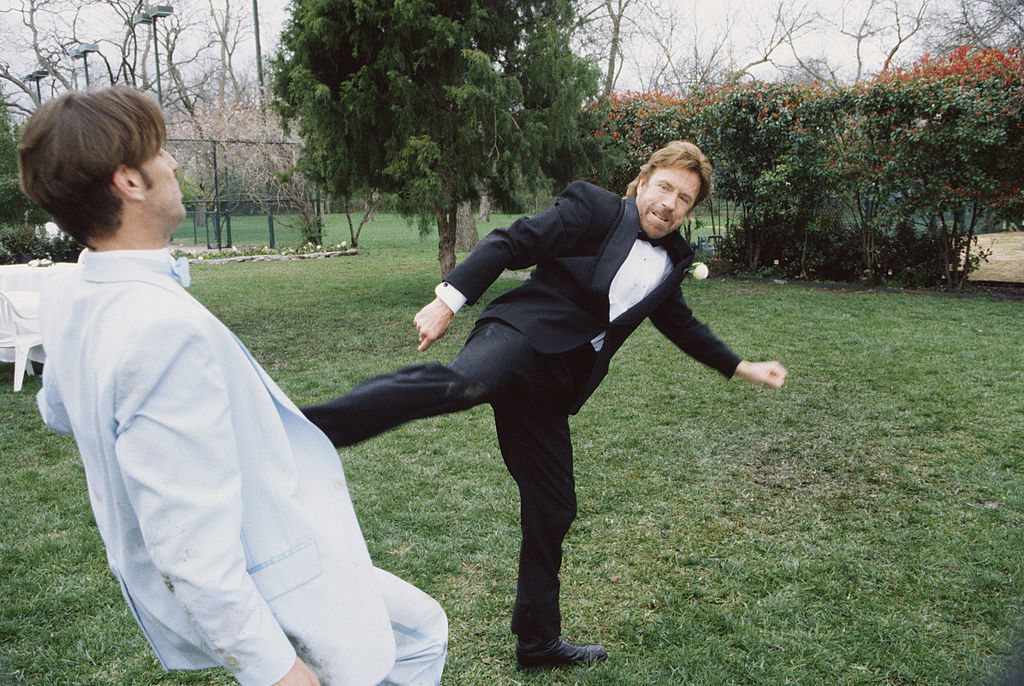
Long before memes became instruments of political warfare, Chuck Norris was the strongest man in the world because everyone agreed to pretend he was. That was the joke. Now it is more or less how politics works. (CBS Photo Archive / Getty Images)
When Chuck Norris died Thursday in Hawaii at the age of eighty-six, the internet, the medium that ultimately defined him more than any film or television role, duly noted his passing with a mix of irony and sincerity.
“Chuck Norris will NOT be resting in peace,” wrote the digital artist Beeple, accompanied by an AI image of Norris in hand-to-hand combat with angels in heaven. “Chuck Norris passed away just so he could punch Satan in the face,” another user replied.
It was a fitting tribute. Norris left the earthly plane with a profoundly bizarre legacy that passed through several distinctly American incarnations: karate champion, B movie action star, Walker, Texas Ranger icon, and then, improbably, patron saint of the early meme web. Squint hard enough and you can spot in “Chuck Norris Facts” the DNA of the “based” right-wing political propaganda of today — the America-as-’80s-action-hero White House videos, the dehumanizing sh-tposting, and creepy AI-generated sludge.
Norris once made propaganda for the American militarism of a previous age. Born Carlos Ray Norris, he was an Air Force veteran and a black belt in martial arts before appearing in film. Early in his film career, he represented a stoic, bland American version of Bruce Lee (they even squared off in the 1972 kung fu film The Way of the Dragon). In the 1980s, he picked up a gun and became a perfect cinematic symbol of the Ronald Reagan era, a shoot-first-ask-questions-later cowboy commando out to do America’s dirty work on screen. Gen Xers know him best as the star of Missing in Action, a cartoonish action trilogy in which Norris flies to Vietnam to rescue prisoners of war — violently, of course. Norris, an outspoken Reagan supporter, admitted that Missing in Action was meant as a corrective to the anti-government mood of Sylvester Stallone’s Rambo. The goal, he said, was “to instill a positive attitude” about the Vietnam War.
In 1985, he cowrote and starred in the pulpy hit Invasion USA, about a CIA agent battling Soviet-backed guerrillas from Cuba who land in South Florida to commit terroristic acts. As with Missing in Action, Norris intended Invasion USA to promote militarism and justify increased national defense spending at America’s borders. “What if some guy on the order of a [Ayatollah Ruhollah] Khomeini or a [Muammar] Gaddafi mobilized those guys and started sending them out to every major city?” he said. “I know it’s going to happen.”
Norris’s star dimmed after the end of the Cold War, though he remained in the public eye with his CBS series Walker, Texas Ranger. He was always more of a living action figure than a talented actor in the first place, and Walker worked largely because it appealed to aging viewers still nostalgic for John Wayne.
By the early aughts, that dated form of American macho righteousness had become ripe for a different kind of afterlife: early-internet irony in the form of “Chuck Norris Facts.” In 2005, a high school senior named Ian Spector was stuck at home on a boring Friday night and logged onto SomethingAwful.com, a pre-Reddit Reddit for teenagers. There, he swapped “Facts about Vin Diesel,” a similar preexisting meme, with absurdist bons mots about Chuck Norris. The joke landed: Within months, Spector had twenty million hits a month, a book deal, and, later, a cease-and-desist letter from Norris’s lawyers. A meme had been born, though nobody quite called it that yet.
“A cobra once bit Chuck Norris’s leg. After five days of excruciating pain, the cobra died.” “When the Hulk gets angry, he turns into Chuck Norris.” “In an emergency, 911 calls him.” Norris did not merely beat bad guys in “Chuck Norris Facts”; he intimidated physics and broke the laws of nature. These jokes, the internet equivalent of tall tales, circulated across forums, chain emails, MySpace pages, and Facebook feeds during a more innocent time. This was also the era of online that gave us LOLcats, Epic Bacon, and the so-bad-it’s-good anti-racist anthem “Chocolate Rain.” The web was a novelty machine — goofy, warm, occasionally stupid, mostly harmless.
It is tempting to remember all this as innocent, and in a sense it was: a comic mockery and celebration of strength and masculine invulnerability. Norris memes were not written by Pentagon contractors or engagement farmers in a content bunker. They were just jokes passed around by bored people amusing one another. But you can see something more sinister in them too: an early lesson in memetic power. The AI-generated slop that now saturates right-wing social media, including from Donald Trump himself — Trump as Roman emperor, Iran crushed beneath a digital boot, the endless parade of hypermasculine fantasy imagery — often feels like a weaponized descendant of “Chuck Norris Facts.”
Today, Norris exits with a legacy stranger than most actors could ever hope for. He was first a Reagan-era fantasy of righteous American force, then an object of affectionate internet exaggeration, and finally, in retrospect, a clue to where online culture was heading. Long before memes became instruments of political warfare, he was simply the strongest man in the world because everyone agreed to pretend he was. That was the joke. Now it is more or less how politics works.