Robber Barons Are Doing Better Than Ever
A new report finds wealth inequality in Canada is reaching new heights, with a tiny elite enjoying lavish lifestyles while the many are left in the cold. The problem is not just moral obscenity but that democracy is perverted by vast wealth concentration.
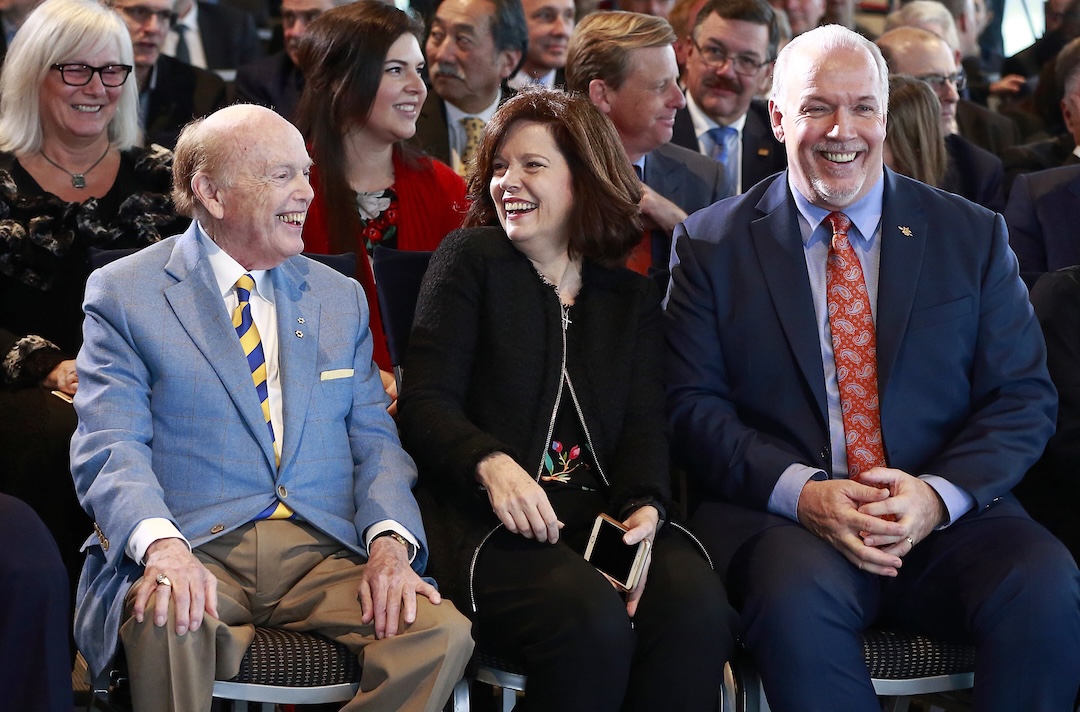
Jim Pattison (left) is one of the richest people in Canada, with a net worth of US$6.75 billion as of 2024. (Province of British Columbia)
- Interview by
- David Moscrop
Canadians for Tax Fairness has found that wealth concentration in Canada has risen over the last twenty-five years, with a handful of families living large while amassing average fortunes approaching $500 million. Ordinary households, meanwhile, continue to struggle to afford bread and milk. That’s not just bad news for the Canadians and their economy but for democracy too.
Jacobin’s David Moscrop recently talked with Silas Xuereb, a researcher and policy analyst with Canadians for Tax Fairness and a coauthor of the report The New Robber Barons: A Quarter Century of Wealth Concentration in Canada.
David Moscrop
What has the trajectory of wealth distribution in Canada been in the last two and a half decades?
Silas Xuereb
We have data in this report from 1999 up until 2023. Over that time period, we see an increase in the concentration of wealth, by which we mean the net worth of families — the total amount of assets they hold, including real estate and stocks and bonds, minus any debts they hold. The concentration of that wealth has increased over time. The wealth owned by the top 1 percent of Canadian families has increased from around 19.3 percent to nearly 23 percent of total wealth today.
If we look even more closely at the ultrawealthy, the wealthiest 1,600 or 1,700 families — about 0.01 percent of all families in Canada — now hold on average nearly $450 million in wealth each, which is four times more than they had twenty-five years ago and over four thousand times the average wealth of a family in the bottom 50 percent in 2023. The overall trend of the last twenty-five years is that wealth has become increasingly concentrated among the wealthiest Canadian families.
David Moscrop
What’s driving the concentration of wealth?
Silas Xuereb
There are a few different things that could be driving it. We can see in the data that people who have higher wealth to start with tend to get higher returns on their wealth than people with smaller fortunes. And this could be for a few reasons. People with large fortunes tend to have access to a wider range of investment opportunities. They might be able to take on greater risk than people with less wealth. And they also might be able to use the power that comes with having huge amounts of wealth to influence politicians and public policy. That might also help them get higher returns on their wealth.
We’ve also seen huge appreciation in the stock market over the past twenty-five years, and we know that corporations are predominantly owned by the wealthiest Canadian families. When we see the stock market growing so much, that tends to increasingly concentrate wealth among the already wealthiest families.
Wealth Begetting Wealth
David Moscrop
Sometimes people conflate wealth and income inequality. What’s the difference between the two?
Silas Xuereb
The two are certainly linked. Income is the flow of economic assets that people get every year. It’s your salaries or your dividends and other stuff like that. Whereas wealth is about the stock of assets that someone holds. The two are definitely linked because when someone makes more income, they tend to also save some of that income, increasing their wealth. And when someone is already very wealthy, they tend to get income from that wealth, and that can help them accrue more income and compound their wealth as well.
Wealth inequality tends to be more extreme than income inequality just because of the nature of asset ownership in our economy, which tends to be very concentrated. More people have significant incomes than have significant amounts of wealth.
For most people, wealth consists primarily of the value of their house — if they’re lucky enough to own a home — less their mortgage, plus maybe some retirement assets. But a lot of people have little to no wealth at all. Renters, for example, often have very little — even negative wealth is very common these days among young people.
David Moscrop
Why should we care about wealth inequality? What does the concentration of wealth do to, say, households and to workplaces?
Silas Xuereb
One clear impact of wealth inequality is on house prices. We’ve seen a huge spike in house prices in the last twenty-five years. And while this benefits a broad section of Canadians, it also makes the housing market much more difficult to access.
People talk a lot about demand for housing coming from immigration, but we don’t talk about the demand for housing that comes from investors. And the fact is that there is a growing group of ultrawealthy people who have money to spend and are looking for assets to invest in — their demand for housing is also going to drive up the price of those houses, making housing less affordable.
On the workplace side, it means that most people don’t have a lot of control over their workplaces. It means that most workplaces are owned by a few ultrawealthy individuals who get to decide how to run those workplaces as they see fit. This can lead to a lot of corporations taking stances that tend to benefit their owners rather than the majority of people who work for them.
We’ve seen examples in the United States like with Jeff Bezos and the Washington Post. He takes over the Washington Post, and we very immediately start to see a change in the newspaper’s editorial stance. Most recently, we saw a massive gutting of the journalism taking place there. So, we can see really direct effects when these very few ultrawealthy individuals take control of these massive workplaces.
Golden Hands on the Levers of Power
David Moscrop
What about political effects? If we think of wealth as, among other things, power, how does the concentration of wealth shape democracy?
Silas Xuereb
I think one of the most important things that we fail to address in our politics is how deeply economic wealth and political power are interconnected. We really need to take note of what’s happening in the United States. We’re seeing this kind of slide into authoritarianism, and we can’t separate that from the fact that the administration is being led by a billionaire. He appointed a record thirteen other billionaires to top roles in his administration. We’re seeing that the people who have accrued vast economic wealth have been able to translate that into political power and are now using the institutions of the state to benefit themselves at the expense of everyone else.
While we haven’t quite reached that point in Canada yet — the United States does have much higher wealth inequality than Canada — but we already have our own billionaires who own our media outlets. We have the Thompson family and the Rogers family. We have families like the Irvings who are able to secure massive government subsidies. If we’re concerned about democracy, about our sovereignty, we can’t just be worried about foreign threats — we also need to think about the concentration of wealth and power at home because concentrating that power among a few individuals is also very undemocratic.
David Moscrop
Does the scale or the expression of wealth inequality matter more now than it did in, say, 1999 or even in 2015? At a certain point, quantity takes on a quality of its own, especially if it coincides with geopolitical upheaval or institutional decline.
Silas Xuereb
I think that’s possible, especially since we’re in some kind of political rupture, a moment when, as Mark Carney says, the old international order is breaking down. Significant changes to our political system could happen in a way that maybe didn’t seem so possible twenty or thirty years ago — when the mainstream neoliberal narratives were really dominant and widely accepted. We are living through a break right now. Like you said, if we have this extreme concentration of economic and political power now, that might give those few people the chance to really influence the direction that we take moving forward as we shift toward some kind of new international political order. We need to really take this issue seriously so that we can democratically decide what kind of new political order we want to forge moving forward and not allow it to be shaped by just these few wealthy families.
Taxing Dynastic Wealth
David Moscrop
Say we wanted to reverse the trend and level things out a bit. How would we go about redistributing wealth — both in the sense of the literal redistribution of the wealth that’s already been created and also in reshaping how wealth is distributed in the first place?
Silas Xuereb
On redistributing wealth that we already have: there are definitely some tax policy tools that we can use. We could start with a form of wealth tax. This is something that countries around the world have used before and many, many countries — Colombia, Norway, Spain, and Switzerland — have right now. My coauthor Alex Hemingway’s calculations have suggested that a pretty modest wealth tax in Canada could have huge revenue raising ability: it could raise nearly $40 billion in its first year and would only affect one in two hundred Canadian families — only the very, very wealthiest. And this kind of thing is massively popular. Polls show that nearly 90 percent of Canadians support a wealth tax.
There are other things we could do as well. We could improve our taxation of inheritances. For example, when we wrote the report, the wealthiest family in Canada was the Thompson family — and they were also the wealthiest family in Canada twenty-five years ago. And they were also one of the wealthiest families in Canada fifty years ago. They’re currently on their third generation as ultrawealthy individuals because we don’t have a good inheritance tax system in this country. There are reforms we could make to close loopholes around capital gains and around tax havens too that could contribute to preventing this wealth accumulation in the future.
But I don’t want to suggest that tax policy alone is going to change how wealth is created and accumulated. If we’re going to build a better, more democratic future, we need workers to organize. We need people to organize in their local communities and build power there and have people ready to fight for the future that we want — that’s what it’s going to take if we want to build a more equitable and democratic country.