The Authoritarian Feelings Machine
From Trump to Orbán, Meloni to Modi, leaders around the world have turned fear, grievance, and national pride into political instruments. Their appeal does not rest on charisma alone but also on the deep insecurity produced by neoliberalism’s long crisis.
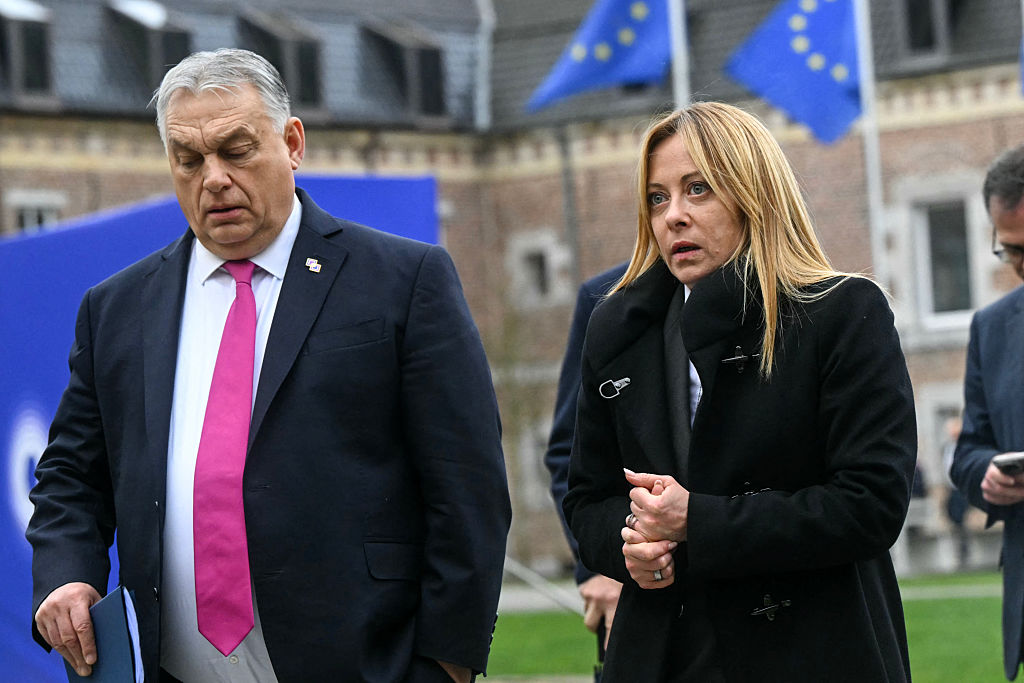
National pride, resentment, and fear undergird the rhetoric of national populist leaders across the globe. (Nicolas Tucat / AFP via Getty Images)
- Interview by
- Dora Mengüç
Over the past several decades, neoliberalism has hollowed out the social and emotional foundations of political life. As welfare states eroded, precarious labor expanded, and public protections disappeared while a new atmosphere of insecurity emerged — one in which anger, fear, resentment, wounded pride, and a longing for belonging became powerful political currencies.
This emotional terrain is not theoretical. It is inscribed in the rhetoric of today’s most influential leaders. Donald Trump vows to speak for “the forgotten.” Viktor Orbán warns that Europe is “under siege.” Narendra Modi frames political transformation as a “national rebirth.” Giorgia Meloni claims identity — “a woman, a mother, an Italian, a Christian” — as a fortress under threat. Javier Milei shouts that “everything will collapse” without radical rupture. Benjamin Netanyahu casts each crisis as a battle for national survival.
Their vocabularies differ, but they share the same emotional grammar: mobilizing fear, pride, humiliation, and existential anxiety in societies fractured by neoliberal restructuring. The rise of today’s authoritarian-populist formations cannot be understood through charisma alone; they are rooted in a deeper landscape of economic precarity, social fragmentation, and collapsing institutional trust.
To understand this convergence of emotion and power, Jacobin spoke with sociologist Mabel Berezin, whose work explores the relationship between affect, political identity, and the historical development of right-wing movements. In this conversation, Berezin explains how emotions become political tools, why new right-wing formations resonate across continents, and how neoliberalism prepared the ground for new modes of authority.
Material Foundations, Emotional Crises
Dora Mengüç
Before we get into structural forces, I want to start with the raw material itself: emotions. Contemporary politics often feels driven not by programs but by fear, pride, and resentment. How do emotions shape political belonging today, and how do leaders convert emotional attachment into lasting loyalty?
Mabel Berezin
Emotions have always been central to politics. Any effective leader — left or right — knows how to work with them. But emotions never operate alone. People respond to what they feel and to what they believe they might materially gain.
Durable political loyalty emerges when affect merges with what I call “deliverables”: economic gains, symbolic victories, or the sense that a leader fills a void. When emotions and material expectations converge, political attachment becomes lasting.
Dora Mengüç
You’ve argued that emotional politics alone cannot explain today’s right-wing endurance. Are emotions or material conditions more decisive — and how do contemporary leaders combine the two?
Mabel Berezin
They are inseparable. Emotional mobilization matters, but without material grounding, it loses force. In many countries where the neoauthoritarian right has risen, leaders combine emotionally charged narratives with symbolic or concrete gestures that address material concerns.
Fear and resentment become politically powerful only when attached to lived experiences of insecurity, inequality, and unfulfilled expectations.
Dora Mengüç
I want to ask about a tool many of these leaders rely on: division. Why has polarization become such an effective political strategy in the neoliberal era?
Mabel Berezin
Because polarization simplifies a world made structurally unstable by neoliberalism. As institutions weaken and people lose economic security, binary narratives provide clarity and direction.
In competitive authoritarian contexts, polarization also helps consolidate power: it frames the leader as the indispensable protector against hostile “others.”
Political-Theological Identitarians
Dora Mengüç
Once polarization takes hold, its language is shaped by slogans — simple, ambiguous, emotionally loaded. Why do vague political slogans mobilize people so effectively today?
Mabel Berezin
Their power lies in their emptiness. Vague slogans allow people to project their own fears and desires onto them. This was true in the 1920s and 1930s as well — authoritarian propaganda used ambiguity to spark collective imagination.
Under neoliberal precarity, vague promises become even more potent because they can absorb the anxieties of fragmented societies.
Dora Mengüç
Let’s talk about the figures who deliver these slogans: leaders who present themselves almost as vessels of meaning. When leaders say, “I am you” or “I speak for you,” are they constructing a new political-theological identity?
Mabel Berezin
In a sense, yes. This rhetoric transforms leaders from ordinary actors into quasi-theological figures. They become symbols rather than individuals with policy programs.
This works most powerfully in societies already marked by fragmentation, cultural tension, or institutional decay. Where it resonates, it creates emotional absoluteness around the leader.
Dora Mengüç
These emotional dynamics feel global partly because the economic conditions behind them are global. How did neoliberal restructuring and the erosion of welfare states fuel the rise of contemporary authoritarian-populist movements?
Mabel Berezin
From the 1990s onward, the erosion of welfare protections weakened the bond between citizens and the state. Job stability collapsed, public guarantees shrank, long-term predictability disappeared.
My comparative research showed that neoliberal restructuring produced emotional responses — fear, frustration, disillusionment — that authoritarian-populist movements harnessed. The economic crisis created the material foundation; the emotional crisis created the political opportunity.
The Rage of the Abandoned
Dora Mengüç
There’s a long-running debate about whether today’s right is driven mainly by cultural identity or economic decline. Is the new right primarily about identity politics — or is economic insecurity still the deeper force?
Mabel Berezin
Identity matters, but economic insecurity is the structural backdrop. Without it, identity appeals lack political force. When structural problems go unresolved, people become more receptive to the promises of neoauthoritarian or competitive-authoritarian actors.
Dora Mengüç
One emotion keeps returning across different societies: a sense of abandonment. Why has the feeling that “the state no longer protects us” become so politically decisive?
Mabel Berezin
Because it captures the essence of the neoliberal era. Across the United States, Europe, and beyond, people feel abandoned by institutions that once guaranteed stability.
This feeling is rooted in real conditions: precarious labor markets, shrinking public services, weakened welfare protections, overstretched institutions. When people feel unprotected, strongman politics becomes attractive.
Dora Mengüç
You say emotions are necessary but not sufficient in politics. What distinguishes authoritarian leaders in the way they mobilize emotions?
Mabel Berezin
Their willingness to cross boundaries. Authoritarian leaders exploit emotions aggressively, often rejecting rhetorical or institutional norms altogether. This transgressive style draws attention and intensifies mobilization.
But material conditions matter. Emotional manipulation gains traction because economic distress creates fertile ground.
Dora Mengüç
Finally, after all these layers — emotion, economics, polarization, identity, leadership — what analytical framework helps us make sense of contemporary politics?
Mabel Berezin
A multidimensional one. To understand today’s landscape, we must examine how emotions are politicized, how neoliberal economies generate insecurity, how authoritarian-populist formations fill the resulting void, and how structural crises reshape political identities.
Neither purely emotional nor purely economic explanations suffice. Emotions become politically decisive only when rooted in material erosion, collapsing state capacity, and the social fragmentation produced by neoliberalism.