A High School Socialist Is Taking on the Bosses in Texas

Reese Armstrong

High school student Reese Armstrong is mounting a socialist campaign for commissioner in Travis County, Texas. It’s a safe bet that Armstrong’s focus on public health care, social housing investment, and class politics will surprise voters more than their age.
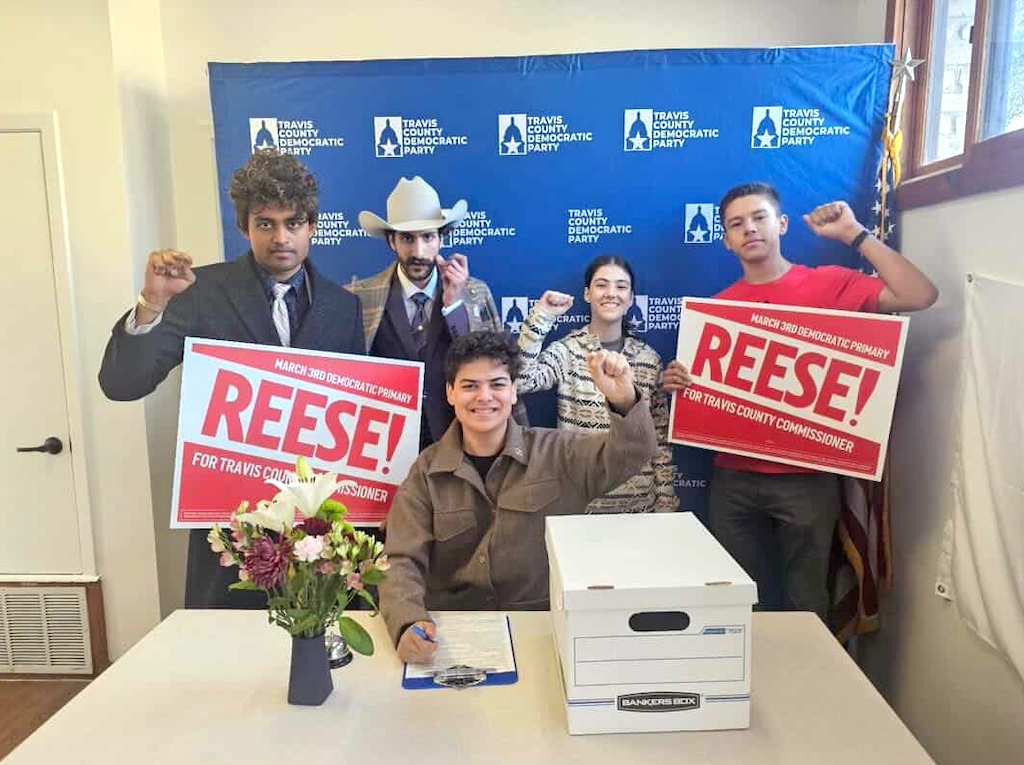
At just seventeen, Reese Armstrong is one of the youngest candidates in the country running for office. (Reese for Travis County)

Interview by
Trey Cook

Young people across the country are fighting back against the incredible challenges they face, from housing and wages to health care and political representation. Inspired by fellow members of Young Democratic Socialists of America (YDSA), high schooler Reese Armstrong has stepped up to represent the workers, tenants, and students of Texas’s Travis County. At just seventeen, Armstrong is one of the youngest candidates in the country running for office, seeking a seat on the Travis County Commissioners Court in the Second Precinct — a body that shapes everything from public health and county courts to infrastructure and housing policy in one of the fastest-growing regions in the state.

Growing up in Austin, Armstrong cut their teeth in student organizing, helping build networks across high schools and taking on fights over school governance and neighborhood displacement. Their campaign is rooted in those experiences and in the reality facing many young people in the Second Precinct, where rapid development, rising rents, and stagnant wages are pushing working-class families out of the communities where they grew up. The race unfolds in a county often described as a progressive outpost within Texas, yet it is also one constrained by state preemption, gerrymandering, and the influence of business and police lobbies.

Armstrong is a member of YDSA but is not endorsed by Austin Democratic Socialists of America (DSA) in this race. Their candidacy offers a test case: whether a student-led, openly socialist campaign, without the backing of the city’s largest socialist organization, can build a durable coalition among renters, workers, and young voters. Jacobin recently caught up with Reese to talk with them about their campaign and how they view the challenges ahead.


Trey Cook

You are one of the youngest candidates in the country running for elected office in a conservative state. What convinced you that now was the right moment to step into a race this big? People often caricaturize teenagers as preoccupied with Fortnite, dismissed as distracted or disengaged.

Reese Armstrong

It comes down to my core beliefs: that all people are people, from youth to the elderly. It appears to be obvious, even condescendingly so, yet it’s not something regarded often in society. Young people face extraordinary barriers to participating with respect and dignity in our public life. We’re systematically disenfranchised, written off as “Fortnite gamers” who haven’t earned a respectable voice — especially those of us from the working class — all while an ever-eroding social safety net limits our ability to stay afloat day-to-day.

Ultimately, age is a characteristic used to divide the working class, just like race, ethnicity, religion, and so on. If we believe that all people deserve inclusion in our democracy and nobody is disposable, then we must practice what we preach and support people without reinforcing divisions weaponized by the capitalist class.

YDSA members who run for office represent student-heavy districts. (Reese for Travis County)

As it pertains to this race specifically, it felt like the next step toward building permanent student power citywide and engaging a much larger base in our work. We had built our nascent student movement into something with multiple chapters across Austin, taken on school administrators through a student union drive, and were hungry to build out our membership with an electric campaign that could inspire a larger audience to get involved.

Electoral campaigns are how the vast majority of Americans view their involvement in politics, and we need to meet people where they’re at to build a mass movement. Electoral campaigns are about so much more than just winning or losing — they capture attention, which we can use to build buy-in to our political program among the working class and structure test our movement’s support. Bernie [Sanders]’s 2016 campaign may not have won, but it revitalized the American left.

The Youth Vote

Trey Cook

Most YDSA members who run for office represent student-heavy districts. Who lives in your precinct? What makes you feel equipped to represent them as a high schooler? Do you intend to stay for the duration of your term?

And how are Texas’s voting laws affecting your strategy? Registering students, who are significantly less likely to vote, can be a major factor in a campaign’s success.

Reese Armstrong

While the Second Precinct has a number of students in it — multiple high schools, the main Austin Community College campus, and a good chunk of University of Texas at Austin students who have moved into off-campus housing — it has been explicitly gerrymandered to exclude the university as part of “cracking” central Austin to hinder progressives’ efforts to win seats on the commissioners court. This race isn’t a home run for student-led politics but rather an opportunity to expand our base, build citywide student power, and develop coalitions. This precinct contains the community I’ve grown up in, one of predominantly working-class families who are being priced out of housing, with young people who are increasingly unable to live where they grew up.

As you mention, the restrictive voter laws present challenges to mass voter registration — for instance, requiring registration at least thirty days before an election. However, considering the already difficult task of engaging young people, it doesn’t represent the majority of our concerns. We’ve been hosting voter registration drives, getting people registered as volunteer deputy registrars to reduce barriers, and phone banking absentee college students still registered locally to ensure they are ready to vote. Campaigning in Texas provides a unique set of barriers, but it’s nothing organized people haven’t overcome before.

Our movement is equipped to govern for a full term and beyond because we face the crises of late-stage capitalism each and every day. And as young people, we have a clear view of the necessity of solving these problems to ensure everyone can live a dignified life. In this environment, only socialists have the vision and determination to build a new world that works for all of us — from the ashes of the old.

Trey Cook

Growing up in Travis County, what experiences shaped how you see local government and its responsibilities to ordinary people?

Reese Armstrong

Growing up, I have watched life slowly dwindle out of reach for working-class people here in Travis County, most notably due to the housing bubble that was created shortly after we purchased our family home in 2014. Very quickly, I found myself getting engaged with the local neighborhood association to fight for land-use reforms, called CodeNEXT at the time, in an attempt to resolve this crisis by increasing local housing supply.

My first canvass was for a campaign to add a bike lane down a busy corridor, a small issue that helped build the larger movement. This campaign pitted us against longtime wealthy property owners, intent on keeping property values high and working-class people out of the neighborhood — a fight that has inspired me to this day. Housing has defined the past twenty years of Travis County politics, and the only winners have been landlords and real estate speculators, at the expense of the working-class people who call this community home.

Toward Stability and Dignity

Trey Cook

County commissioners usually operate far from the spotlight. What is one power of the office that young voters might not realize affects their daily lives?

Reese Armstrong

I think the county’s role in providing public health care, due to disinvestment and the closure of Brackenridge Hospital — formerly our only full-service public hospital — has been significantly overlooked as an avenue for providing dignity to residents. Here in Texas, counties can either operate a public hospital or hospital district funded by property taxes. In Travis County, our hospital district is known as Central Health.

We need to expand Central Health significantly in order to fill the gaps created by federal Medicaid cuts and Texas’s failure to expand eligibility, and to move toward health care as a human right. We must rebuild our public hospital and take back our health care from “nonprofit” hospitals like Ascension (Ascension currently operates a major hospital on land owned by Central Health, as it was the former site of Brackenridge Hospital) that have been gouging patients and exploiting employees. Additionally, I would like to see a study on the feasibility of full single-payer health care through property taxes and whether that would save taxpayers’ money.

Trey Cook

Your campaign talks about building stability for people trying to stay afloat. When you talk with voters, what does stability mean to them?

Reese Armstrong

Stability is about being able to live a life of dignity, without living in fear of losing basic necessities like housing, health care, or food, and doing so while still having time to exist in community, be with family, and take care of oneself. Ultimately, we are still fighting for the dream of labor unions nearly a hundred years ago — a fair day’s work for a fair day’s pay — all while productivity soars and wages stagnate.

Trey Cook

Housing defines life for people under thirty. How do you imagine county-level action shifting the landscape on rent, displacement, and public investment?

Reese Armstrong

While counties do not have the same broad land-use authority as home-rule municipalities, they do have the power to invest in and build housing as well as tax and issue bonds. This presents a real opportunity to build publicly owned social housing that can serve as both a market anchor — effectively de facto rent control — and as high-quality affordable housing for working-class people struggling to keep a roof over their head. Travis County currently spends almost no money on housing its residents, despite the existence of a public housing authority and other infrastructure to allow for housing investment.

Additionally, while exploring solutions on the campaign trail, I’ve been incredibly inspired by the social housing and community land trust initiatives in Burlington, Vermont, as well as in Vienna, Austria, as examples of how we can utilize public ownership to lower housing costs and keep working-class people housed. We know public-interest housing works, and as the housing crisis continues to ravage Travis County, we must have a county government that takes proactive action to house residents.

Fighting the Boss

Trey Cook

You have roots in student organizing and workplace fights. How have those experiences shaped your approach to electoral politics?

Reese Armstrong

I think my experiences as a student and labor organizer have shaped my view of electoral runs not as campaigns to get yourself elected, but rather as campaigns to engage people in a fight against the boss — in this case, the capitalist class of Travis County. This campaign has been intentionally built as a campaign of local student organizations, as just another facet of our fight for dignity, respect, and student political power. We’ve been utilizing strategies from Labor Notes, intentionally organizing supporters toward the core of the involvement bull’s-eye, inoculating against the scare tactics from the machine, and tracking engagement as we would a union campaign.

Armstrong believes the fight to govern doesn’t end after the electoral campaign. (Reese for Travis County)

Without the grounding that being accountable to working-class and socialist organizations provides, campaigns can serve as tools of the ruling class to exacerbate divisions and support the status quo. The fight doesn’t end on election day, and I’m incredibly proud of how we’ve been able to leverage the broad appeal of electoral politics to engage students in our organizations to build lasting student political power here in Austin.

Trey Cook

You are running in a political environment shaped by police unions, business interests, and a state government hostile to local autonomy. What does it look like to govern when the opposition is that powerful?

Reese Armstrong

I see governing in the opposition as analogous to organizing against a hostile boss. Just as our electoral run is a campaign led by student organizations to take on the machine, governing for transformation will require us to continually run similar campaigns with a working-class base in order to win. Just as bargaining never really ends after contract ratification, the fight to govern doesn’t end after the electoral campaign.

Additionally, if elected, our office will need to take on the task of expanding our base from the movement that elected us into a broad coalition of the working class, in order to put enough pressure on the reactionary opposition to win concessions and real social welfare. This will require us to build infrastructure like binding popular assemblies, strong constituent services, field teams, and new tenant and labor unions, as well as continuing to organize alongside and amplify demands of working-class movements to really deliver community governance and maximize our power in fights against the opposition.

Trey Cook

Texas politics can feel bleak, but Travis County has a long history of experimentation and resistance. Which local figures or movements inspire your work?

Reese Armstrong

I’ve been inspired by a combination of both present Austinite socialist leaders, like my councilmember, Mike Siegel, and US House candidate Heidi Sloan, as well as Texan socialists like E. R. Meitzen, who ran for governor in 1914, garnering over 11 percent of the vote and building a farmer-labor bloc that later powered New Deal support in the state. These people, and many others, have shown how to build powerful working-class movements in Texas that can win reforms despite the opposition. My campaign seeks to build on their legacy to win change today.

Trey Cook

What is the first concrete change you want people to feel when you win?

Reese Armstrong

I want people to feel that their voice matters and that real change is possible at the commissioners court. For far too long, working-class voices have gone unheard in an inactive county government that only serves the wealthy and well-connected. When we win, our office will immediately get back to work organizing constituents to deliver change rooted in popular mass engagement on day one.