The Afghan-Pakistan War Is Spiraling Out of Control
Clashes between Pakistan’s military and Afghanistan’s Taliban rulers took a bloody turn this week as an air strike in Kabul killed at least 100 people. With world attention focused on the Middle East, there’s little sign of either side backing down.
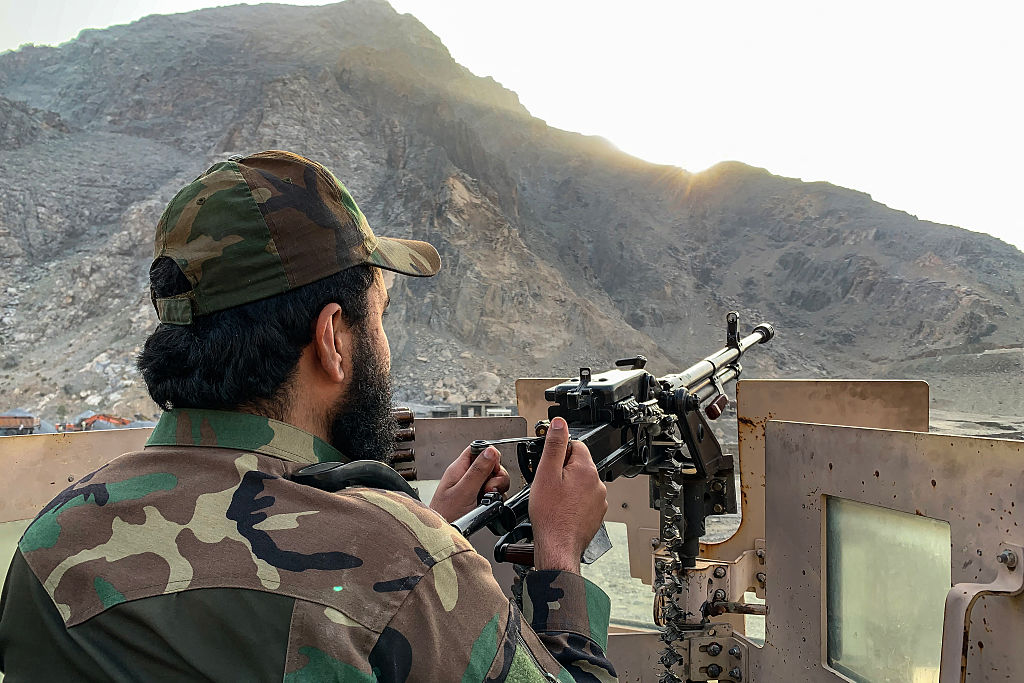
The hostilities between Pakistan and Afghanistan’s Taliban government escalated dramatically this week after an air strike in Kabul killed at least 100 people. Neither of these former allies appears willing to back down from military confrontation. (Aimal Zahir / AFP via Getty Images)
Pakistan’s defense minister, Khawaja Asif, recently said that the country is in a state of “open war” with Afghanistan. Asif issued this statement after Islamabad launched air strikes deep inside its neighbor’s territory. Both countries have engaged in hostile acts against one another.
The confrontation between these former allies has now escalated dramatically after Pakistani forces carried out strikes in Nangarhar province and Kabul on the night of March 16. A drug rehabilitation center was hit in the Afghan capital, reportedly killing at least one hundred people and attracting widespread condemnation.
In the aftermath, Taliban spokesmen stated that the time for diplomacy was over and promised revenge for the loss of civilian life. Pakistani government ministers retorted by insisting that no hospital was targeted and vowing to carry on with their military campaign. Neither side appears willing to back down.
The current escalation began when the Pakistan Air Force (PAF) conducted raids that supposedly targeted hideouts of the Tehrik-i-Taliban Pakistan (TTP), a group that opposes the Pakistani state, on February 23. According to the Afghan Red Crescent Society, at least eighteen civilians were killed in these attacks. The Afghan Taliban then announced that it would respond.
Pakistan has been carrying out air and cross-border strikes inside Afghanistan for the last few years against the background of a rise in terrorist attacks on Pakistani soil. Islamabad has alleged that the perpetrators of these attacks, mainly the TTP, have been operating from Afghan bases with the support of the Afghan Taliban.
That is not what Islamabad had expected from the Taliban when they retook Kabul in 2021, having assisted them in their fight against the US-led forces in Afghanistan. Many Pakistani figures, including former prime minister Imran Khan, believed that with the Taliban back in power, Islamabad would have a friendly regime in Kabul. The growing hostilities between the two states proved them wrong.
A Changed Taliban
Pakistan had clear reasons for its pro-Taliban policy before 2021. One was to stop the Northern Alliance, seen as a pro-India force, from gaining power after the United States and its allies ousted the Taliban in 2001. Pakistan also thought that a Taliban government would be more flexible about the Durand Line between the two states and might even accept it as the official border. The Durand Line was devised by a British diplomat at the end of the nineteenth century, and Afghan leaders have long disputed its legitimacy.
However, within a few months of the Taliban takeover in 2021, the first clash had taken place over the issue of the border. More important, terrorist activities inside Pakistan increased significantly. Pakistan has accused the Afghan government of failing to act against those carrying out such attacks.
Although the Taliban have maintained control and a semblance of order in the country since regaining power, it may be reluctant to take action against groups like the TTP for several reasons. One is its hesitation to go against a former ally, since the TTP supported it in its war against foreign forces in Afghanistan. The Taliban also fears that if it goes after the TTP, the latter may turn against it and even join up with organizations like the Islamic State–Khorasan Province (ISKP), which has carried out attacks in both Pakistan and Afghanistan as well as neighboring states such as Iran.
The third and most important factor is its seeming desire to use the TTP as a source of leverage against Pakistan. Severing ties with the TTP, the Taliban believes, will make the Pakistan government more assertive toward Afghanistan, especially on issues related to the border and trade. That is why it has arranged talks between the Pakistani government and TTP leaders and still suggests that Islamabad talk to the group.
This complicated situation is likely to continue and remain a source of tension between Pakistan and Afghanistan. Such tensions could worsen if the nexus among various militant groups expands, involving some Baloch rebel groups or even anti-Shi’ite groups in Pakistan, which could lead to attacks like the one on the Shi’ite Imambargah in Islamabad in February of this year.
Pakistan’s Challenges
Pakistan’s president, Asif Zardari, has admonished the ruling group in Kabul, claiming that over the last few years, the “ungrateful Taliban regime” has been involved in facilitating TTP terrorist activities across Pakistan. As well as increasing the number of attacks, the TTP has changed its tactics, inflicting heavy losses on the Pakistani security forces while also striking civilian targets.
Pakistan’s former prime minister Imran Khan had started negotiations with the TTP in the hope of persuading them to lay down their arms. In an interview from October 2021, Khan said that his government was offering amnesty and the release of prisoners. In the same period, Khan celebrated the Taliban’s return to power in Kabul, remarking that Afghanistan had broken the “shackles of slavery.”
In April 2022, the PAF targeted TTP camps inside the Khost and Kunar provinces of Afghanistan. Zabihullah Mujahid, a Taliban spokesperson, condemned the attack as an act of “cruelty” that was “paving the way for enmity between Afghanistan and Pakistan.” The attack was carried out a few days after the ouster of Khan as Pakistan’s prime minister, indicating a shift in Islamabad’s policy toward the Taliban.
In October 2023, the Pakistani government decided to expel unauthorized Afghan immigrants, claiming that some of them were involved in carrying out or facilitating acts of terrorism. However, this decision turned out to be a counterproductive one. The government faced criticism for expelling Afghans who had been living in Pakistan for decades, and it cost Pakistan goodwill among Afghans. Even after expelling thousands of Afghans, the number of terror attacks did not decline.
Delegations, such as one led by the pro-Taliban Pakistani politician Maulana Fazlur Rehman, visited Afghanistan hoping to convince the Taliban to take action against the TTP, but they did not yield much by way of positive results. Nor did efforts at persuasion from influential religious scholars like Mufti Taqi Usmani. TTP attacks continued, and Pakistan kept blaming the ruling group in Kabul.
Pakistan’s leaders decided to launch military action in December 2024 inside Afghanistan’s eastern Paktika province against alleged TTP hideouts. Afghan officials reported that forty-six innocent civilians were killed by the attacks. The Taliban responded with strikes of its own inside Pakistan at the end of December, beyond what it called the “hypothetical” (Durand) line.
The situation deteriorated further in October 2025 when the PAF carried out strikes in Afghanistan, including Kabul, where the TTP chief, Noor Wali Mehsud, was the target, although he survived the attack. The strikes took place against the background of the Afghan foreign minister’s visit to New Delhi between October 9 and 16.
This visit was crucial in the context of deteriorating relations between Islamabad and Kabul, not merely over the issue of terrorism but also over the former’s claim that the Taliban was now aligning with India against Pakistan. The Taliban’s goal in engaging with New Delhi appears to be attracting investment for development projects, although it may also be cultivating another source of leverage against Pakistan. India strongly condemned this week’s air strike in Kabul, calling it a “barbaric act.”
What Lies Ahead?
The recent escalation in hostilities has involved direct attacks by the two sides against each other’s security forces and installations. Given the decentered nature of the various factions that comprise the TTP, not to mention the Taliban’s own limitations and calculations, we have to assume that terrorist attacks will keep happening on Pakistani soil and that Pakistan will keep on carrying out strikes inside Afghanistan.
At the moment, Islamabad has taken an offensive position to force the Taliban to abide by the dictates coming from the rulers in Pakistan. That seems partly driven by the failure to contain the rising terrorist attacks.
There is also the question of internal political instability with the government of Prime Minister Shehbaz Sharif, who is supported by the military establishment but in constant conflict with Imran Khan’s Pakistan Tehreek-e-Insaf (PTI). This turbulence is diverting the focus of Pakistan’s ruling elite from the challenging issue of security. Although Khan is in jail, he remains the most popular leader in the country.
Additionally, the PTI holds power in Khyber Pakhtunkhwa, the province most affected by terrorism. Citing the human and material losses caused by past military operations, the provincial government opposes yet another counterterrorist military operation in the tribal areas. Unable to deal with the problem of terrorism internally and facing growing popular anger, the army establishment and the government appear to have resorted to an offensive across the border instead.
The Taliban’s growing relations with India also seem to figure in the strategic calculations of Islamabad’s policy makers. The Pakistani government has linked the surge in terrorist attacks with this alleged nexus between the Taliban and India. All of these factors combined seem to be driving Pakistan’s military actions inside Afghanistan.
None of the policies that Pakistan has followed so far have addressed the core issues. In fact, they have led to a loss of goodwill toward Pakistan among ordinary Afghans. It would be more effective (and more costly) to pursue alternative strategies, such as improved security at the border, improved intelligence-gathering within Pakistan itself, and the use of local platforms, like jirgas (assemblies of Pashtun leaders) and religious scholars, to woo potential recruits away from the TTP in the Khyber Pakhtunkhwa region.