Israel’s West Bank Occupation Is a Danger to Women
Women in the West Bank face daily harassment by Israeli settlers and troops. While Israel often paints itself as more forward-thinking on women’s rights, its occupation crushes Palestinian women’s autonomy and exposes them to violence.
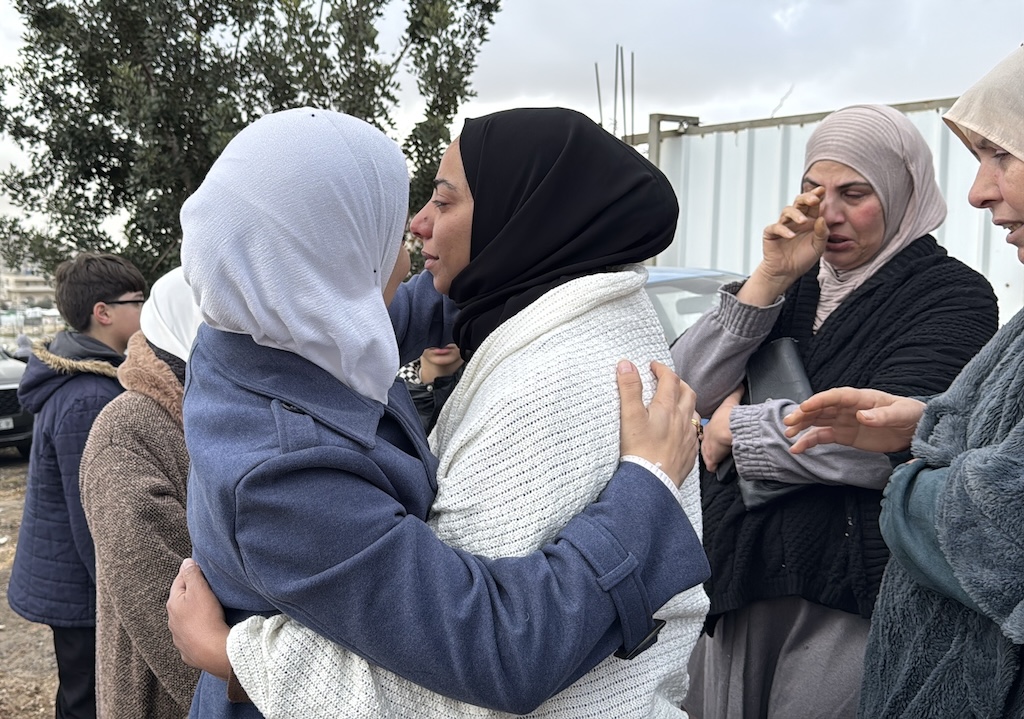
Israel often presents itself as a champion of women’s rights. In the West Bank, the harassment of Palestinian women by Israeli settlers and troops tells the opposite story. (Hisham K. K. Abu Shaqra / Anadolu via Getty Images)
Being a woman in Palestine means experiencing violence on two parallel tracks. There is the violence inflicted by the Israeli state, its military and settlers. There is also the violence perpetrated by men, whether soldiers, settlers, or husbands. Beyond the most visible manifestations of the Israeli occupation — arbitrary executions, home demolitions, land confiscations, and forced displacement — it also slowly tears away at the fabric of Palestinian society.
Palestinian feminists and social workers have long recognized the connection between internal violence, sustained by patriarchal cultural codes, and external violence imposed by the Israeli army and settlers. This relationship operates on multiple levels, making the work of feminist organizations extraordinarily difficult. On the one hand, the daily harassment and attacks endured by West Bank communities steadily reduce women’s participation in social life, forcing them back into the home. On the other hand, collective trauma and individual humiliation intensify interpersonal violence and the gradual erosion of emotional bonds. The effect is that violence is passed down from the powerful to the vulnerable — with women and children bearing the brunt.
“Where the occupation is most severe, particularly in Area C [the fully Israeli-controlled area of the West Bank], in refugee camps, or in cities like Hebron that contain settlements, we see a significant increase in gender-based and child violence compared to Area A,” explains Khawla Al Azraq, director-general of the Palestinian NGO Psychosocial Counseling Center for Women (PSCCW). This applies both to violence by occupation forces and to violence within families. This was true even before October 7, 2023: according to a PSCCW report published four weeks earlier, five women in Hebron reported being stripped and threatened with weapons and dogs by Israeli soldiers in front of their children. At the same time, worsening living conditions contribute to rising rates of post-traumatic stress disorder which, in the absence of a public system for addressing psychosocial trauma, often feeds into violence turned inward, against family members.
“This observation in no way seeks to justify abusers,” Al Azraq stresses. Rather, it recognizes the real situation on the ground. “We also work in schools and universities to raise awareness about women’s and children’s rights, we provide affective education, and we challenge systemic violence in Palestinian courts and hospitals.” Still, she adds, “it is a fact that where the occupation is harsher – especially in refugee camps – gender-based violence within families also increases.”
There are concrete reasons for this. Many Palestinian women who once worked and took part in everyday life in cities and rural areas have gradually stopped going out, studying, or working, fearing rape, stripping, or violations of their privacy. “This also prevents them from reporting abuse or leaving their homes, because they have no other safe spaces and no jobs that would guarantee economic independence,” Al Azraq explains. This further limits women’s autonomy, and makes them more vulnerable to male violence. “In practice, the severity of the occupation discourages resistance to domestic violence or even the idea that escape is possible. We provide psychological support to hundreds of women who remain in abusive marriages for these reasons.”
In 2025, the Palestinian Bureau of Statistics reported that 19.8 percent of married women in the West Bank said they had experienced at least one form of violence. This figure is widely understood to be an underestimate: Palestinian authorities believe that at least 46.5 percent of women do not report abuse due to a lack of support services and alternatives, or because of social stigma. PSCCW operates not only on the psychological front – reaching 1,300 people through group therapy, around 200 through individual therapy, and 194 through case management in 2024 alone – but also provides legal and financial assistance in Palestinian courts and applies political pressure where it encounters institutional resistance. “Recently, we supported a woman whose husband severed three of her fingers. The hospital refused to classify the incident as domestic violence, and the police refused to arrest him,” Al Azraq recounts. “Only after weeks of media pressure and emails to the Palestinian Authority’s Interior Ministry, was the man finally detained”.
Another key objective of the organization is women’s education and empowerment through professional training, also as a means of combating child marriage. While the practice had declined in recent decades, it is now rising again. According to Girls Not Brides reports covering 2019–20, 2 percent of women aged fifteen to forty-nine were married before the age of fifteen. Since October 7, 2023, however, “the severe economic crisis, widespread withdrawal from schools and workplaces due to fear of occupation forces, and the overcrowding of large families into increasingly confined spaces because of displacement have all contributed to a rise in child marriage,” says Al Azraq. Monitoring the phenomenon is especially difficult, she adds, because many of these illegal unions go unregistered, despite the fact that marriage under eighteen — except in rare cases — is illegal in Palestine.
PSCCW also works with children, offering recreational activities to help process psychological trauma, academic support programs – “when performance is limited by psychosocial rather than cognitive difficulties, we reached 2,297 beneficiaries in 2024” – and awareness campaigns within school committees focused on children’s rights and needs.
In the absence of governance capable of guaranteeing their protection, Palestinian women protect one another. They organize autonomously and draw strength from sisterhood. Support from NGOs like PSCCW has become indispensable. “Without PSCCW’s psychological support and group sessions, I would probably be dead today,” says Hala Khalil Abu Saltah. Beyond forced confinement at home due to army and settler incursions, the inability to maintain routines aligned with cultural norms has contributed to rising depression among women. “I have a violent husband and I am undergoing treatment for metastatic cancer. Before finding this outlet, I felt irredeemably alone, I couldn’t hold on to any thread of hope,” she says.
Abu Saltah was born and raised in the Balata refugee camp in Nablus, where the violence of the occupation has been omnipresent since the first intifada beginning in the late 1980s. “Even alone in my room I couldn’t find peace. In the camp, houses are built wall to wall; my neighbors’ window looks directly into my bedroom. Everyone can see and hear what I do. For Palestinian women, privacy is fundamental, and I have been deprived of it my entire life.”
Forced displacement further exposes women to male violence. “Thousands of people have been expelled from their homes in the Jenin and Tulkarm camps and have sought refuge in schools and government buildings,” explains Alaa Abu Hashish, a PSCCW staff member working in the northern West Bank. “This means thousands of women living alongside thousands of men, without any guarantees for their safety.” While PSCCW’s stated goal is to promote psychological well-being and socioeconomic rights, conditions demand other tasks: “under these conditions it becomes almost impossible. Formally we provide psychosocial support, but in reality we end up doing everything: delivering water, food, and medicine.”
Before October 7, 2023, PSCCW was able to reach all the districts it aimed to work in, especially marginalized areas such as Area C and refugee camps. Since then, however, the Israeli state has imposed what Abu Hashish describes as “a further clampdown on freedom of movement: hundreds of new checkpoints, new restrictions on aid distribution, and the revocation of work permits for the two hundred thousand Palestinians who worked inside Israel.” As a result, reaching communities and responding to women’s needs has become increasingly difficult. “When the army enters Balata — which happens on average once a week — “the women we support cannot reach our offices in Nablus for group sessions. Others simply cannot afford transportation because of the economic crisis.” She concludes: “Even if our services are only a Band-Aid on a structural problem, these obstacles prevent us from applying even that. The occupation blocks our ability to address internal social issues, let alone those produced by the occupation itself.”
Founded in 1997, PSCCW has historically operated exclusively in the West Bank. Since the onset of the genocide, however, its staff have felt compelled to extend their work to Gaza as well. “The female population there has been devastated,” Al Azraq explains. “Together with several European NGOs, we try to organize the distribution of sanitary pads and facilitate psychological support groups to help women survive daily life amid death and destruction.” In the Gazan cities of Deir al-Balah and Khan Yunis, they have set up tents for distributing gynecological medications, “beauty clinics” intended to restore a semblance of normalcy and self-care, and therapeutic groups.
This work in Gaza receives no formal funding. “It is all carried out by volunteer workers, whom we support from here as best we can,” Al Azraq says. Another priority is access to drinking water – “a fundamental right that is almost entirely denied in Gaza.” She concludes: “In the political economy of genocide, women’s dignity is completely trampled. Beyond the bombings, they endure conditions so degrading I can scarcely describe them clinically, post-traumatic stress disorder is not an adequate term.” Their femininity is erased, their privacy nonexistent, self-care inaccessible. “Many women shave their heads because they lack even the most basic hygienic conditions. There is no running water, and thousands of people are forced to share a handful of bathrooms. Our group sessions give them just enough strength to carry on. But the violence inflicted on women in Gaza will leave deep, generational scars.”