We Need Natural Disaster Insurance for All
California’s private insurers are abandoning homeowners and dodging payouts while padding executives’ pockets. A public disaster insurance system would cover everyone automatically, spread risk fairly, and invest in disaster prevention.
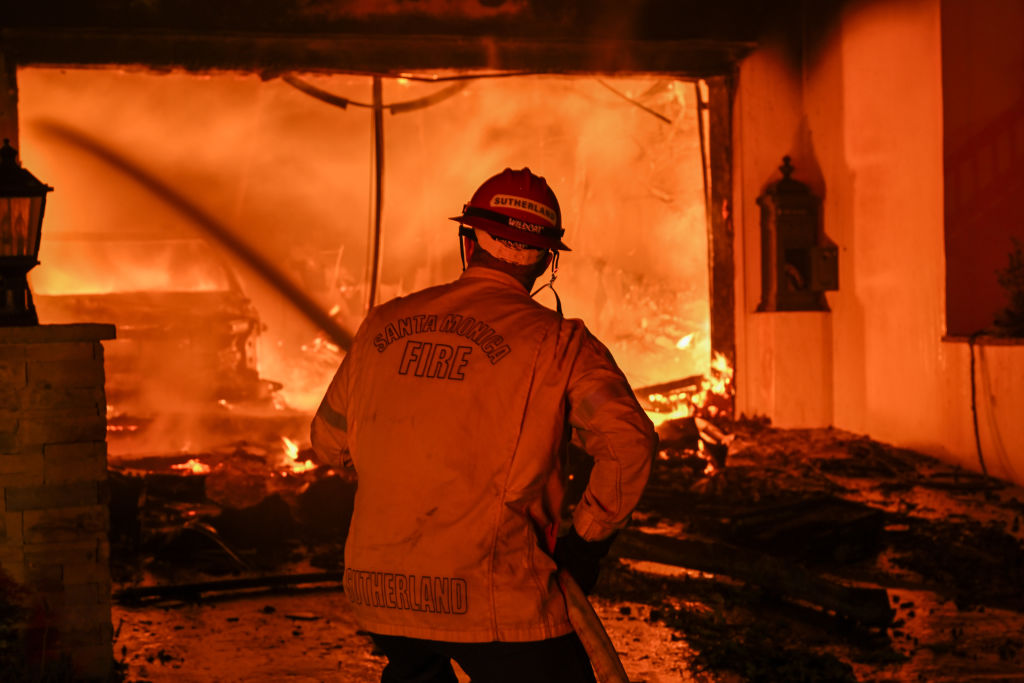
Insurance companies say California wildfires are forcing them to charge higher premiums. In reality, they're making record profits while dumping risk onto the state. We need natural disaster insurance for all to protect people, not shareholders. (Tayfun Coskun / Anadolu via Getty Images)
California’s multibillion-dollar home insurance industry would have you believe it’s on the verge of collapse. In recent years, we’ve seen major insurance companies pull out of California, citing an inability to handle the state’s wildfires and other natural disasters. Other large insurers have threatened to follow suit — and then stayed put, using that threat as a pretext to demand unaffordable rate hikes on residents. They do all of this while investing our premiums into the fossil fuel companies that are accelerating these disasters.
Despite devastating wildfires resulting in thousands of claims, insurance profits are higher than ever. In a deep dive into how insurance companies are making money, climate researcher Kate Aronoff found that, complicating the picture, California “has in recent years been among the country’s most lucrative states for [insurance] companies.” Aronoff also points out that, in 2023, the year State Farm stopped insuring California, the state actually “buoyed the company’s performance nationally.” Risk is good for business.
These companies are using climate disasters as an excuse to keep the customers they want and to dump the rest. Then they charge their remaining lower-risk customers higher premiums, justifying these rate increases by pointing to wildfire risk while off-loading that actual risk to California’s insurer of last resort, the FAIR Plan.
Insurers release balance sheets to the media showing companies in the red, yet shareholder value keeps rising. Importantly, insurance companies don’t make their money from our premiums alone. Instead, they act as an investment bank, making money by putting our premiums into bonds and the stock market.
That’s partly how insurance CEOs, whose companies are supposedly too cash-strapped to cover Californians, are able to pay themselves absurdly high salaries. Many bring home tens of millions each year, with the AllState CEO making an eye-watering $26,147,258 in 2024. And working-class Americans are footing the bill.
The current insurance system is a private market failure. Premiums are too high, many are getting their coverage canceled, and even if you have insurance, these companies fight claims every step of the way.
I have not spoken to a single Californian who is happy with their insurance. And I don’t know anyone, including me, who doesn’t think twice about filing a claim in fear of rising rates or having their policy canceled.
Home insurance is an overlooked driver of our affordability crisis. The insurance industry holds enormous power over who gets to build wealth in this country, and state regulators have long allowed this to go unchecked. The state requires Californians to have insurance — to drive to work, get a mortgage to purchase a home, or to open a small business — but does very little to make insurance affordable and accessible. We’re cutting many thousands of uninsured people out of economic opportunity.
That is why I’m proposing a single-payer disaster insurance policy for every Californian. Call it Natural Disaster Insurance for All.
This isn’t a radical or new idea. Other countries have established single-payer universal disaster insurance. For example, in New Zealand, homeowners buy policies from private insurers, but disaster coverage, for which policyholders pay an assessment with their policy, is provided by the state. France has a similar model.
Meanwhile, the FAIR Plan — which exists to stabilize insurers, not to guarantee that Californians are protected — falls woefully short when it comes to actually covering Californians. It insures over six hundred thousand people, but isn’t public insurance; it’s a privately run program designed by the insurance industry to protect itself. Its coverage is limited, and it charges punishingly high premiums, leaving people underinsured.
A public, nonprofit disaster insurance system would do the opposite. Coverage would be automatic and universal. Everyone would be in the same pool and pay premiums based on income, property cost, or risk. A nonprofit program doesn’t need to generate shareholder profits or fund marketing budgets. Investment returns can stay in California, strengthening reserves instead of padding executive compensation.
But the real difference is structural: a public system would address climate disaster instead of avoiding it.
The private insurance business model is to price risk and avoid losses, not to reduce risk. When wildfire exposure grows, they don’t invest in fire prevention or community resilience — they pack up and leave taxpayers to foot the bill. We have socialized the costs of climate catastrophe but privatized the gains.
A public insurer would invest in prevention and resiliency, and the public would benefit with fewer claims to pay out. A state-run model could tie premiums directly to mitigation, giving homeowners clear and transparent financial incentives to harden properties and communities to invest in defensible space. A portion of the state pool could be invested in resilience infrastructure: fuel management, firefighting capacity, and early warning systems. It could require the worst corporate polluters to pay into the system, connecting the source of climate risk to its costs. And it could guarantee coverage in high-risk areas, because abandoning communities isn’t an option when you’re accountable to people instead of shareholders.
To be clear: if we keep sprawling into wildfire zones, natural disaster insurance for all won’t be enough. Everyone deserves affordable insurance that will allow them to recuperate after a disaster. But insurance availability and premiums, as they exist today, are a blunt and often ineffective tool for shaping development. Any universal insurance plan must be coupled with strong land-use rules and accountability for developers who profit when building in risky areas like wildfire, landslide, and flood zones.
Natural disaster insurance for all is not radical. Insurers are already threatening to leave California, and it’s time we build something for ourselves — a public system to make insurance affordable and accessible for all. Without action, we lock in a system where security is a luxury, not a public good.