Trump Is Dismantling Civil Rights Oversight of ICE
When the Department of Homeland Security was first created, Congress established a civil-rights watchdog office for DHS and its various arms, including ICE. Amid mounting concerns about DHS’s rights violations, Trump has been erasing the oversight office.
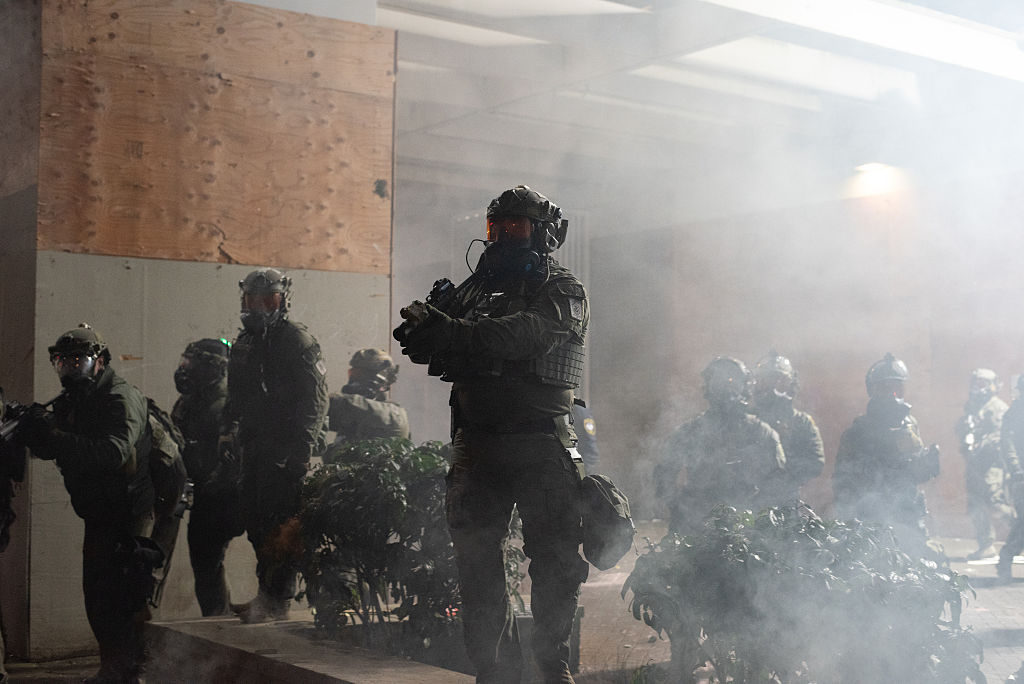
The civil-rights watchdog office charged with inspecting ICE detention facilities and investigating officers’ use of force has been all but eliminated under the Trump administration. (Sean Bascom / Anadolu via Getty Images)
In the early days of Immigration and Customs Enforcement (ICE), long before the brutal raids and mass detentions, advocates warned of what the agency might become.
In the wake of the 9/11 terrorist attacks, as Congress debated the creation of the Department of Homeland Security (DHS), civil rights advocates argued that immigration enforcement would be distorted — and weaponized — by its merger with the national security state. As civil rights lawyer Katherine Culliton-González told Congress at an April 2003 hearing, the move threatened to label “all immigrants, including millions of legal immigrants, as suspected terrorists.”
In response to such concerns, Congress created an unusually far-reaching internal watchdog office for DHS and its various arms, including ICE: the Office for Civil Rights and Civil Liberties.
But today, that office, which is charged with inspecting ICE detention facilities and investigating officers’ use of force, among other duties, has been all but eliminated, even amid mounting concerns about ICE operating with impunity and without regard to civil rights.
With its budget slashed by more than 75 percent, the watchdog agency has been left with a skeleton crew of nine people, down from 150 at the beginning of 2025. It’s now run by a former adviser to the conservative Heritage Foundation think tank who also holds another full-time job as deputy chief of staff at the Department of Homeland Security.
Meanwhile, ICE’s budget has quadrupled.
In the fall, the Guardian reported on warnings from experts and staff that the agency’s demise could open the doors to ICE impunity. Last month, court filings revealed that the office had received nearly six thousand civil rights complaints since March — but had issued no recommendations to officials in response, compared with the hundreds of policy recommendations it issued in 2023.
“It breaks my heart,” said Culliton-González, who led the office under the Biden administration. “The things that I see now are just the polar opposite of the policies that we put into place.”
The office is a “shadow of what it once was,” agreed Michelle Brané, a longtime immigrant rights advocate who served as the immigration detention ombudsman, another oversight body within the Department of Homeland Security, under the Biden administration.
Now the office’s fate hangs in the balance as federal lawmakers wrangle over an annual spending package for the Department of Homeland Security, which has to pass by Saturday.
While Democratic leadership vows to block the bill until it includes ICE reforms, restoring the Office for Civil Rights and Civil Liberties isn’t explicitly listed among their demands, even though most requested reforms — such as standards for detention and use of force by ICE agents — would likely hinge on effective oversight offices.
An earlier proposed version of the DHS spending bill formalized the Trump administration’s dismantling of the office, slashing its funding to just $10 million, less than a quarter of its previous annual budget. This week’s bill will decide whether those cuts go through.
“This is one of the very, very few oversight and accountability mechanisms that Congress created alongside the creation of DHS,” said Lilian Serrano, director of the Southern Border Communities Coalition, an advocacy group for communities along the US–Mexico border that is suing the Department of Homeland Security over its dismantling of the civil liberties office. The cuts to its staff represented a “huge loss,” she said.
Serrano said that her organization had called for the “full restoration” of funding to the civil liberties office in negotiations. Such funding wouldn’t necessarily require a cash infusion for DHS — which many advocates oppose — but could be drawn from already existing resources, including the massive slush fund awarded to the agency by the Trump administration in the GOP megabill last summer.
“Writing on the Wall”
ICE came into being on March 1, 2003, absorbing the responsibilities of the Immigration and Naturalization Service, an agency under the Department of Justice. At a congressional hearing the following month on potential oversight of the massive transition of responsibilities to the Department of Homeland Security, former representative Sheila Jackson Lee (D-TX) warned that bringing civil immigration enforcement under the umbrella of an agency created ostensibly to fight terrorism could threaten civil liberties.
Congress should make clear, Jackson Lee urged, “that immigration does not equate to terrorism, and that there must be distinctive responsibilities of enforcement as well as immigration services.”
These concerns had dogged ICE since its inception. To appease critics, the original Homeland Security Act of 2002 — which won bipartisan approval — included a mandate for an “officer for civil rights and civil liberties.” The office’s authority was expanded in 2004 and then again in 2007 amid growing concerns about DHS’s activities.
The office “was not only part of the original creation of the Department of Homeland Security but a critical part,” said Brané, the former Immigration Detention Ombudsman.
“The Department of Homeland Security would not have passed muster in Congress without it,” she said.
But the office didn’t stop ICE from carrying out alleged civil rights violations. A year after its creation, ICE launched “Operation Endgame,” a “plan to deport every deportable immigrant by 2012.” Insiders described this operation at the time as a stark departure from prior immigration policy; for the first time, agents were systematically targeting immigrants for mass deportations, regardless of their criminal background.
In 2008, lawmakers convened a congressional hearing on the subject of “problems with ICE interrogation, detention, and removal procedures,” in part to address an incident the previous year in which the agency had detained and deported a US citizen, sparking public outcry.
“I feel we have arrived at that era where an overzealous government is interrogating, detaining, and deporting its own citizens while treating noncitizens even worse,” Rep. Zoe Lofgren (D-CA) said as the hearing began.
These early civil liberties concerns have striking parallels to ICE under the second Trump administration, which is building out a mass deportation apparatus while systematically detaining US citizens. As Gabriel Sanchez, a senior fellow at research think tank the Brookings Institution and professor at the University of New Mexico, told the Lever, “There was some writing on the wall.”
Despite its ambitious mission and reach, advocates say the Office for Civil Rights and Civil Liberties has always been constrained by limited funding and resources.
The office “has not been effective in preventing systemic civil rights violations” for families and children in detention, concluded a 2019 review by the US Commission on Civil Rights. The first Trump administration bypassed the office when it implemented a family separation policy, which mandated that DHS separate parents from children when a family was apprehended at the border. Left in the dark, the office was only able to investigate complaints after the fact, said a source familiar with the situation.
The office “was, unfortunately, never given what it needed to have the teeth to actually bring accountability,” said Serrano of the Southern Border Communities Coalition.
“But now, with the cuts — it’s hard to believe there’s even an office,” she said.
Insiders agree with that assessment.
“I don’t think that the office has ever been able to exercise all the powers that it has,” said Culliton-González, who led the office from 2021 to 2023. She says she still “stands by every word” of her testimony when ICE was created, including her concerns about potential “racial profiling, human rights violations at the border, and the use of state and local police to enforce federal immigration law.”
But while the Office for Civil Rights and Civil Liberties might have been an imperfect solution to those risks, she added the watchdog was still “a very powerful civil rights office.”
The 2019 Commission on Civil Rights study found that the office had a uniquely broad mandate compared with other internal oversight offices; it was given far greater leeway to develop and review high-level agency policy and to interact with the public through community engagement.
Such powers could help explain the Trump administration’s focus on dismantling it.
“If the offices were truly that ineffectual, the administration probably wouldn’t have gone through the trouble of shutting them down,” said Anthony Enriquez, vice president of advocacy and litigation at the Kennedy Human Rights Center, another organization suing the Department of Homeland Security over the oversight cuts.
Although Culliton-González said she was “not idealistic enough to believe that a civil rights office could stop everything that’s happening in Minneapolis,” she emphasized that the office, in the old days, might have proved an important counterweight to the violence of ICE and Customs and Border Protection amid the Trump administration’s operational surge in the state last month.
“We would have found out in advance that this operation was going to happen,” Culliton-González said. “If a use-of-force incident happened, we would have been notified. There probably would have been an investigation of the incidents that we’ve seen.”
Instead, the federal government has limited its internal investigations into the killings of Alex Pretti and Renée Good, two legal observers shot by DHS agents in Minneapolis, and forced out federal prosecutors who tried to open an inquiry into Good’s death.
A “Lethal Combination”
The Trump administration originally aimed to completely eliminate the Office for Civil Rights and Civil Liberties, alongside two other oversight bodies within the Department of Homeland Security: the Office of the Citizenship and the Immigration Services Ombudsman, charged with providing oversight for immigration and naturalization services, and the Office of the Immigration Detention Ombudsman, which provides additional oversight of ICE’s sprawling detention apparatus.
The proposal to slash the oversight bodies originated in Project 2025, the right-wing blueprint for a second Trump administration, in a section written by Ken Cuccinelli, who worked in the Department of Homeland Security under the first Trump administration. Project 2025 was crafted by the Heritage Foundation, the powerful right-wing think tank that counted Troup Hemenway as an adviser before he was hired to run the Office for Civil Rights and Civil Liberties in May 2025.
On March 6, 2025, at the behest of billionaire Elon Musk’s Department of Government Efficiency, an officer at DHS issued a memo asking officials to prepare to eliminate the three agencies. By the end of the month, Homeland Security secretary Kristi Noem had signed off on laying off every staff member at all three offices.
In April 2025, several organizations, including the Southern Border Communities Coalition, sued DHS over the elimination of the oversight offices, arguing that the offices were required by law to carry out their duties. As the litigation proceeded, the Department of Homeland Security cobbled together new bare-bones staff for the agencies and claimed they would continue to run. (At some point, a note was added to the Office for Civil Liberties and Civil Rights’ website telling viewers that the office “continues to exist and will perform its statutorily required functions.”)
That litigation is ongoing. In January, attorneys for the advocacy groups filed a new motion laying out the case against DHS and demanding that a judge intervene to compel the government to rebuild the offices. The offices are “unable to carry out basic statutory functions despite the growing need for their independent oversight activity,” attorneys wrote.
Complaints can no longer be submitted to the civil liberties office and the Office of the Immigration Detention Ombudsman — both of which monitor issues in ICE detention centers — in languages other than English. (The “overwhelming majority” of people in ICE detention have limited proficiency in English.) And despite receiving almost six thousand civil rights complaints in the last year amid ICE’s massive expansion, the civil liberties office has issued no new recommendations to Homeland Security based on its investigations since March. Last year, according to data in court filings, it issued hundreds of such memos.
Brané, the former immigration detention ombudsman, called the erosion of detention oversight a “grave concern,” given that some 73,000 people are currently locked up in ICE detention centers, more than ever before. In her role overseeing that sprawling system, she would conduct facility inspections and call attention to potential civil rights or policy violations.
Now her former office has been hollowed out
“They are drastically increasing the number of people in detention, are receiving billions of additional dollars for spending, and they’re openly talking about reducing the requirements of contracts, as far as standards go — basically saying that conditions don’t matter,” Brané said.
This, she said, was a “lethal combination.”
Amid ICE’s rapid expansion, advocates say that restoring — and strengthening — oversight is more important than ever.
One answer, said Enriquez at the Kennedy Human Rights Center, would be for lawmakers to grant the civil liberties office binding enforcement authority. Currently, the office can only recommend changes to DHS leadership, which means Department of Homeland Security secretary and Trump ally Kristi Noem has veto power over its recommendations.
“Congress needs to take a good look at providing these offices with enforcement power,” Enriquez said, adding that lawmakers should also scale back Homeland Security’s seemingly unlimited resources.
“We’ve seen what happens when you write them a blank check, and it turns into murder in the streets,” he said.