On Tariffs, Neil Gorsuch Is Hardly Apolitical
Justice Neil Gorsuch’s decision to strike down Trump’s tariffs underscores a broader truth: the Supreme Court is just as insincere as every other branch of government, with justices often prioritizing the political dynamics of the moment.
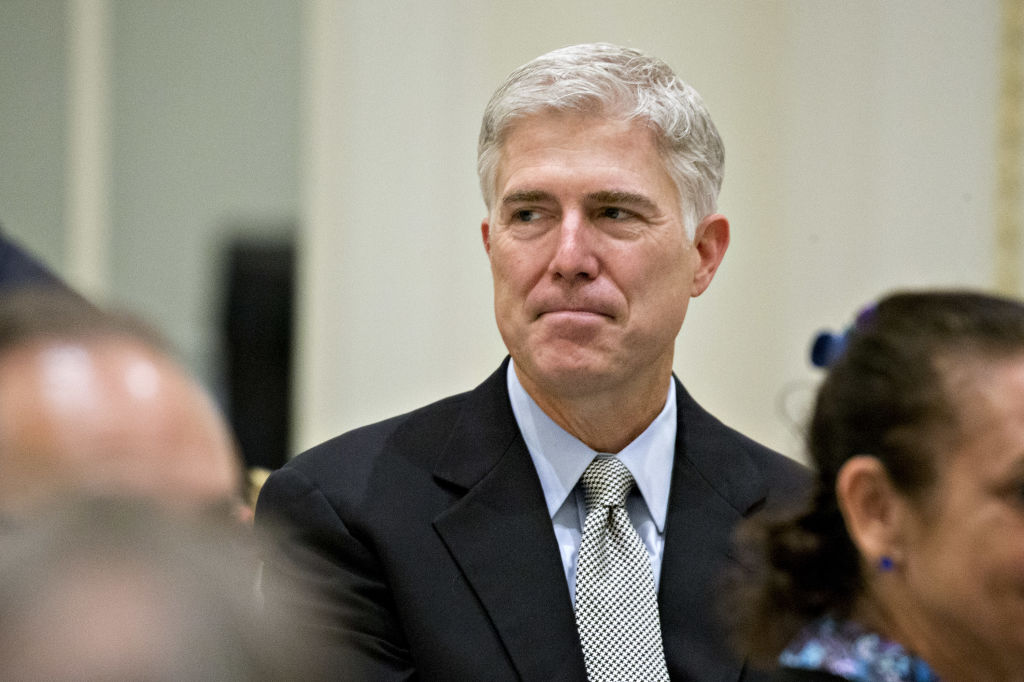
Neil Gorsuch's decisions and statements over the last 19 months remind us that Supreme Court justices are just as political as every other player in Washington. (Andrew Harrer / Bloomberg via Getty Images)
For most of our lifetimes, we’ve been inculcated to perceive the Supreme Court as above the dirty, conniving, unprincipled dynamics of day-to-day politics. In this fairy-tale version of America, politicians are the nasty ideological street brawlers, while the justices are high-minded, apolitical referees who attempt to apply empiricism and ideals to the messy fights of the other governmental branches.
And the justices are desperate to preserve this image of themselves as upstanding West Wing characters — indeed, Justice Amy Coney Barrett gave a speech a few years ago in which she declared, “My goal today is to convince you that this court is not comprised of a bunch of partisan hacks.”
But we can thank Justice Neil Gorsuch for this week disabusing anyone of these fantasies. His decisions and statements over the last nineteen months remind us that the justices are just as calculated, hypocritical, and, yes, political as every other player in the political arena.
Yesterday Gorsuch was lauded for supporting the Supreme Court ruling to strike down Donald Trump’s tariffs — and specifically for his righteous defense of checks and balances and congressional prerogatives here in his concurrence:
Most major decisions affecting the rights and responsibilities of the American people (including the duty to pay taxes and tariffs) are funneled through the legislative process for a reason. Yes, legislating can be hard and take time. And, yes, it can be tempting to bypass Congress when some pressing problem arises. But the deliberative nature of the legislative process was the whole point of its design. Through that process, the nation can tap the combined wisdom of the people’s elected representatives, not just that of one faction or man.
There, deliberation tempers impulse, and compromise hammers disagreements into workable solutions. And because laws must earn such broad support to survive the legislative process, they tend to endure, allowing ordinary people to plan their lives in ways they cannot when the rules shift from day to day.
In all, the legislative process helps ensure each of us has a stake in the laws that govern us and in the nation’s future. For some today, the weight of those virtues is apparent. For others, it may not seem so obvious. But if history is any guide, the tables will turn and the day will come when those disappointed by today’s result will appreciate the legislative process for the bulwark of liberty it is.
Gorsuch is explicit in his criticism of the idea of a president as an all-powerful king who can do anything he wants, at any time:
The president insists he may use IEEPA [International Emergency Economic Powers Act] to equalize foreign and domestic duties — or not. He may use it to negotiate with foreign countries — or not. He may set tariffs at 1 percent or 1,000,000 percent. He may target one nation and one product or every nation and nearly every product. And he may change his mind at any time for nearly any reason. At least as I see it, history dating “back to near the Founding” does not support the notion that presidents have traditionally enjoyed so much power. More nearly, history refutes it.
This is all great stuff — and it’s fine to laud it. I’m genuinely glad Gorsuch put it all in writing, so that it’s there for posterity.
But as right as Gorsuch is in the tariff case, his statements also should disabuse everyone of the idea that there’s much principle or empiricism at play here, considering that Gorsuch only eighteen months ago helped give Trump and every other president near-absolute power to proudly ignore the laws passed by the very Congress that Gorsuch now touts. In that ruling, Gorsuch — a supporter of the so-called “unitary executive” theory of an all-powerful president — signed onto an opinion that declared:
The nature of Presidential power requires that a former President have some immunity from criminal prosecution for official acts during his tenure in office. At least with respect to the President’s exercise of his core constitutional powers, this immunity must be absolute. As for his remaining official actions, he is also entitled to immunity.
So, Gorsuch in 2026 is telling us that the legislative process is literally “the bulwark of liberty,” just after Gorsuch in 2024 told us that the president is “entitled to immunity” from the laws created by that legislative process. And back then, Gorsuch didn’t just sign onto the ruling; he waged a public defense of it when hawking a book.
Sure, the tariff and immunity cases are different, but the central question of executive power undergirds both, and so Gorsuch’s stances present a clear contradiction. And if he is ever asked about the tension between these two stances, Gorsuch will undoubtedly manufacture some convoluted logic to try to pretend he’s consistent and principled — but the absurdity is obvious on its face.
So what’s going on here? It’s hard to know, but in my opinion, the timing offers a clue. Back when Democrats were the unpopular White House incumbent and Trump was about to reclaim the presidency, Gorsuch was arguing that Trump is above all laws. Now that Trump is wildly unpopular, Gorsuch is suddenly touting the need for limits on Trump’s power.
I don’t think this is coincidental, because when it comes to the Supreme Court, I don’t believe there are any consistent principles at work at all. Over and over again, the high court has proven itself to be not the apolitical above-it-all branch of government that our civic fairy tales and media pretend it to be. On the contrary, the Supreme Court has proven itself to be just as insincere and venal as every other branch of government.
Its justices are selected for their political ideology — and many of them in the court majority were quite literally political operatives who helped stop the counting of votes and pilfer a national presidential election. So not surprisingly, the court mostly responds to the demands of corporate power, and justices periodically respond to the political power dynamics of the moment.
They aren’t superhuman deities or high-minded statesmen — they are politicians, just like everyone else in power.