The Life and Death of Paris’s Red Belt
How discontent over housing, and not workplace struggle, made Paris’s suburbs hotbeds of communism.
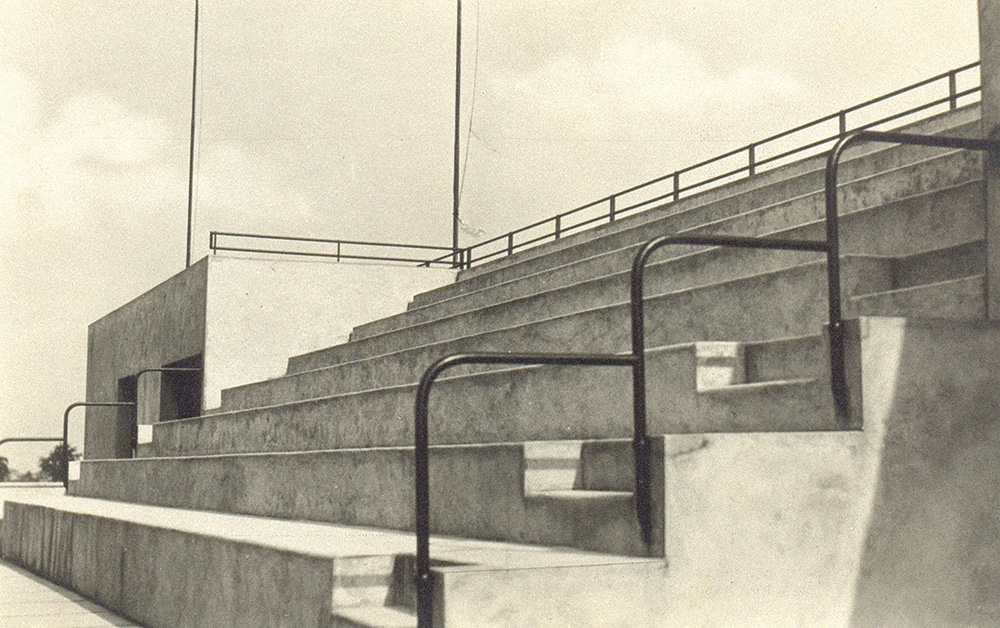
Adjoining the Karl Marx School was a stadium complex, one of many erected by the suburban communists of the Red Belt. Both the academic building and the stadium, widely acknowledged as representing one of the most iconic school designs of the 20th century, were restored in a decade-long undertaking in the early 2000s. (Photo Albin Salaün / Collection Archives communales de Villejuif. 5Fi17.)
If you spend any time in the suburbs dotted around the Paris metropolitan area and you’re blessed with even a cursory knowledge of twentieth-century history, you’ll soon begin to notice a pattern in the street names. Take the Métro line 13, for example, from the tourist-friendly city center until you reach the main stop in Saint-Denis. A short walk will bring you to Lenin Avenue, a long, wide thoroughfare that overlaps with various streets named after the heroes and martyrs of French communism, from the journalist Gabriel Péri to the philosopher Georges Politzer. You don’t have to be French to make the cut — Mexican muralist David Siqueiros and Irish hunger striker Bobby Sands feature on the Saint-Denis landscape, too.
This is the atmosphere conjured up by a casual stroll through Paris’s Ceinture rouge, or “Red Belt,” where the French Communist Party (PCF) dominated suburban politics for two generations.
On the other side of Paris, in the commune of Villejuif, you can take a swim in the fifty-meter outdoor pool at the Yuri Gagarin Aquatic Stadium, which is located at the point where Karl Marx Avenue meets Yuri Gagarin Street. Until a few years ago, you could also have walked from Villejuif to the neighboring district of Ivry-sur-Seine in search of another landmark named after the Soviet cosmonaut: Cité Gagarine, a public housing project with nearly four hundred apartments that began construction in 1961, the same year its namesake became the first man to leave the earth’s atmosphere.