The Kurdish Freedom Struggle Is Facing a Crucial Moment
Abdullah Öcalan’s Kurdistan Workers’ Party is engaged in high-stakes negotiations with the Turkish government over a peace settlement. The outcome will shape the future for Kurds throughout the region, including the PKK’s sister parties in Syria and Iran.
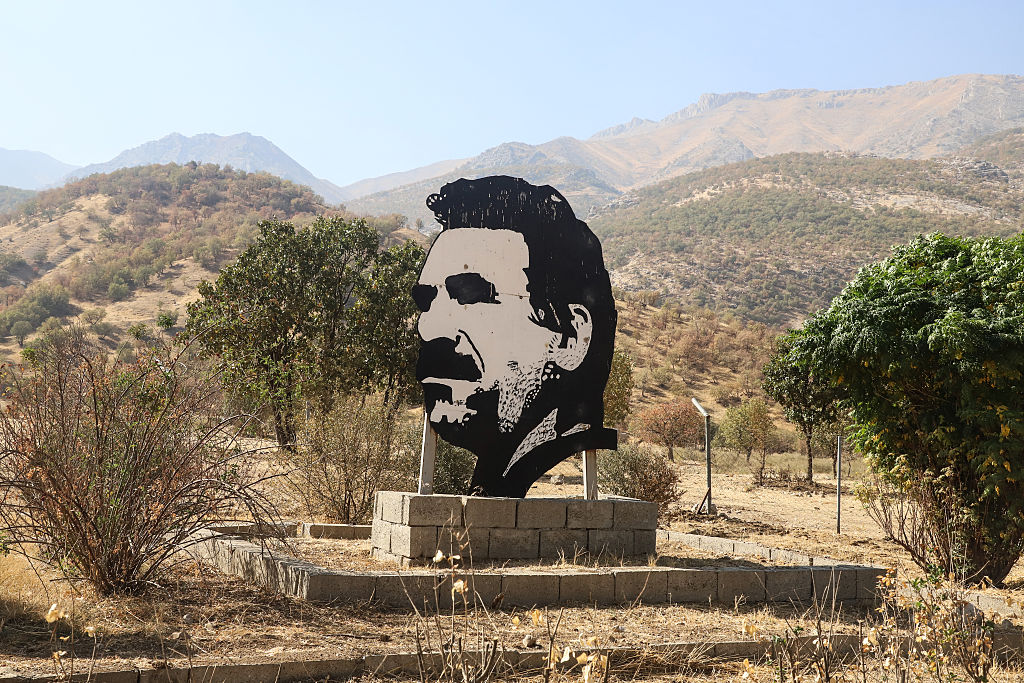
A cutout portrait of jailed leader of the Kurdistan Workers’ Party (PKK), Abdullah Öcalan, is seen during a ceremony in the Qandil area of northern Iraq, where the militant group announced its complete withdrawal of forces from Turkey, on October 26, 2025. (Shwan Mohammed / AFP via Getty Images)
“I encountered patriarchy and male dominance presiding over women and life, all in conjunction with the occupation of my homeland. We all knew that the state was the root cause,” says Peyman Viyan, the female coleader of PJAK, the most prominent Kurdish revolutionary group in Iran.
I am reading her responses, which have been sent to me and translated by intermediaries from a PJAK base in the mountainous border region of eastern Iraqi Kurdistan, on the border with Iran.
Kurdistan, divided and occupied by the regional powers of Turkey, Syria, Iraq, and Iran, is a nation without a state. But its various political groups have carved out a semblance of autonomy for themselves, especially in Iraq and Syria, where centralized government control has receded as both states crumbled into internal conflict.
Peyman Viyan is her nom de guerre, inspired by her comrade Viyan Peyman, a singer and sniper who died fighting ISIS at Kobane in 2015. She tells me she comes from the “small but strategic” city of Maku in northwest Iran, near the Turkish border.
“We were children when the influence of the Apoist movement and its members spread. When we became teenagers, that influence became stronger. At one point, they distributed CDs with teachings about the struggle for a life of freedom,” Viyan says. “Apo” is the affectionate name that supporters use for Abdullah Öcalan, founder of the Kurdistan Workers Party (PKK), who has been in jail on a small island near Istanbul since being captured by Turkey in 1999.
Despite his confinement, Öcalan’s influence among his Kurdish supporters and his importance to Turkish and Syrian politics have never been greater. He has become a key figure in the disarmament negotiations between Turkey and the PKK, and between the Syrian government and the Kurdish-led Syrian Democratic Forces (SDF) who have controlled the Autonomous Administration of North and East Syria (AANES) since the start of Syria’s civil war.
Potential for Peace
After Öcalan’s imprisonment on İmralı island, he turned toward studying and writing, incorporating the work of American anarchist Murray Bookchin into a new theory of government tailored to the needs of the Kurds. This political philosophy, called Democratic confederalism, rejects nationalism in favor of a confederation of autonomous, democratic, and decentralized political groups. Öcalan and the Kurdish parties in Turkey then modified their separatist demands to put forward a less antagonistic call for greater autonomy.
As beloved as Öcalan is by many Kurds, he is hated by Turkish nationalists. Around forty thousand people have been killed in the conflict between Turkey and the PKK, and many Turkish families have relatives who have died fighting the PKK. Nobody is keen to return to the dark days of the 1990s, with the Turkish army demolishing Kurdish villages and frequent extrajudicial killings.
Turkey’s pursuit of a conclusive peace process with the PKK at the end of 2024 began just as the Syrian civil war was ending. Thousands of Kurdish fighters with nothing to do in Syria could easily move to Turkey or Iran to help their fellow Kurds. For its part, Turkey is looking to consolidate its military supremacy and become a key hub for energy resources from the Gulf.
The goal of peace with the Kurds is key to Turkey’s regional hegemony. This puts Öcalan in a surprisingly important position as a figurehead for Kurds in Syria and Turkey. There are suggestions he could even be invited to address the Turkish parliament.
The top general of the Kurdish-led SDF, Mazloum Abdi, says that he wants to meet with Öcalan, and that a successful PKK disarmament process would lead to peace between Turkey and Syria’s Kurds: “There is currently a ceasefire with the Turkish army here. This came about thanks to the [peace] process. If the process reaches a conclusion, the ceasefire on our side will also become permanent.” However, Öcalan has warned that if the peace process breaks down again, as it did previously in 2015, Turkey could return to the “coup mechanics” that brought down governments in 1960, 1971, 1980, and 1997.
Negotiations between the SDF and the post-Assad Syrian government to integrate Kurdish fighters into the Syrian army have also stalled. Al-Monitor suggests that the pause is probably meant to give Öcalan space to broker an agreement that Ankara and the SDF would both find acceptable: “But that’s a tall order.”
“The process that began in Turkey is very important,” Viyan says:
If the Turkish state resolves the Kurdish question and recognizes Kurdish identity officially, then the war in Turkey will cease, politics will change, the economy will change, foreign policy will change, and all of that will have a ripple effect on the region.
Rojhelat
The Iranian part of Kurdistan, known as Rojhelat in Kurdish, has long been a problem for the Iranian state, under both the regime of the Shah and the Islamic Republic that replaced it. It was here that the only independent Kurdish state in history existed for a year at the end of World War II. The Shah’s forces crushed the Republic of Mahabad in 1946, but its memory continues to inspire Kurds who dream of autonomy.
Estimates of the number of Kurds in Iran vary, from seven to fifteen million (which would be somewhere between 8 and 17 percent of the total Iranian population). Data is patchy because Kurds often don’t receive documentation until the age of ten, while many ethnic and religious groups are simply denied identification as a way to pressure them to convert to the state religion, Twelver Shi’ism. Outside of the three recognized minority groups — Zoroastrians, Christians, and Jews — Iran often does not recognize the marriages of religious minorities, meaning that people from groups like the Baháʼí, Yarsan, and Sunni groups like the Shafi are not counted.
Rojhelat was the home of Jina Mahsa Amini, the young Kurdish woman who was killed by members of Iran’s Guidance Patrol after being arrested for supposed improper wearing of the hijab. Her death sparked widespread anti-government protests in 2022. The slogan that came to be associated with these protests, “Woman, Life, Freedom” (“Jin, Jiyan, Azadi” in Kurdish), was also inspired by the prison writings of Öcalan, who has said that “a country cannot be free unless the women are free.”
Iranian Kurds like Peyman Viyan hope that peace between Turkey and the PKK will force Iran to address its own Kurdish question. PJAK representatives say they are not looking for open confrontation with the Iranian state but will retaliate when attacked. Small clashes took place in 2025, with Iran killing PJAK members and PJAK retaliating by killing soldiers from Iran’s Revolutionary Guards (IRGC).
In December, Iran launched a “counter-terrorism exercise” in the northwest with participants from the Shanghai Cooperation Organization (SCO). Launched with six members in 2001, most notably China and Russia, the SCO now comprises ten states, and Iran joined it in 2023.
According to PJAK Assembly Member Siamand Moeini, PJAK has the military capacity to take control of cities in Rojhelat, but it refrains from doing so because of the consequences that would follow for the people living there from retaliation by Iranian forces. Viyan insists that the ideas of Democratic confederalism can be applied here as well:
Whether the Iranian regime changes itself or collapses under pressure, opportunities for freedom will emerge for the peoples of Iran, the Kurds, and other ethnic groups. While the formula for the system we use is unique for Kurdistan, it can be adjusted to suit the needs and requirements of Iran.
Iran’s Kurds have been making common cause with the Baloch people, whose land is split between Iran and Pakistan, and who also dream of autonomy, although it is not clear how deep coordination with the Baloch goes. “I must be clear that our perspective is not nationalist,” Viyan insists. Democratic confederalism seeks the self-determination of all peoples, she says, and this has encouraged the trust of other peoples like the Baloch:
The Baloch are both historically and culturally close to Kurds and, in many cases, religiously closer to Sunni Kurds (given that there are also Shia Kurds in Rojhelat), and they also face similar levels of oppression by the regime. Geographically we have some distance between us. Spiritually and culturally our ties are very close.
An open fight with the IRGC is not one PJAK could win by themselves. Asked whether PJAK would accept Israeli or US help, Viyan says that “any help and assistance offered must respect our fundamental human rights and freedoms. We will not accept assistance that costs us our principles of freedom and equality.”
Iran’s access to water is a particularly important issue, with the government warning that Tehran may need to be evacuated if there is not significant rainfall in December. The Iranian authorities have even begun cloud seeding to induce rain. Viyan accuses Iran’s rulers of mismanaging the water resources of Rojhelat:
Over the decades, the Iranian regime has built thousands of kilometers of dams and underground wells, and diverted Kurdistan’s water to other cities, especially Iran’s capital and central cities. Part of this is connected to global climate change, but a large part is connected to the regime’s malicious policies and the corrupt and inept government.
Prospects
Kurds in Syria have welcomed the Turkey–PKK peace process. Hassan Mohamed Ali, the cochair of the Public Relations Office of the Syrian Democratic Council (SDC), says that if it makes progress, “it will have a positive impact on us as well. This progress could reduce the Turkish threat and lessen the dangers facing Rojava and northeast Syria. The more the process advances, the better it will be for us.”
Ali believes Turkey has no choice but to seek a diplomatic solution with the PKK as it aims to position itself as a hub for energy supplies coming from Gulf states via Iraq and possibly Syria: “For these plans to succeed, there must be stability and peace in the region.”
Progress in negotiations between the SDC and Damascus has been slow, though Ali says that there were some positive developments in the latest meeting: “It was agreed that the SDF will be transformed into three integral military divisions, each maintaining its own structure and distinct formation within the government forces.”
The SDC is maintaining its demand for a more decentralized Syria. According to Aldar Khalil, a leader of the PKK’s sister party, the PYD, Syria’s interim president Ahmed Al-Sharaa “went as far as to say that he was okay with decentralization as long as we did not use that term. We could have it in practice and call it something different, he said.”
According to Ali, the US ambassador to Turkey, Tom Barrack, has taken part in discussions between Al-Sharaa and the SDF commander Mazloum Abdi. Barrack, for his part, has said that he does not believe that decentralization is right for Syria, and that “benevolent monarchy” is what works best in the Middle East, which doesn’t bode well for the type of state the United States envisions in Syria.
The peace process is complicated by differing views of what its outcome should be. As the journalist Frederike Geerdink observes, Turkey’s governing parties AKP and MHP like to define the goal of negotiations as “a terror-free Turkey,” while DEM, a Turkish leftist party rooted in the Kurdish political movement, talk about the need for a democratic Turkey.
Berdan Öztürk, a DEM spokesperson, insists that a sustainable peace will require “the recognition, strengthening, and institutionalization of the Kurdish people’s political and cultural rights.” He adds that “concrete legal measures are needed to anchor the process on a solid and transparent foundation.”
What emerges from these conversations with Kurdish leaders is that everything now hinges on their ability — and that of Abdullah Öcalan — to reach an acceptable deal first with Turkey, and then with Syria. Peyman Viyan is optimistic that the ongoing processes of negotiation with Öcalan and the SDF will lead to greater freedom for Kurds throughout the Middle East: “Our motto for fifty years has been: either victory or victory. We see that victory is near now. With the hope of a liberated future.”