Walter Benjamin’s Graveyard
On the run from the Gestapo, Walter Benjamin committed suicide on the French-Spanish border in 1940. The place where he spent his last days now overlooks the most brutally policed border of the EU.
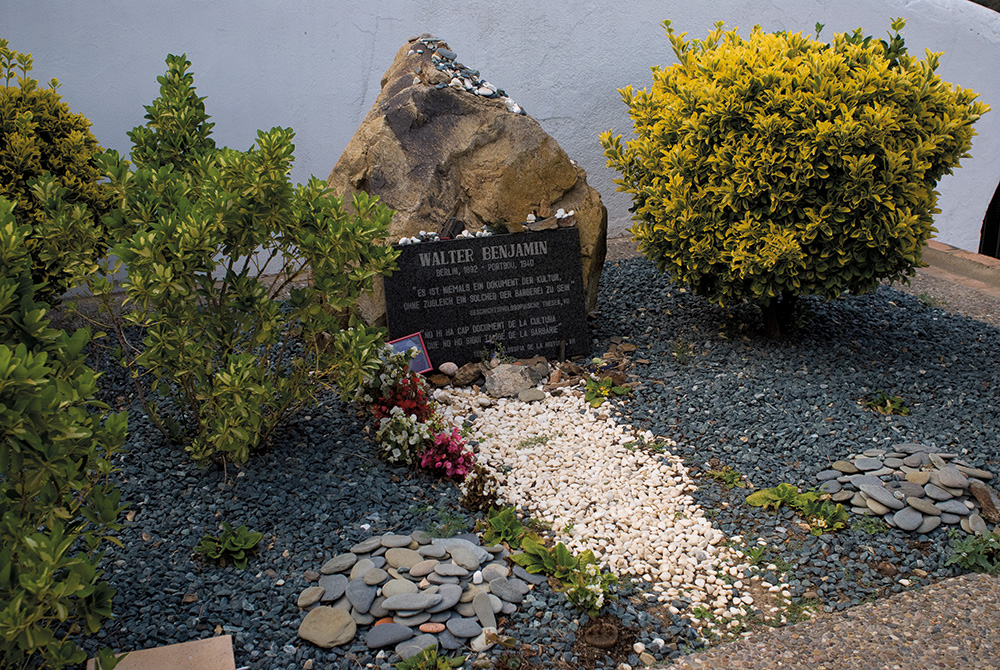
(JMN / Cover / Getty Images)
A little municipal cemetery sits on a cliff above Portbou, the first small fishing village on the Spanish side of the French-Spanish border. The village is nestled around a natural harbor, deep in a steep valley that seems to cut it off from both countries. Today, with both nations now members of the Schengen Area, it’s a small, quiet town that receives little traffic, but it still holds a few relics that remind the visitor that it was once a busy frontier: an enormous, now largely empty railway station that seems to dominate the town; an abandoned customs post on the quiet coastal road; and the grave of Walter Benjamin, who killed himself in one of the village’s little hotels in 1940.
To those who helped Benjamin cross the border from Vichy France into Francoist Spain in September of that year, he must have appeared as just another Jewish refugee fleeing the encroaching horror of the Holocaust. Since it wasn’t until after his death that Benjamin found his full audience, they would have little idea as to just how deeply influential the thinking of this man — influenced as it was by Marxism, Jewish mysticism, and theology — would one day become. But in September 1940, he was simply another exile, tracing in reverse la retirada, the evacuation of Spanish Republicans into France following Franco’s victory of the year before. For Benjamin, neutral Spain, while fascist, seemed like a temporary reprieve from the Nazi threat; from Spain, Jewish refugees could make their way to Portugal, and from there on to the safety of the United States.
Yet Benjamin died here by his own hand. When he arrived in Portbou, he and his party were informed that all travel visas had been revoked. The following day they would be returned to the hands of the Vichy government. That night, Benjamin overdosed on morphine. Whether by accident or intentionally, the doctor who wrote Benjamin’s death certificate named him “Benjamin Walter” (not a Jewish name) and ruled that he had died of apoplexy rather than an overdose. As the death was not ruled a suicide and his name was not identifiably Jewish, Benjamin’s burial was permitted in the Catholic cemetery carved into the hillside overlooking the sea. “The cemetery faces a small bay directly looking over the Mediterranean,” Hannah Arendt, Benjamin’s friend, would write when she arrived in Portbou after the war. “It is by far one of the most fantastic and most beautiful spots I have ever seen in my life.”