The Other Conflict in Kashmir
The contested region has become a flash point in India’s struggle to break its dependence on Chinese lithium.
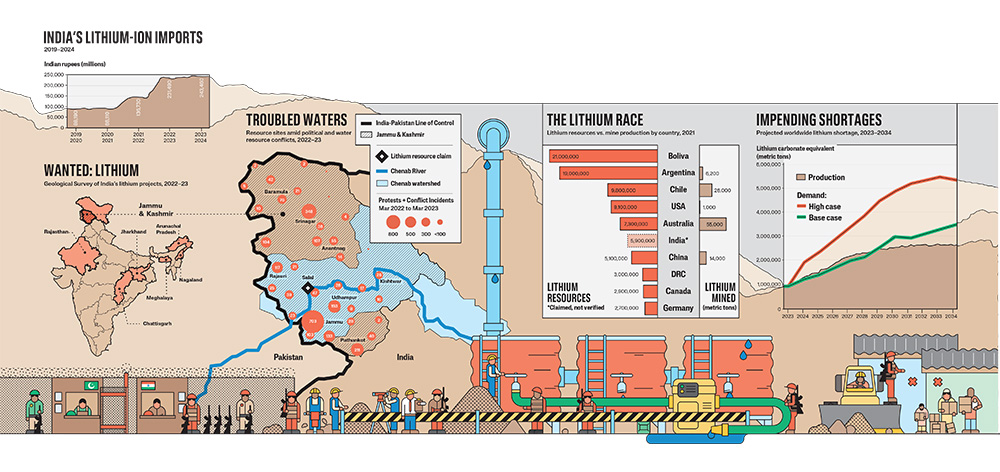
Illustration by Meg Studer.
In February 2023, the Geological Survey of India announced that it had discovered 5.9 million tons of lithium in Kashmir, a territory claimed by both India and Pakistan. The lode, which would give India the world’s sixth-largest lithium reserve, apparently sits below the sleepy mountain village of Salal, about thirty miles from the line that separates India’s portion of Kashmir from Pakistan’s. As the Indian media boasted of interest from Mitsubishi and Tesla, Salal’s residents imagined themselves selling their land and striking rich — yet they also worried about the political strife, environmental destruction, and violence that could come with such a windfall, especially in a contested region like Kashmir. The next two years brought much uncertainty for the people of Salal, but the money and the lithium still haven’t appeared.
Demand for lithium, a crucial metal for electric-vehicle batteries, is surging amid the global transition to green energy. With supply shortages expected as soon as 2030, lithium producers — such as Australia, China, and the countries in South America’s “lithium triangle” — have found themselves in a strategic and lucrative position. Between 2018 and 2023, India’s lithium-ion battery imports increased from $384.6 million to $2.8 billion, and the lion’s share of that trade was with China. This is a bad look for Prime Minister Narendra Modi’s Hindu nationalist government, which has challenged China’s regional influence and pursued a policy of Atmanirbhar Bharat, a “self-reliant India.” In 2023, India designated lithium as a critical mineral whose uninterrupted supply is “essential for economic development and national security.”
Modi-aligned news outlets and politicians hailed the 2023 lithium discovery as a victory for self-reliance. In the background, however, was the increasing militarization of Kashmir since 2019, when the Indian government revoked the region’s semiautonomous status and launched a crackdown on dissent. Kashmiri militants responded to the announcement by threatening to “attack Indian companies that dare to venture into the troubled waters of Jammu and Kashmir.” The Indus Waters Treaty raised further problems: lithium extraction can pollute and drain watersheds, and the lode is right next to the Chenab, one of the Indus tributaries that Pakistan manages under the treaty. When the Indian government took steps to commercialize the reserve, some companies began to wonder whether, on top of these political issues, India had misled the world about the discovery’s potential. The find may only contain 0.02 million tons of lithium carbonate equivalent. To make matters worse, the lithium is in clay deposits, for which extraction techniques are still in their infancy.