The Invisible Kuwaitis
Kuwait systematically denies citizenship to a population that has lived there since before the state existed.
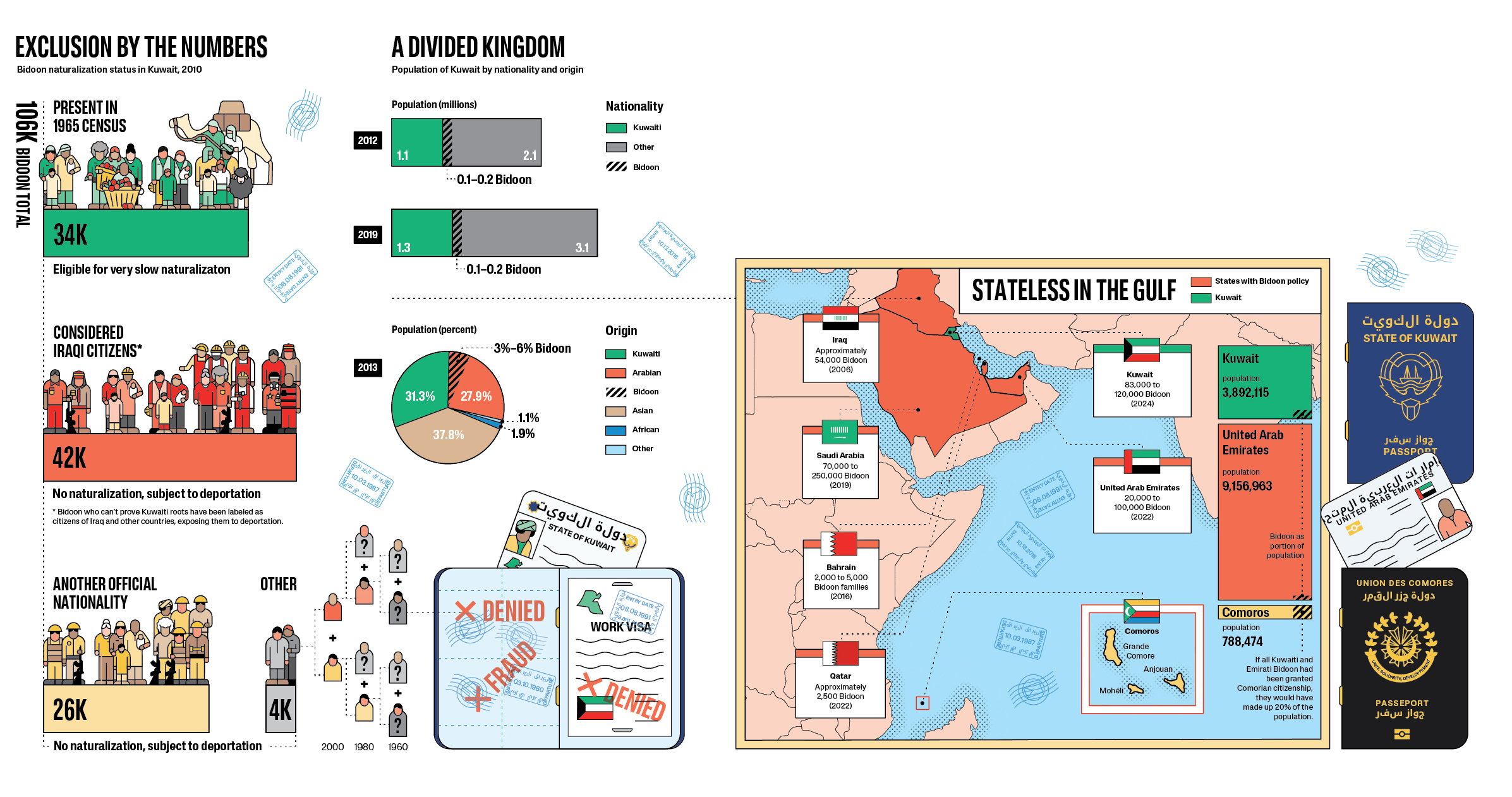
Illustration by Meg Studer.
The 2019 suicide of Ayed Hamad Moudath drew the world’s attention to one of Kuwait’s dirty secrets: its apartheid-like treatment of its Bidoon minority.Moudath had been unable to secure identity documents and lost his job because, like most of Kuwait’s approximately one hundred thousand Bidoon, he was stateless. Protests followed, and the Kuwaiti parliament considered, but ultimately rejected, reforms to address the status of Bidoon. Six years and several more high-profile suicides later, little has changed.
The Bidoon emerged as a group after Kuwait won its independence in 1961, when anyone within its borders who failed to claim citizenship was classified as bidūn jinsiyya, or “without nationality.” Initially, the designation included about one-third of Kuwait’s population, primarily members of nomadic tribes from rural areas. Until the 1980s,this status mostly affected the Bidoon by prohibiting them from voting. The real trouble started during the Iran-Iraq War, when a paranoid Kuwaiti government, doubting Bidoon loyalty, reclassified them as illegal residents. This meant that Bidoon could no longer get birth certificates, marriage certificates, drivers’ licenses, and other important legal documentation. As a result, they were functionally excluded from housing, health care, public education, and on-the-books employment. After Iraq occupied Kuwait in the Gulf War, the state once again scapegoated Bidoon, who comprised over 80% of the defeated Kuwaiti army. Displaced Bidoon were barred from reentering the country, and some ten thousand were deported — when the dust settled, their prewar population of 250,000 had fallen to around 100,000.
Today Bidoon can be naturalized if they prove that their ancestors were in Kuwait before 1965, but in practice this has mainly benefited a small number of wealthy, well-connected families. Most Bidoon live in slums outside of Kuwait City, where their hyperexploited labor helps power one of the richest economies in the world. Many Bidoon children cannot attend school, and those who receive an education often have to enroll in low-quality, overcrowded, and costly private schools.