Can 15,000 NSK Citizens Be Wrong?
In the 1980s, the Yugoslav industrial band Laibach raided history’s darkest symbols. In the 1990s, they declared independence from history itself.
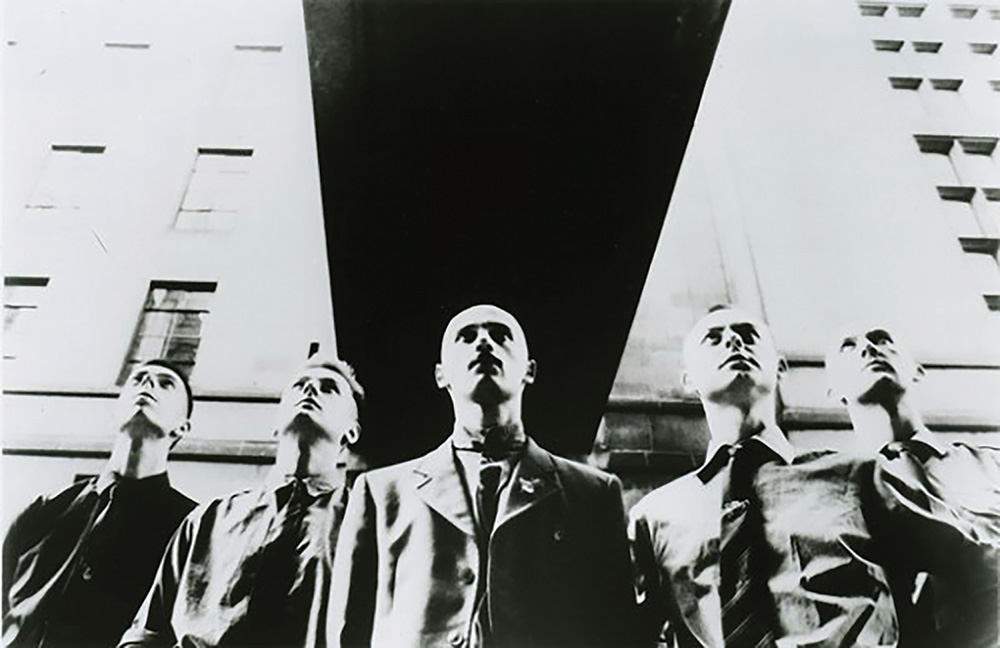
(Wikimedia Commons)
Every era gets the art movements it deserves, just as every country gets the art movements it deserves. The most influential avant-garde group in 1960s Slovenia was OHO, a collective of painters, sculptors, and other artists. One of its most important members was the celebrated absurdist and surrealist poet Tomaž Šalamun. In 1964, Šalamun was arrested and detained for five days by Yugoslav authorities for a poem, “Duma ’64,” he had published in a literary magazine. Šalamun advised OHO to consolidate into a smaller, nimbler collective of four members; this decision was followed by further international recognition and an invitation by the Museum of Modern Art to its hugely influential Information exhibition in the summer of 1970. A year later, OHO officially disbanded and established a commune at Šempas in the Vipava Valley in western Slovenia.
In September 1980, a musical group (and artists’ collective) called Laibach was banned by the local authorities in Trbovlje, a town in central Slovenia. Laibach wanted to provide an “alternative to the (official, centralistic) Slovenian culture,” which was “poisoned and saturated by [socialist] realism and provincialism.” What the local authorities found problematic was not that stated aim but the group’s name: Laibach is the German name for Slovenia’s capital, Ljubljana, and was, after World War I, shunned by the Slovenian authorities and most Slovenians. It was a very deliberate provocation, both artistic and political. Despite the ban, the members of the group managed, at night, to put up posters featuring the motif of the Laibach painting Tarkvinij in Lukrecija from 1979. The group later insisted that it was not trying to provoke the socialist authorities and that said authorities reacted hysterically. Laibach was thus born into the febrile and complicated political reality of 1980s Slovenia and Yugoslavia. It eventually became one of the most successful Slovenian musical groups in history, with more than one million albums sold. The road there, though, was long and winding.
Laibach’s first concert, in Ljubljana, in January 1982, was advertised with the Soviet modernist painter Kazimir Malevich’s 1923 Black Cross, which was adopted by the group as its symbol. In the same year, one of its founding members, Tomaž Hostnik, committed suicide. Following a few eventful gigs — replete with heavy industrial music and revolutionary imagery mixed with pornographic films — Laibach appeared on Slovenian national television for an interview in June 1983. The band was promptly castigated by the presenter for “these horrible ideas and beliefs” that should, according to him, be “banned and exterminated.” The authorities obliged, and Laibach remained banned until February 1987.