Building Civilization at Shenzhen Speed
Once the poorer neighbor of Hong Kong, Shenzhen has been transformed into a showcase for the speed, power, and dynamism of Chinese development — and a study in extreme inequality.
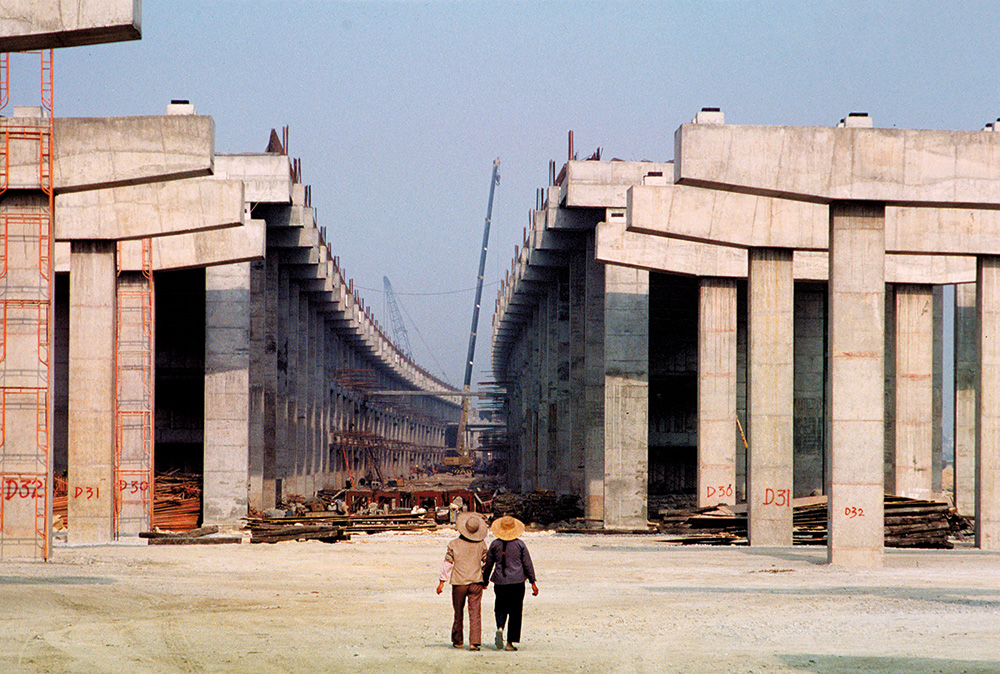
(Andrew Holbrooke / Corbis / Getty Images)
Shenzhen, in southern China, is one of the world’s largest cities, and it didn’t exist in 1979. It is a border zone on top of another border zone, an enclave originally designed to take advantage of another enclave. It is now the center of the Chinese tech industry — the likes of Tencent and Huawei are headquartered here — which makes it the de facto world capital of electronics manufacturing. Above all, it’s a place that has taken advantage of borders to create a commanding state capitalism whose infrastructure shames that of Europe, not to mention the United States.
It is hard not to be awed by the fact that a city of eighteen million people with seventeen metro lines and high-speed connections to Beijing and Shanghai, both in faraway regions, emerged in less than the time it takes for Britain to build a train line or for New York City to extend a subway. But looking at Shenzhen — and how it has emerged in partnership with and in opposition to the colonial city next to it, Hong Kong — should be useful in understanding what exactly Chinese capitalism is, and isn’t, capable of.
There have been villages in this part of the Pearl River Delta in southern China for millennia, but Shenzhen’s modern history begins with the Opium Wars. Near the mouth of the Pearl River is Guangzhou, originally anglicized as Canton, where the Qing dynasty concentrated its foreign trade. In 1839, the British Empire, disgruntled at its inability to truly break open the Chinese market, launched the first of a series of wars on the pretext of forcing China to allow opium grown in British India into its ports. One effect of the Qing’s defeat was its surrender of an island in the Pearl River estuary, Hong Kong, to the British. Subsequently, the British government was given a lease on a chunk of the mainland, the Kowloon Peninsula, which ended in 1997.