Biafra’s Back
More than 50 years after the end of the civil war, there’s a new generation of Biafran separatists in Nigeria.
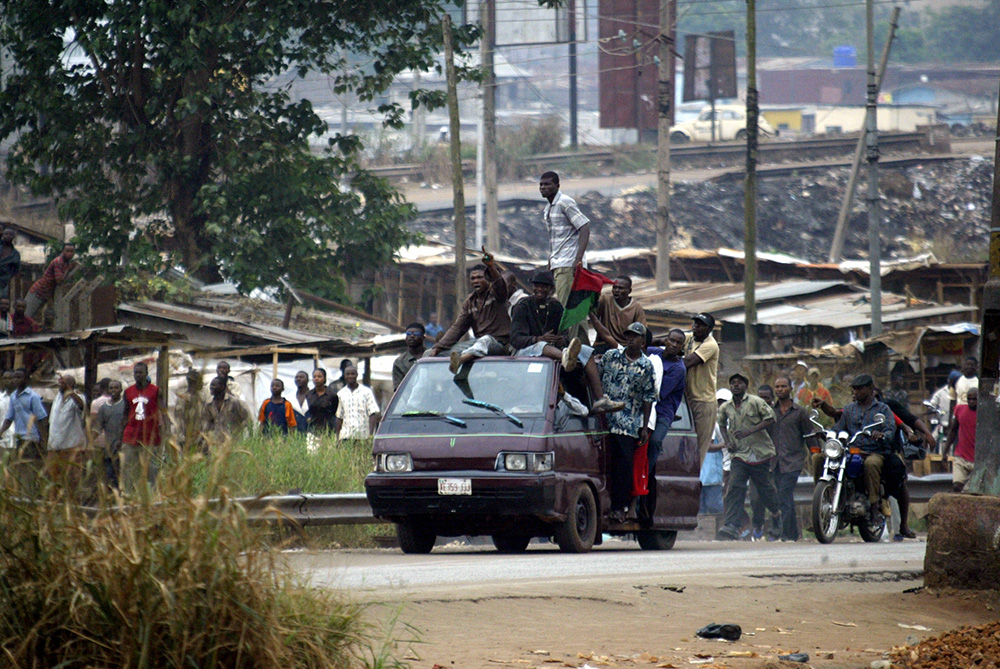
(Pius Utomi Edpei / AFP / Getty Images)
Earlier this year, a video posted to Nigerian social media showed Donald Trump, in the Oval Office, promising to “liberate the Igbo people of Biafra.” The clip was AI generated, but it quickly circulated amid the reopening of one of Nigeria’s deepest historical wounds. In 1967, after a pogrom against Igbos in the north, Nigeria’s predominantly Igbo southeast seceded to form the short-lived state of Biafra. During the civil war that followed, hundreds of thousands of Biafran civilians starved to death. Igbo nationalism remained a powerful force after the war, and in 2012 two British Nigerian activists founded the Indigenous People of Biafra (IPOB), a separatist group whose leader, Nnamdi Kanu, is now at the center of a renewed crisis in southeast Nigeria.
The oil-producing southeast is among the richest regions of Nigeria today. Yet it has not been exempt from the soaring inflation of recent years. Nor have its Igbo residents overcome a sense that the state is against them. An Igbo hasn’t been president of Nigeria since before the civil war, and Igbo politician Alex Ekwueme’s failed 1999 bid for the Peoples Democratic Party’s presidential nomination catalyzed the emergence of the Movement for the Actualization of the Sovereign State of Biafra. MASSOB was a largely nonviolent group, but the government repressed it anyway, driving young Igbos to the more radical IPOB throughout the mid-2010s.
In 2021, Nigeria arrested Kanu and charged him with terrorism. His ongoing trial has upended southeastern Nigeria, with IPOB calling on citizens to stay at home on Mondays, important Biafran anniversaries, and days when Kanu appears in court. This tactic has seriously disrupted the region’s economy: a study from the consulting firm SBM Intelligence estimated the total cost of four years of protests at $4.6 billion and found that 82.9% of surveyed southeasterners had participated. Opinion polling suggests that while most southeasterners approve of Kanu and distrust the central government, only a minority supports a second Biafran secession.