Japanese Pop’s Secret Utopians
Bright, ironic, and tuneful, Yellow Magic Orchestra provided the soundtrack to Japan’s bubble economy in the 1980s. But the band’s work also contained hidden depths and the memories of East Asia’s political struggles.
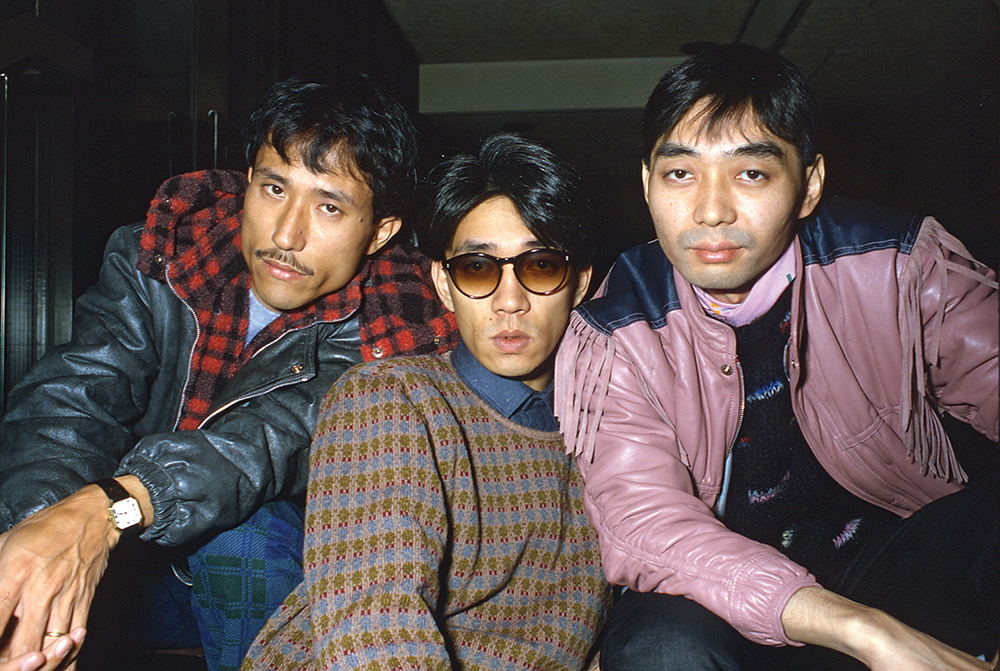
(BSR Agency / Gentle Look / Getty Images)
In a 1983 episode of the Fuji TV variety show Quiz! Do-Re-Mi-Fa-Don!, three men in peculiar get-ups take part in a game-show pastiche, swaying to pop tunes while giving sheepish answers — though only one, composer and multi-instrumentalist Haruomi Hosono, puts in much effort, performing a strange, distracted strut. The segment cuts to the trio performing their new single — the titles inform us the group is YMO, or Yellow Magic Orchestra — a cry from the heart propelled by a tangle of hallucinatory synthetic percussion, a synthesizer melody that turns restlessly in a wind of overdrive and noise, pierced by distorted vocals that are nonetheless as reassuring as a lullaby. To top it off, the episode ends with the director and ferocious social critic Nagisa Oshima, whose most recent film, Merry Christmas, Mr Lawrence, starred YMO pianist Ryuichi Sakamoto alongside David Bowie, coming on-screen and shaking hands with everyone in a tracksuit emblazoned THE OSHIMA GANG.
Encountering this artifact, a sense of a whole foregone world takes shape. How could popular culture have once crosscut the high and the low, the alien and the everyday, with such assurance, pleasure, and lightness? The nearest contemporary Western equivalent, TV competitions in which celebrities bake cakes or guzzle hot sauce, are strangled by the desperation to appear human. YMO was the expression of a young Japanese pop industry born, like the postwar state itself, from intense contradiction. Cutthroat and highly regimented, formally free yet dictated by market imperatives, the band’s work in the golden age of J-pop forms an afterimage of the early, triumphant history of neoliberal capitalism while leaving traces of an extinguished radicalism.
Early YMO releases have a gleeful sense of collage that continued from the solo work on which the trio first collaborated. The project started as a disco novelty group that approached the genre in a similar manner to the dandyish eclecticism of drummer and vocalist Yukihiro Takahashi’s attitude toward easy listening on his solo album Saravah!, or of Sakamoto’s rendering of heavy funk on his Thousand Knives. Programmer and engineer Hideki Matsutake, who had worked on Thousand Knives, brought the group’s synthesizer arrangements to a level of complexity and agility only matched at the time by disco producer Giorgio Moroder. The debut single, “Firecracker,” a cover of Martin Denny’s 1959 Asian exotica instrumental, took the original’s kitsch at face value before smashing it into a language of growling sawtooth waves, erupting like wah-wah guitars. The central melody staggers around rigidly like a lobotomized version of itself. The Roland MC-8 computer-based sequencer, a cutting-edge product manufactured in Japan, allowed the group to coordinate complex rhythms among networks of analog equipment — a preview of the perfectionist aesthetics that would come to dominate digital dance music — but its timing was still primitive, preserving a sense of humanity. The Japanese term for this new form of electronic pop music, technopop, suggests a union between technology and the people or popular will itself, where politics disappears in a continual refinement of cultural thrills.