Welcome to Everytown
The sci-fi film Things to Come debuted just before World War II. It was all too prophetic in its portrait of a society destroyed and then rebuilt by advanced technology.
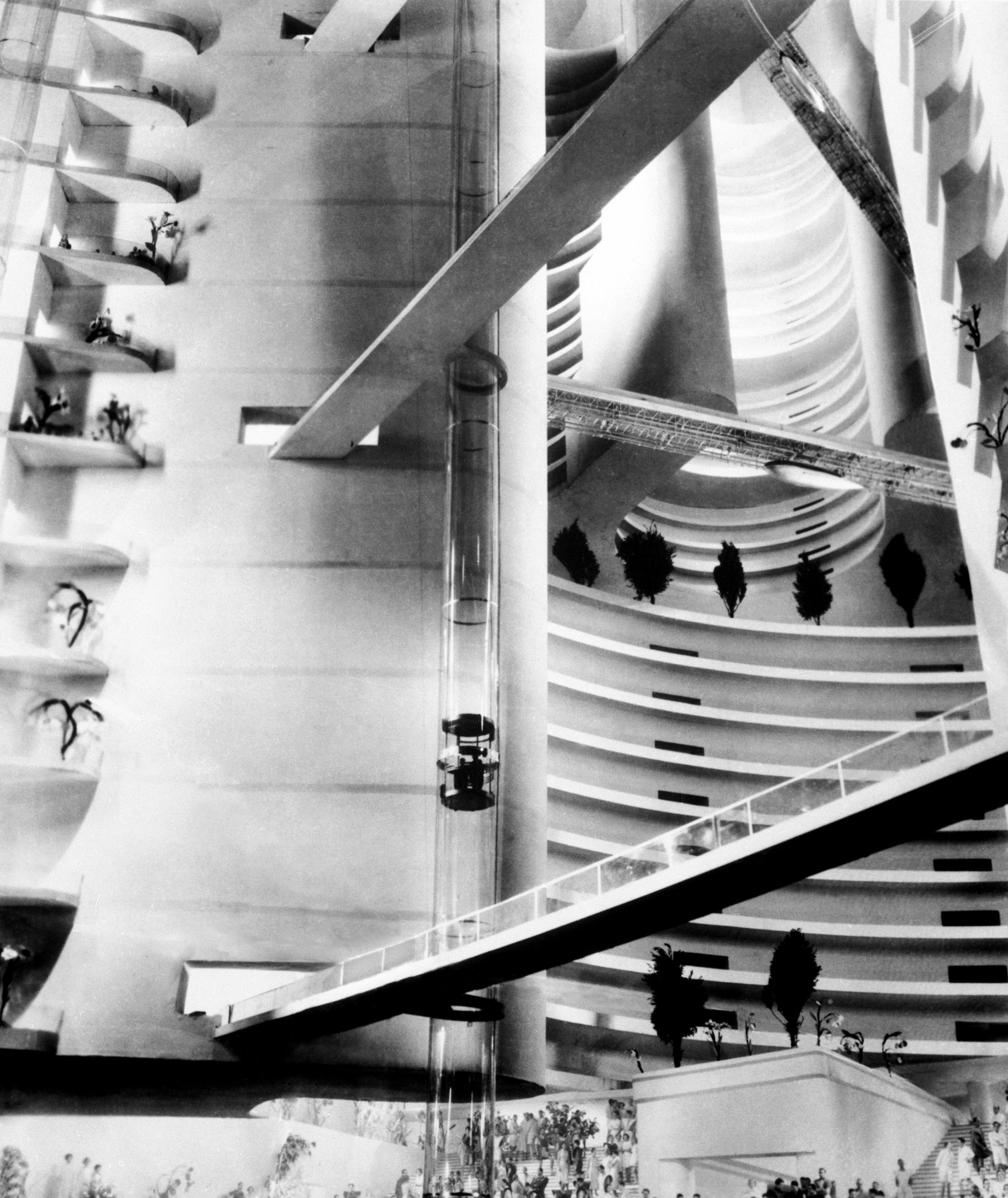
Fictional city of 'Everytown' in Things to Come (Photo by Bettman / Getty Images)
Based on H. G. Wells’s 1933 science-fiction novel and released just three years before Adolf Hitler’s invasion of Poland in 1939, Things to Come opens at Christmastime in Everytown, a city closely resembling London that is on the brink of world war. A montage moves quickly through the ensuing years, during which conflict continues to rage. An intertitle then informs the viewer of a “terrible pestilence” that emerged in its wake, killing half the world’s population.
Afterward the film returns to the now rubble-filled streets of Everytown in the far-off year of 1970, where a local warlord bemoans the disappearance of fast cars and airplanes: “Flying’s over, everything’s over, civilization is dead.” A horse drags the carcass of a car through unpaved streets. Then a man lands an airplane amid the ruins, emerging from the cockpit in a sleek black outfit that sets him apart from Everytown’s shabby inhabitants. He is bringing together surviving engineers and mechanics as “Wings of the World” to salvage the earth and act as the trustees of a new civilization without nation-states, proclaiming them “the brotherhood of efficiency, the freemasonry of science.”
The film then jumps forward again to 2036, by which time the gray ruins have been transformed into a gleaming, terraced atrium crisscrossed by skywalks, part of an extraordinary set designed by producer Alexander Korda’s brother Vincent, with input from former Bauhaus professor László Moholy-Nagy and inspiration from Le Corbusier. Here the streamlined, white glassy interiors of the future stand in stark contrast to the dirt and debris of the past.