Veni, Vidi, Vici
How Giovanni Battista Piranesi’s mournful portrait of Rome shaped the Enlightenment’s understanding of progress.
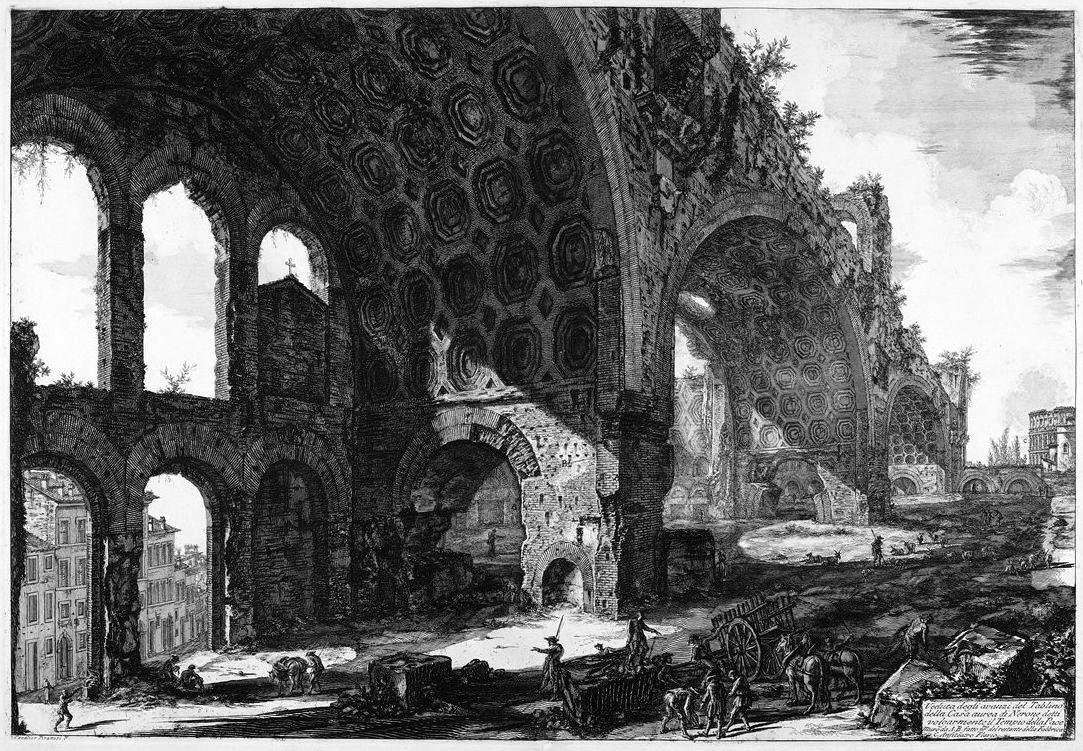
For the novelist Marguerite Yourcenar, Giovanni Battista Piranesi was “the inventor of Rome’s tragic beauty.” The son of a Venetian stonemason, Piranesi arrived in Rome around 1740 and soon became infatuated with the Eternal City’s antiquities. His etchings of Roman ruins, which he began producing as a 20-year-old architectural draftsman, went on to capture all of Europe’s imagination. In these darkly grand scenes, the remains of the Colosseum, the Arch of Trajan, and various fictional monuments tower over a fallen city, overgrown and teeming with paupers. When Johann Wolfgang von Goethe visited Rome for the first time in the 1780s, he wrote that it was as if his father’s collection of Piranesi prints had “come to life.”
Then as now, many took Piranesi’s images to symbolize the superiority of the past; a recent edition of Edward Gibbon’s History of the Decline and Fall of the Roman Empire uses them for gloomy illustrations. Yet in the late 18th century, the themes of decline and reinvention were deeply intertwined. Gibbon’s history, published in six volumes between 1776 and 1789, described how Rome’s collapse led to centuries of barbarism — but it was also a favorite of Enlightenment thinkers who hoped to revive the virtues of classical antiquity. Piranesi’s works didn’t exclusively inspire despair either. After the Enlightenment-era revolutions in France and the United States, architects influenced by Piranesi redesigned civic buildings in a neoclassical style that’s synonymous with republicanism today.