Syria’s Revolution
Bashar al-Assad has left the building. It took fourteen years of bloody conflict.
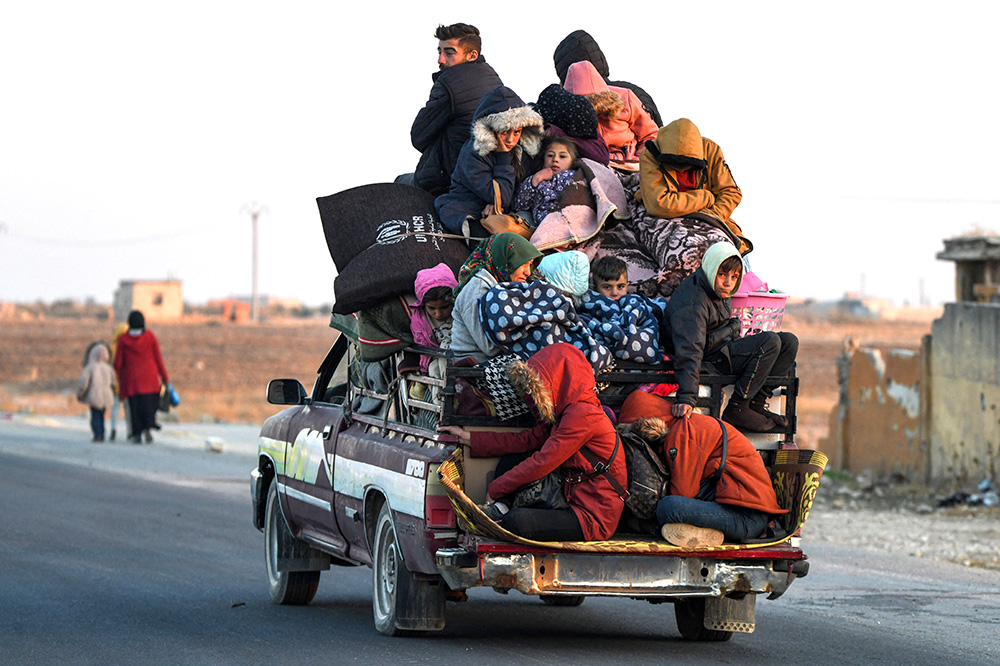
(Rami al Sayed / AFP)
- 2011
Protests against President Bashar al-Assad break out in March in the town of Daraa following the arrest and alleged torture of around 15 teenage boys for spray-painting “The people want the downfall of the regime” on a school wall. Security forces subsequently mobilize with tanks and heavy artillery in Daraa, killing more than 120 protesters. In July, defectors from the Syrian Army form the Free Syrian Army. The United Nations (UN) condemns the Syrian authorities’ violence against civilians; the United States, European Union, and Arab League impose sanctions on Syria and Turkey.
- 2012
The Arab League’s attempts to conduct a monitoring mission in Syria are suspended after a matter of months due to “the critical deterioration of the situation.” Meanwhile, a UN-brokered cease-fire takes effect but quickly runs aground in summer as violence intensifies throughout the country, including raids on Aleppo University and an attack on the town of Houla that leaves more than 100 dead in May. In June, the UN declares the conflict in Syria a full-scale civil war. In July, opposition forces capture and create a de facto capital in Aleppo. The Assad government withdraws forces from Rojava to focus on the revolution, allowing for the formation of an autonomous Syrian Kurdish region formally known as the Democratic Autonomous Administration of North and East Syria (DAANES).
- 2013
As violence continues with lethal bombings in Aleppo and Damascus and mass murder in Baniyas and Bayda, the UN announces that as many as 100,000 Syrians have died, 1 million have been made refugees, and 4.25 million have been internally displaced. That spring, ISIS establishes control over large parts of both eastern Syria and western Iraq, though it will lose much of this territory by 2017. The United States begins to issue military aid and training to the rebels. In August, the Assad government uses chemical weapons on civilians in the countryside surrounding Damascus.