Donald Trump’s Reactionary Futurism
Like its twentieth-century predecessors, today’s far right longs for the purported glories of the ancient world, all while fetishizing modern technology.
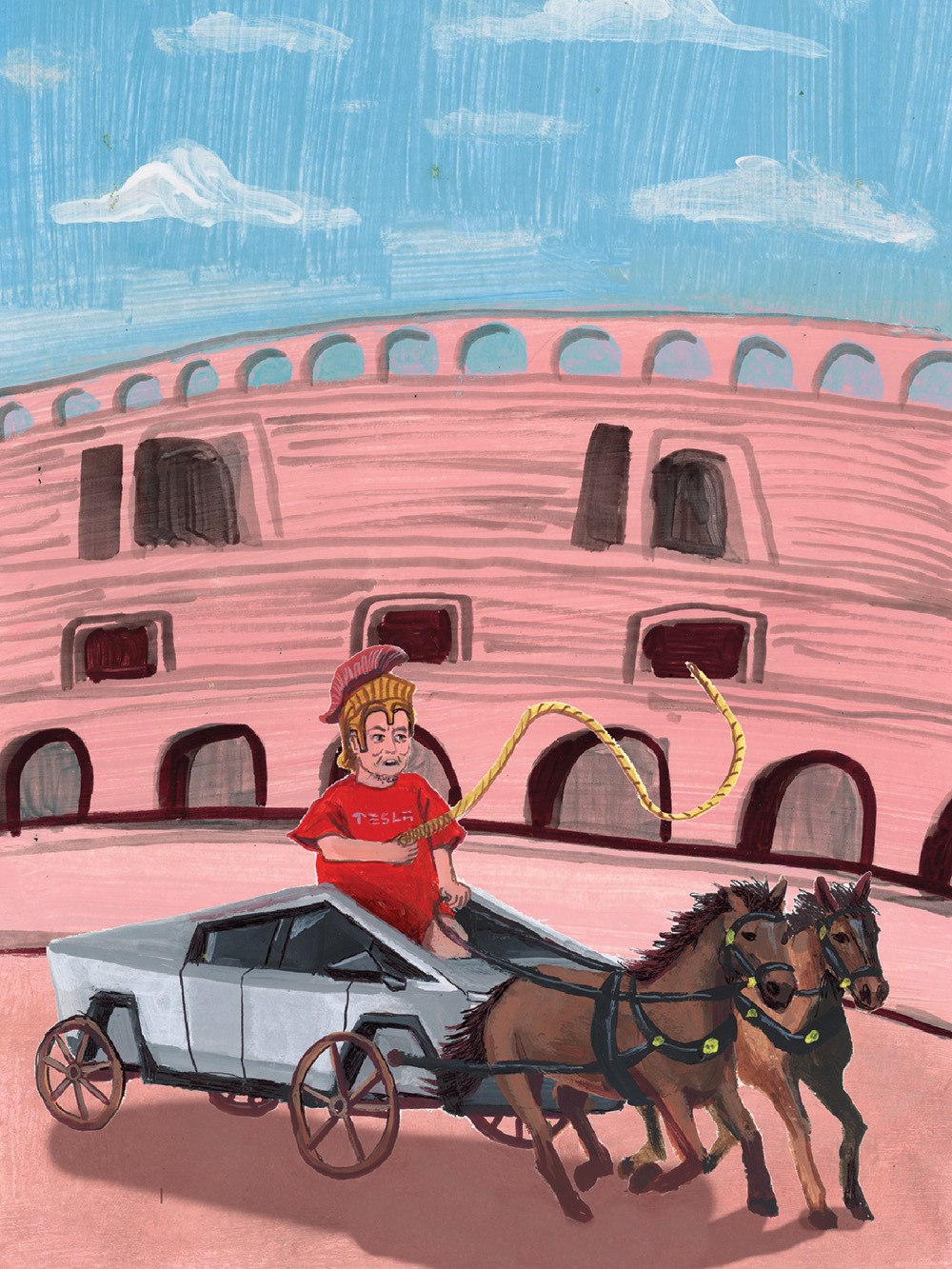
Illustration by Brandon Celi.
Weeks into his second presidential term, Donald Trump is moving ahead with what his former confidant Steve Bannon called “deconstructing the administrative state.” Led by Elon Musk’s advisory task force on government efficiency, this effort has already produced a wave of headlines and controversies.
Far from preserving the status quo, as would befit a conservative government, the current administration seeks to reshape our future to mirror an idealized past. This peculiar form of progress grafts cutting-edge technologies of surveillance, information control, and mass murder, along with hefty doses of techno-optimism, onto a nostalgic Christian ethnonationalism. Whether Trumpism is actually fascist or not is beside the point: despite its futuristic trappings, it is less forward-looking than even the stagnant liberal politics it repudiates.
This mixing of past mythologies with present-day technology has a clear historical precedent. In the mid-1980s, historian of Nazism Jeffrey Herf coined the term “reactionary modernism,” which combined “great enthusiasm for modern technology” with a “rejection of the Enlightenment and the values and institutions of liberal democracy.” Herf showed how reactionary modernists in interwar Germany tarred abstract, intellectual, and profit-focused practices as “Jewish” and “socialist” while glorifying the tangible, “spiritual,” and entrepreneurial. In contrast to “civilization,” which they coded as Jewish, proto-Nazi and Nazi thinkers admired “culture,” which they believed could only be produced by people of German blood.