Aliens Are Probably Communists
Hear us out . . .
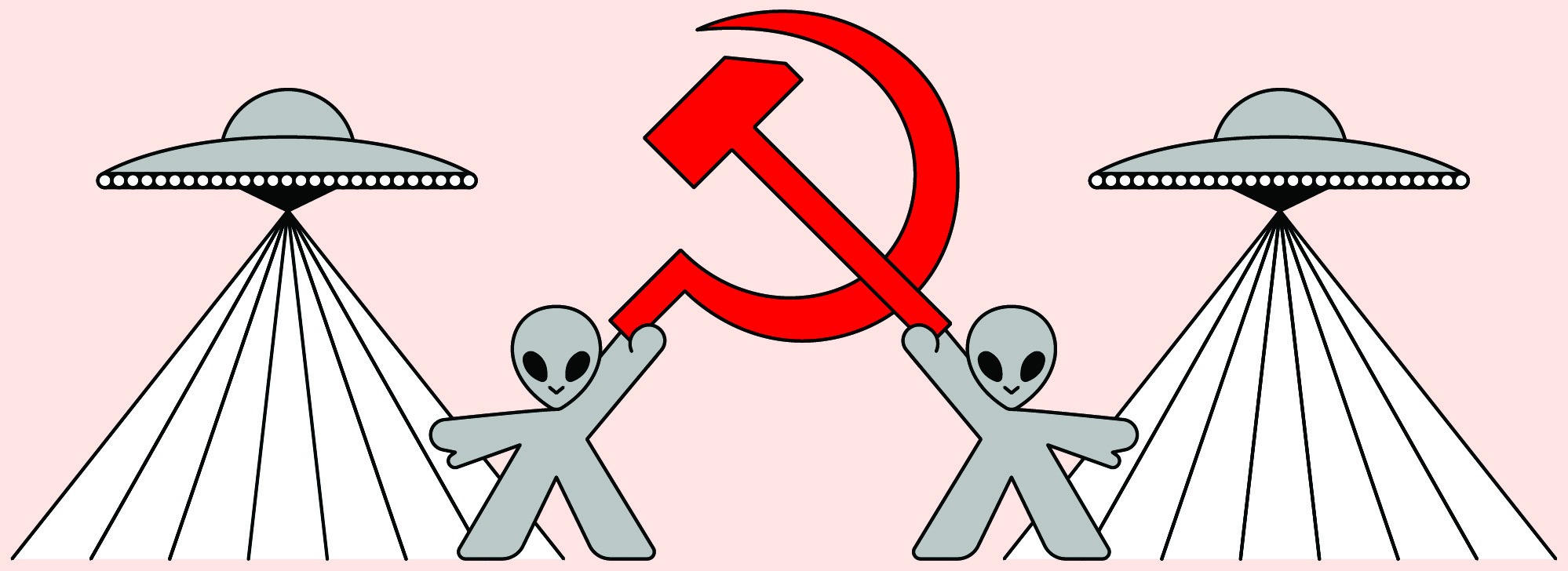
Illustration by Rose Wong
When aliens arrive on earth, will they be communists? The Argentine Trotskyist J. Posadas answered this question with an emphatic yes. Born to an impoverished Italian immigrant family in Buenos Aires in 1912, Posadas became a skilled union organizer and rose to the top ranks of the Fourth International’s Latin American section. In 1962, he broke with the Fourth International and formed his own organization, dedicated to an eccentric, futuristic program — one that condemned nonreproductive sex and urged the Soviet Union to launch a nuclear first strike so that communism could rise from the ashes.
These positions marginalized the Posadists in their time and turned them into a joke today. Yet as journalist A. M. Gittlitz points out, Posadas wasn’t alone in his belief that an intergalactic civilization couldn’t be as greedy and violent as ours: Carl Sagan would likely have agreed with him. The atomic bomb and the spacecraft were the defining technologies of the 1960s and much of the Cold War, one threatening to end human life while the other gestured toward our grand potential. Any species with technology advanced enough to travel the stars, Sagan reasoned, would need a social order that prevents it from destroying itself. As he promoted efforts to contact extraterrestrials, Sagan worked to build such an order on earth, advocating against nuclear proliferation, militarism, and the United States’ callousness toward the poor.
Unlike Sagan, Posadas believed that aliens had already visited Earth. The fact that they came in peace was, for him, more evidence that space travelers must have overcome the impulse to loot and conquer. In his 1968 text on UFOs, Posadas argued that a capitalist interplanetary society was inconceivable because bourgeois interests hold back scientific research, limiting it to subjects that are profitable or reinforce the state. From these claims he drew extravagant conclusions: that aliens might help revolutionaries bring down capitalism, and that an unfettered socialist science could unleash infinite energy, vastly extend the human lifespan, and enable asexual reproduction. This millenarian worldview, in which utopia is only a flying saucer away, connects Posadas’s ufology to his strange faith in apocalyptic rebirth through nuclear warfare. Still, Posadas’s son might have been onto something with his quip about his father’s theories: “When Carl Sagan says it, it’s fine, but when Posadas said it . . . he was a planetary madman.”