A City Built for Sunshine
In a moment of climate fatalism, ecomodernists are imagining a green urbanism that doesn’t come at the cost of abundance or beauty.
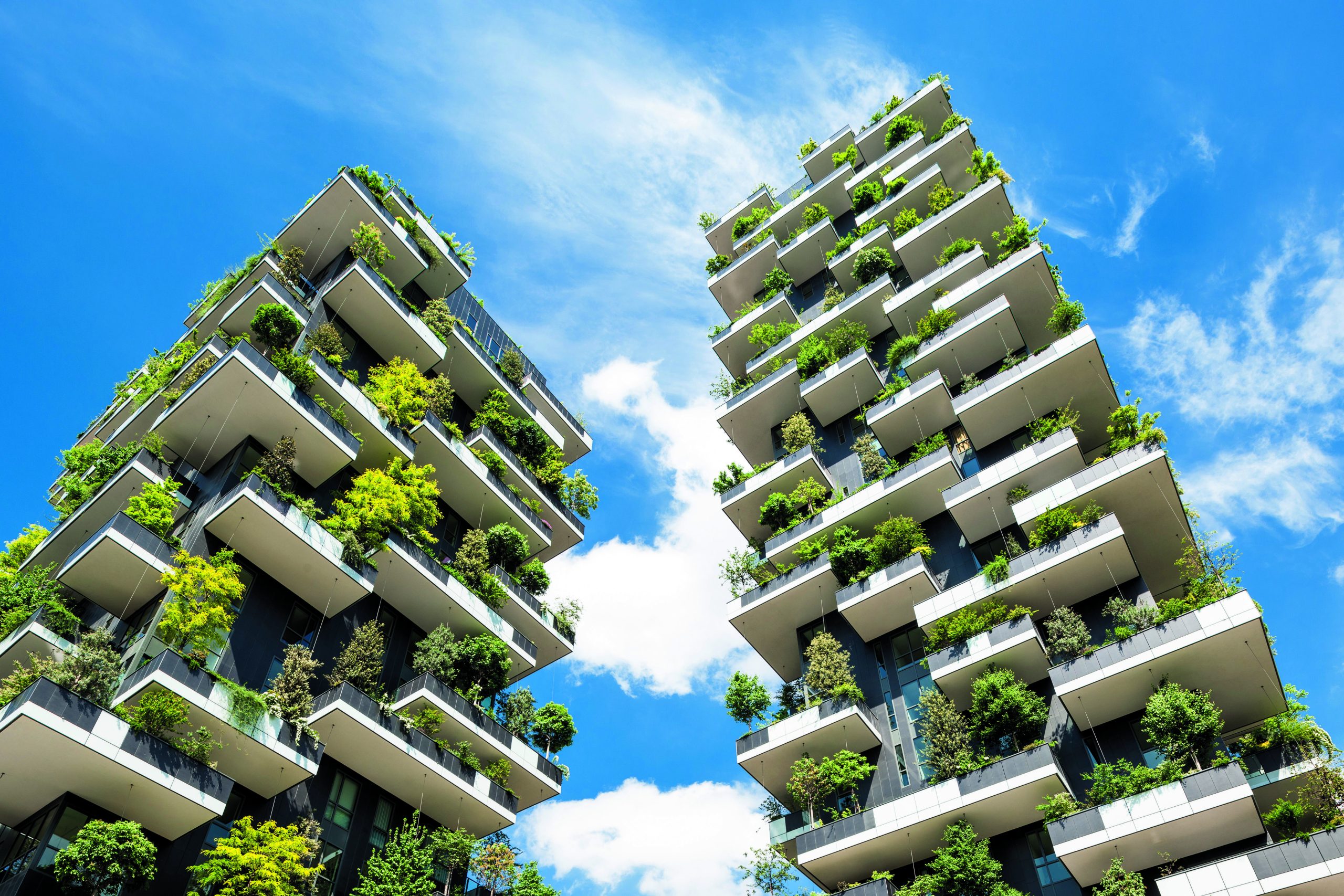
Upward view of balconies and vegetation. Vertical Forest, Milan, Italy. Architect: Stefano Boeri Architetti, 2014. (Photo by Inigo Bujedo Aguirre / View Pictures / Universal Images Group via Getty Images)
If there is hope, it lies in the solar panels.
The last decade has not been abundant in good news, but for perhaps one technological advance: we can now build solar, hydro-, and wind power so cheaply, at such quantity, and with such efficiency that, if our society were so inclined, we could run entire industrialized countries and their metropoles with no recourse to fossil fuels. What this would mean for how cities look and how they’re lived in is a great deal of new paraphernalia: solar panels on most buildings, wind turbines everywhere. Modern architecture, when it emerged out of postrevolutionary Germany and the Soviet Union in the 1920s, was all about taking the newest and most advanced technology and figuring out how it could work aesthetically and what kind of city it would make possible. So we should be asking: Where is the ecomodernist metropolis?
As ever, the future is unevenly distributed — the ecomodernist future city exists in patches. But it has a major fan club online. This community defines itself as “solarpunk,” and it’s disseminated mainly via memes, computer-generated cityscapes, and a few decontextualized photographs of real places. The name comes via the now rather venerable and hoary dystopian cities of cyberpunk, those 1980s visions of the future that proved depressingly accurate: the 2020s really did turn out to look like an aggressively cyberpunk Paul Verhoeven film. Solarpunk’s optimism is, in this context, refreshing. But the really great thing about it is that it offers an image of a post–fossil fuels future that you might actually want to live in, a vision of affluence and pleasure. There are few or no cars, and there are fast elevated trains and subways everywhere. There are no McMansions, and the imaginary apartment blocks are organic and visually imaginative. You won’t get a front lawn, but why would you want one, when the entire city looks like a botanic garden?